

PANHANDLE
Dune Allen
fishing guide
Dune Allen gives shore anglers a choice of public Gulf entries on the western side of 30A. Its coastal lakes add interest, but they do not make every bank a public fishing spot. Use a named beach access and build the session around the sand and surf you can safely reach.
Explore the guide ↓Pick Dune Allen or Fort Panic before leaving home
Visit South Walton identifies Dune Allen Regional Beach Access at 5999 West Scenic Highway 30A. Its listing includes parking, a beach-condition flag, accessible restrooms and a boardwalk. Fort Panic is another regional beach option in the neighborhood. Compare current access information instead of assuming every road leading south offers the same facilities.
Observe the entrance rules and public beach boundaries at the selected site. A full parking area is a reason to use another legal space or a current transport service, not nearby landscaping. County tourism describes park-and-ride connections serving this area, but verify today's schedule and how safely your equipment can travel.
Keep the coastal lakes separate from the Gulf plan
Dune Allen's landscape includes several coastal dune lakes. They make this part of South Walton distinctive, but a lake's presence does not prove that its banks, a private dock or a tempting opening are available for fishing. Identify the manager and the exact access before adding inland water to the trip.
The straightforward starting plan is a public Gulf crossing. If considering nearby Topsail Hill Preserve State Park for a separate lake or beach outing, check its current closure and access notices first. Do not assume a park is open because another county beach is available. Each setting has its own permission and route.
Use the breaking waves to choose a first range
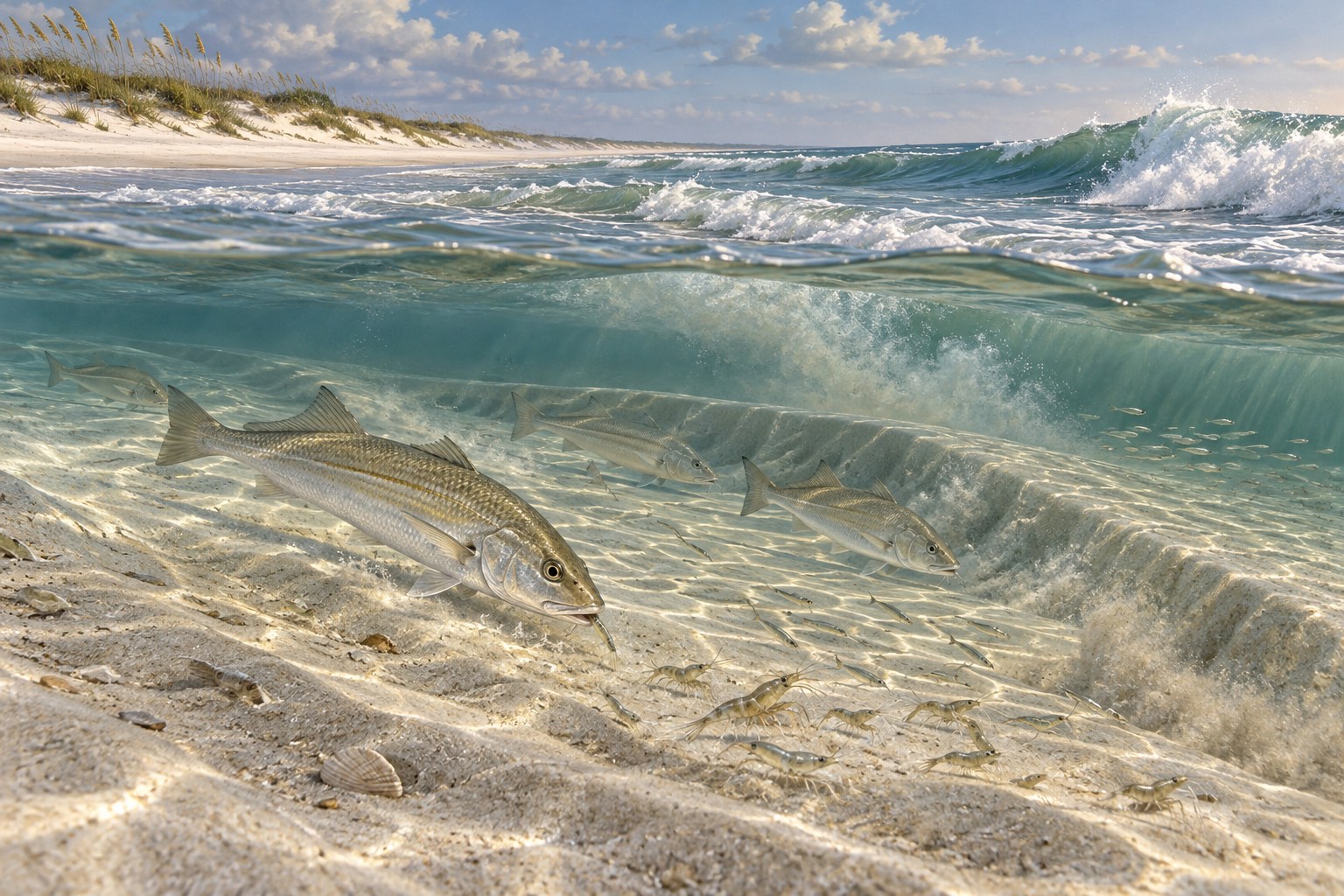
On the Gulf beach, a consistent line of breakers usually reflects shallower sand. A trough beside it may hold moving prey and bottom-feeding fish. Watch more than one wave set and look for a stable pattern. Color alone can be misleading when the light changes or stirred sand clouds the water.
Start with a repeatable cast into the nearer suitable trough. If nothing happens and the bait stays intact, compare a second clear range. A bar gap can move food but may also carry a rip current. Keep that feature at casting distance from dry sand rather than using it as a route into deeper water.
Test crustacean-sized food for passing pompano
Pompano can move along South Walton's coast during appropriate seasonal conditions. A small sand flea, piece of shrimp or tidy strip bait is a reasonable test. The offering should fit the hook and leave its point able to engage. More bait does not necessarily mean more attraction when it spins or hides the hook.
A compact dropper rig holds bait above the sinker, with an optional small float to raise it from shifting sand. Use a holding weight within the rod's casting limit. Retrieve and inspect the offering regularly. Record the distance and bait that draw attention so the next cast repeats something useful.
Keep both a close bait and an active option in mind
Whiting can make close surf fishing worthwhile with modest shrimp pieces near the sand. Their taps may be subtle under the wave movement. Gather slack without sweeping the sinker constantly. Feel for sustained weight before applying a smooth lift, and keep the outfit balanced enough to enjoy small fish.
If small baitfish flee repeatedly along an open lane, a little spoon or baitfish lure may interest passing predators. That activity needs space for every cast and the final retrieve. In a shared swimming area, the correct choice is to pause. Do not chase a school through water occupied by beach visitors.
Select tackle by control rather than distance
Choose a rod that comfortably carries the bait and weight required for the conditions. Strong side drift can bow line and pull a sinker across the beach. Improve line tension and reassess the safe lane before adding lead. When the setup cannot stay clear of others, end that presentation.
Carry just enough spare tackle to handle bait loss, a tangle or a change in holding weight. Keep leaders in a pouch and used hooks in a firm waste container. A measuring tool and pliers belong within reach. The following comparisons help turn a beach observation into a purposeful next cast.
| Observation | Useful test | What to compare |
|---|---|---|
| Bait remains untouched | A second visible depth change | Range rather than new tackle |
| Shrimp disappears quickly | Smaller fresher pieces or strip bait | How long the offering survives |
| Rig sweeps along the shore | Better tension and suitable weight | Whether the lane remains safe |
| Visible prey passes a clear section | Small casting lure | A steady versus paused retrieve |
Allow for wind and afternoon heat
Dune Allen's open Gulf frontage can change when a breeze builds. A quiet early beach may become hard to fish after the wind turns alongshore. Check flags and the actual wash on arrival, then repeat that assessment during the session. A favorite tide hour is not a reason to ignore a rapidly worsening surf.
Seasonal pompano interest often focuses on spring and fall. Hot months bring heat, more beach visitors and storm planning. Cooler periods can bring abrupt frontal changes. Prepare enough water and a clear return route. A short well-controlled session can teach more than staying all day with an empty or weed-covered rig.
Use the regional facilities without spreading tackle
Restroom and boardwalk access help a mixed group enjoy the beach. Keep the sharp-tackle area away from shared food and children's play. Mark a meeting point and arrange who is watching the rod before anyone leaves. An unattended outfit can fall, hook a passerby or lose a fish without anyone ready to respond.
Confirm assistance arrangements if a visitor needs help crossing soft sand. Listed accessible parking and restrooms do not automatically mean every stretch of beach is easy to reach. Choose a comfortable load and use designated routes. Dune plants and nesting enclosures should never become an alternate path around a crowded crossing.
Check rules before keeping a fish
Identify the catch accurately and use current regulations for harvest size, season and numbers. A protected or similar-looking species may be mistaken for an intended target. Keep an uncertain fish in good condition and release it promptly. Have measuring and hook-removal tools ready instead of searching while the fish lies on sand.
Remove worn leaders, bait packaging and every personal item from the setup area. Check around the sand spike for scraps hidden by footprints. Use the same lawful crossing on the return journey. A responsible Dune Allen fishing trip combines a clear public route with care for a coastline shared by wildlife and many visitors.
Common questions
Where is Dune Allen Regional Beach Access?
Visit South Walton lists it at 5999 West Scenic Highway 30A, with parking, a boardwalk and restroom facilities.
Are all Dune Allen lakes public fishing areas?
No. Verify the manager, specific entry and permitted activity for any inland water. This guide's basic plan uses a designated Gulf access.
Is Fort Panic another access option?
Yes. It is a separate regional beach access in Dune Allen. Confirm its current conditions and public boundaries before using it.
What if a public parking lot is full?
Use another lawful access or check a current transport option. Do not park in landscaping or obstruct neighborhood roads.
Prepare for your visit
Check local tides and weather. Read more about florida pompano, whiting. Check current FWC saltwater fishing rules.