
SPACE / TREASURE COAST
Frederick Douglass Memorial Park
fishing guide
Frederick Douglass Park fishing guide with an unresolved access notice, surf methods for a confirmed open visit and practical planning.
Explore the guide ↓Confirm reopening before making this the destination
Frederick Douglass Memorial Park is an Atlantic beach access on South Hutchinson Island. Its county listing includes fishing, but the access information needs a careful check before a trip.
At the October 2026 review, the park page still carried an old closure notice with a spring 2025 target. That target date is not proof of an actual reopening. Current usable access could not be confirmed from that notice alone.
Contact St. Lucie County Parks and check the current entrance status before driving with fishing gear. This guide explains the area’s surf-fishing approach for a confirmed open visit; it does not authorize entry through a closure.
Use the correct park and an open public crossing
The county lists Frederick Douglass Memorial Park at 3600 South Ocean Drive. Do not confuse it with nearby John Brooks Park or assume the two share the same work status.
Use only an open designated crossing. Barriers, closed lots and work areas should remain closed to visitors, even if the beach beyond appears empty. A short walk around a fence is not an acceptable access plan.
The park is also associated with managed beach horseback activities. Confirm current arrangements and give any authorized horse group a wide margin. Fishing line, hooks and unpredictable movement do not mix well.
If access is not confirmed, choose another verified public destination. Nearby Blind Creek Beach has a very different visitor setting that should be understood before selecting it as an alternative.
A small bait can work close to the beach
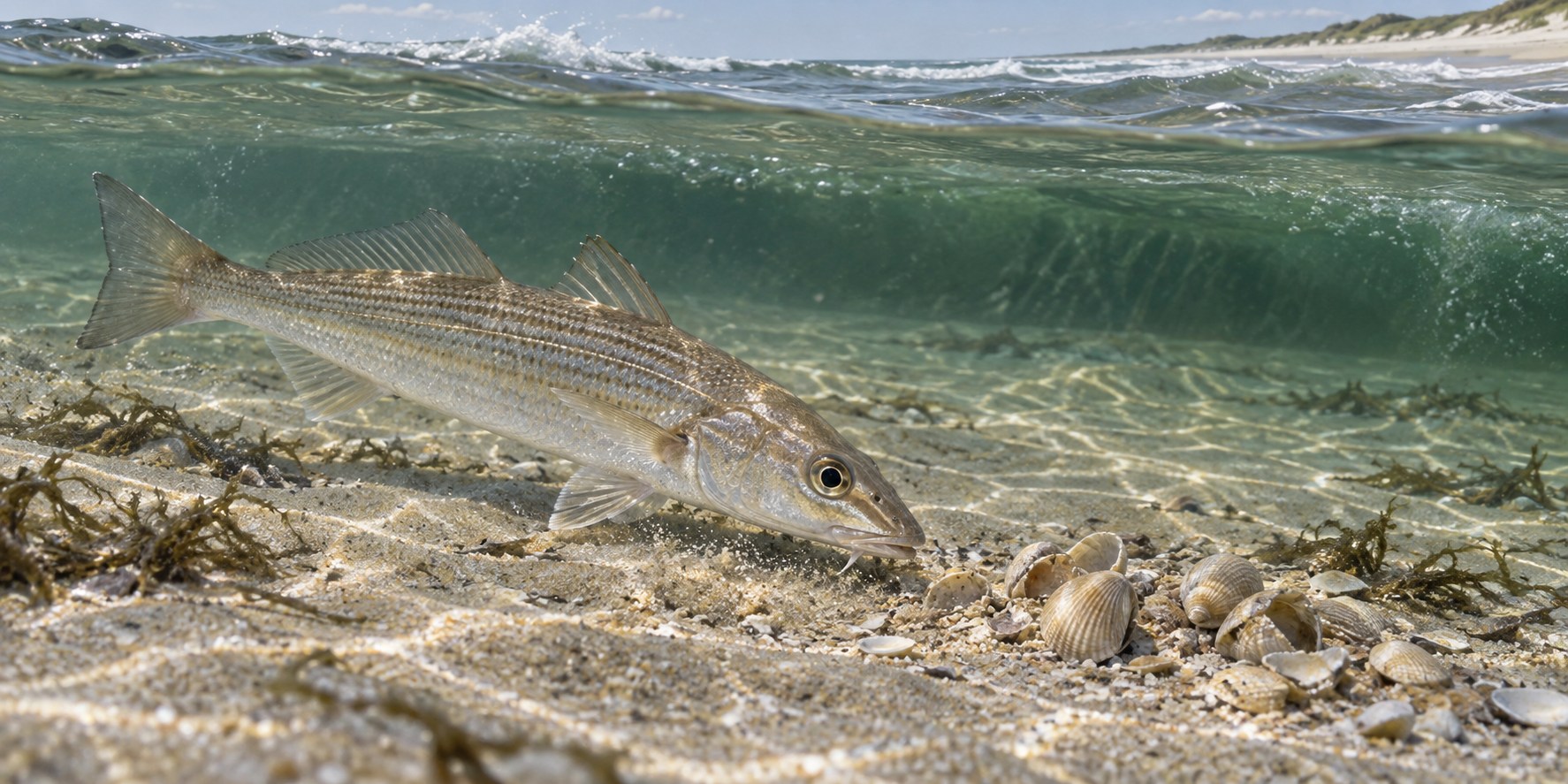
For a confirmed open visit in suitable conditions, whiting are a practical target. Watch the first breaking bar and the water inside it. A trough can run close enough for a moderate cast.
Use a short shrimp piece on a small hook, with the point left clear. A large soft piece may be pulled apart without a secure bite. Check the bait after light taps and replace it when damaged.
Repeat the distance that receives attention. A useful lane can be narrow, and a longer next cast may pass beyond it. Let the fish’s response guide the adjustment.
Keep the rig simple enough to inspect after each retrieve. Tangled leaders or missing bait can make a productive stretch appear empty.
Study the sand before selecting a rod position
Look along the beach for changes in breaking waves. A shallow bar produces a repeated line, while a deeper lane may appear darker or smoother. Observe more than one wave set before deciding.
Stay on firm shore rather than entering a gap in the breakers. Outward-moving water can be stronger than it looks. A fishable feature is not necessarily a safe place to stand.
Place equipment above the active wash with a clear route back. Rising water can reduce the space available, especially where the beach is narrow.
If the rig drifts rapidly downshore, retrieve before it enters another person’s area. Use only weight within the rod’s rating, and reconsider the session if conditions exceed the outfit’s limits.
Try pompano without oversizing the bait
Pompano can move through clean surf over sand. A compact dropper rig holds a small bait above the bottom, where it can remain visible in the wash.
Small shrimp pieces and appropriate prepared bait are convenient choices. Sand fleas may be useful where gathering is permitted, but do not assume every collection activity is allowed at a managed beach.
Test a second distance over successive casts while keeping the basic rig similar. If the nearer lane works, there is no reason to abandon it merely because another angler casts farther.
Clear weed promptly. A line loaded with seaweed creates drag, masks small bites and can pull the bait away from the chosen trough.
Make the decision in the right order
| Question | What to establish | Then decide |
|---|---|---|
| Is the park open? | Current county confirmation, not an expired target date | Whether to travel here at all |
| Is the beach lane clear? | Space away from swimmers and other activities | Where a rod can be used safely |
| Can the rig remain controlled? | Wave, weed and current conditions | Whether the outfit suits the day |
| Where are bites occurring? | Distance and bait condition | Which small adjustment to try next |
| May the fish be kept? | Identification and current regulations | Release or lawful retention |
Starting with access prevents a well-packed fishing trip from depending on an unavailable facility.
Keep one lure option for passing bait activity
Small fish scattering in the surf can indicate a predator moving along the beach. A compact lure can be tried if the area is open and safe. Do not cast toward birds or people to reach the activity.
Retrieve through a clear edge of the school and vary the pace modestly. A lure far below the prey may not draw the same response. Keep control throughout the cast and retrieve.
Bluefish or similar toothy catches require suitable leader and careful handling. Check line after a strike and keep fingers away from the mouth.
If the activity passes, return to the bottom-bait plan. Chasing it by wading or moving into a restricted area is not justified.
Choose a comfortable window after access is settled
Once the park is confirmed open, check the local tide and weather outlook. Manageable surf and a clear lane matter more than a particular month.
Summer visits benefit from drinking water, sun protection and a quick route to shelter. Thunder should end the session before the storm arrives overhead. Keep equipment organized enough to leave promptly.
Cooler periods may provide good surf-fishing weather between fronts. Strong wind can still make the beach unsuitable. Inspect the actual waves on arrival rather than relying on temperature alone.
Do not let an uncertain closure status become the last thing checked. Access is the first requirement, before weather, bait or timing.
Keep handling and cleanup ready
Carry pliers and a measuring device where they can be found quickly. Support released fish with wet hands and avoid prolonged time on dry sand. A quick photograph should not delay the release.
Use FWC’s current saltwater fishing guidance for licensing and species requirements. A county park listing that includes fishing does not remove those rules.
Chill any legal retained catch and keep bait waste contained. Remove line, hooks and wrappers before leaving the position. Check especially around the rod holder, where small items disappear into sand.
After the trip, note the confirmed access date and the useful trough. That record is more valuable than repeating an old closure or reopening estimate as current fact.
Ask a precise access question before leaving home
When checking with the managing office, ask whether the parking lot and beach crossing are open for ordinary public use on the intended date. A project being nearly finished, a nearby park being open or a scheduled program operating elsewhere may not answer that question.
If the response identifies a different entrance, confirm its name and route instead of assuming it belongs to Frederick Douglass Park. Keep the fishing plan attached to a real open access.
Ask about any temporary limits affecting equipment, parking or other beach activities. Those practical details help decide whether a short surf session is suitable for the group.
Save the date of the confirmation with the trip notes. Access information can change, so it should not become a permanent claim based on one conversation. Before a later visit, repeat the check if work is still underway or a new notice appears.
This extra step is especially useful here because the old target date has already passed without clearly establishing the current condition.
Put the plan into practice
A backup beach should have its own confirmed entrance and fishing rules. Do not assume walking around a closed park boundary provides a lawful alternative to the intended access.
Frederick Douglass Park fishing questions
Is the park definitely open?
Current usable access was not confirmed from the county’s old closure notice during the October 2026 review. Contact the county before making the trip.
Does the spring 2025 target prove it reopened?
No. A planned completion date is different from a confirmed opening.
What fishing method fits an open visit?
A compact shrimp bait in a safe sandy trough is a practical whiting approach when surf and spacing are suitable.
What should I do around an authorized horse group?
Keep hooks and line clear, give handlers plenty of room and follow any staff directions.