
HookCurrent Florida fishing
Tarpon
Understand the silver king before the first cast.
Megalops atlanticus

A rolling tarpon can look calm until it takes a bait. Then the fish may run, jump and change direction faster than an unprepared angler can react. Successful tarpon fishing starts well before that moment. Learn the fish’s route, prepare tackle that suits its size and have a release plan before you hook one.
Recognizing a tarpon
Large, reflective scales are the easiest feature to notice. Tarpon have bright silver sides, a darker back and a large upward-facing mouth. The last ray of the dorsal fin extends into a thin trailing filament. Their forked tail powers long runs and sudden jumps.
Small tarpon can be confused with ladyfish. Look at the much larger scales and upturned mouth, then check the dorsal filament when it is visible. A rolling fish seen at a distance is not always enough for certain identification. Watch its shape and movement instead of calling every surface disturbance a tarpon.
The bony mouth is an important fishing detail. A sharp hook and controlled line pressure matter. Repeated violent strikes do not guarantee a better hook hold. Match the hook to the bait and use the correct technique for that hook, especially when fishing a circle hook with natural bait.
A fish built for more than one kind of water
Tarpon can use marine water, brackish estuaries and even freshwater rivers or lakes. Salinity alone does not explain where they live. Temperature, food, access to the surface and connections between habitats also matter.
Their modified swim bladder allows them to take oxygen from swallowed air. That helps explain the familiar surface roll and their use of some low-oxygen backwaters. It does not mean they can tolerate being handled on a dry deck. Air exposure, exhaustion and injury still affect survival.
Tarpon are long-lived and take years to mature. FWC’s species profile places maturity broadly around seven to thirteen years, while other biological accounts describe earlier ages for some fish. Growth and maturity vary, so body weight is not a dependable birthday calculator. Large females can live for more than 50 years. A memorable adult catch may be a fish that has already survived decades of changing conditions.
Where young tarpon grow
Young tarpon often use sheltered backwaters, mangrove creeks, coastal ponds and connected marsh habitat. These places can be warm and low in oxygen compared with open bays. Air breathing gives tarpon an advantage there, but a nursery still needs suitable water conditions and access as the fish grows.
A small fish rolling in a ditch or canal does not make the place a good fishing destination. It may be private, difficult to access or important nursery habitat. Avoid repeated pressure on a tiny isolated group. Do not move fish between waters or open barriers yourself in an attempt to help them.
As tarpon grow, they can use larger creeks, bays, channels and coastal routes. Healthy connections between wetlands and estuaries help support that life cycle. Protecting a shallow nursery can be just as important as protecting the adult fish seen along a famous beach.
Seasonal movement around Florida
Warm weather brings tarpon into coastal areas throughout much of Florida. During colder months, many fish concentrate farther south or in warmer refuges. Some are seasonal visitors, while others remain associated with a local estuary for longer periods. There is no single migration date that applies to every fish.
Spring and early summer are well-known periods for adult tarpon fishing in the Keys and along much of southwest and west-central Florida. Fish may travel beaches, stage near passes or feed around bays and bridges. Northern Gulf areas often see more activity later as coastal water warms.
These patterns are broad planning guides. A cold front, a change in bait or a different current pattern can alter what you find. A beach with traveling fish may offer poor feeding opportunities at that moment. A nearby inlet or bay can be more productive if food is concentrated there. Follow the combination of fish and feeding conditions, not a calendar alone.

Spawning and the unusual larval stage
Adult tarpon spawn offshore. Florida accounts describe a broad warm-season spawning period, commonly late spring through summer and into September. The timing differs among regions, and many details of spawning location and behavior are still being studied.
Females release large numbers of eggs into the water. Fertilization is external. Tarpon do not build nests, and adults do not guard the eggs. Ocean currents help move the early stages toward coastal nursery areas.
The first recognizable larval stage is a transparent, ribbon-shaped form called a leptocephalus. It looks very different from a small silver adult. The body changes greatly before the fish becomes a juvenile. That unusual early life history links tarpon with a small set of other fish groups and helps explain why offshore spawning and protected coastal wetlands are both parts of the same story.
What tarpon eat and how they feed
Tarpon eat fish and crustaceans. Mullet, sardines, threadfin herring, pinfish, shrimp and crabs can all be useful foods or bait choices in the right setting. Diet changes with fish size and habitat. A small creek tarpon is not hunting the same-sized meal as a large adult beside a bridge.
Tarpon can feed by day or at night. Rolling at the surface may reflect air breathing rather than active feeding, so visible fish do not always take a lure immediately. Watch for direction changes, chasing bait or repeated use of a current seam to learn more about their behavior.
Try to present an easy meal along the fish’s path. A live bait swimming naturally can be more useful than one struggling under too much weight. A fly or lure should move in a way that makes sense for the prey it represents. The aim is to make the fish eat, not to put a hook into a school by force.
Choosing a Florida tarpon setting
The Florida Keys offer flats, channels, bridges and coastal routes. Clear water can allow sight fishing, but boat positioning and accurate casting become especially important. Strong current around bridges needs a clear plan for following a hooked fish without putting people or vessels at risk.
Charlotte Harbor and Boca Grande are famous adult tarpon areas. They also attract heavy boat traffic and have specific gear rules. Nearby beaches and estuary routes offer different opportunities, so a first visit should not begin by joining a crowded pass without understanding how boats are drifting.
Tampa Bay, Sarasota Bay and the surrounding Gulf beaches can hold migrating adults and feeding groups. Northeast Florida, the Space Coast and the Panhandle have their own seasonal opportunities. Local resident or juvenile fisheries exist too. Treat these as broad regions for research, not guaranteed locations or permission to enter private marinas and canals.
| Setting | What to look for | Main planning issue |
|---|---|---|
| Open beach | Traveling groups and bait close to a contour | Approach quietly and leave their route clear |
| Bay or harbor | Rolling fish near bait and depth changes | Separate resting fish from feeding fish |
| Bridge channel | Current seams, bait and shadow edges | Plan the fight around pilings and traffic |
| Pass | Concentrated food and moving schools | Strong current, crowding and special rules |
| Backwater | Small fish using sheltered connected habitat | Protect nurseries and respect access |
When to plan a trip
A good tarpon trip needs more than the peak month. Consider the size of fish you want, the method you enjoy and whether your group can handle the conditions. A sight-fishing day on a flat and a nighttime bridge trip are different experiences.
Warm, settled periods often make it easier to locate fish and see their movement. Wind can hide surface signs and make boat control harder. Tide changes can create short feeding windows where bait is carried through a pass or channel. Moon phases can affect tidal strength and bait movement, but a particular moon does not guarantee bites.
Ask a local captain what is realistic for your dates rather than requesting a fixed number of fish. Tarpon fishing can involve patient watching and repeated careful presentations. Build flexibility into a multi-day visit so a rough or stormy day does not become pressure to fish unsafely.
| Period | Broad Florida pattern | What to check locally |
|---|---|---|
| Cool months | More reliable warmth farther south and in refuges | Recent cold fronts and resident fish activity |
| Spring | Adult coastal activity often increases | Wind, bait and water temperature trends |
| Early to midsummer | Major adult opportunities in many regions | Storm timing, crowding and spawning movements |
| Late summer and fall | Regional feeding and movement patterns continue | Bait migrations and changing weather |
Reading current without chasing every roll
Before casting, watch several fish surface. Are they traveling in a line, milling in a pocket or returning to the same edge? A fish that rolls once and disappears may not be where you aim by the time a bait sinks.
Use the current to deliver the offering. Around a bridge, that may mean positioning up-current so a bait drifts toward a seam. Along a beach, it may mean waiting ahead of a traveling group. Avoid repeatedly motoring over the fish and then trying to cast back at them.
Strong current can make a fight much harder than the fish’s size suggests. Account for that before selecting tackle or a location. Stay clear of navigation channels when you cannot control the situation, and never anchor where the boat or line will obstruct traffic. If several boats are working a drift, learn the pattern and give each crew room.
Use enough tackle to finish the fight
Adult tarpon need a system that works together: rod, reel, drag, line, leader, hook and angler. An undersized reel or damaged leader can undo an otherwise sensible setup. Choose equipment for the expected fish and current rather than for the lightest line you hope to claim.
FWC’s adult-tarpon guidance gives examples using heavy spinning tackle, 50 to 60-pound braid and at least 60 to 80-pound leader, adjusted to conditions. Large circle hooks may fall in the 6/0 to 10/0 range depending on bait and brand. Hook numbering varies, so judge the actual gap and wire strength.
Smaller fish in open water may call for lighter equipment, but they still deserve a quick fight. Test knots, check the drag and inspect the leader after contact with the mouth or structure. Carry long-handled dehookers and line cutters. Never wrap leader around a hand to control a fish that can suddenly jump.
Natural baits and circle-hook technique
Live crabs can suit some pass and channel situations. Mullet, threadfins, pilchards and other suitable baitfish can work around coastal routes and bridges. Large shrimp may be useful for smaller fish or particular local feeding patterns. Choose a bait the fish can encounter naturally in that water.
Keep the bait lively and avoid overcrowding the livewell. A bait that spins, lies sideways or cannot swim against its weight is less convincing. Hook it securely while leaving the point and gap free. Ask the crew to demonstrate the chosen rig before the first fish appears.
With a circle hook, allow the fish to take the bait, then smoothly remove slack and increase pressure. Do not make an exaggerated upward strike. The hook is designed to move toward the mouth corner as the line comes tight. FWC recommends non-offset, non-stainless, barbless circle hooks for bait fishing and single-hook rigs to help release fish safely.
Artificial lures for tarpon
Soft swimbaits, plugs and jigs can catch tarpon when they match the feeding level and speed of the fish. Strong hooks and split rings matter. A lure sold for smaller inshore fish may not survive the pressure of an adult tarpon even if its shape looks right.
For traveling fish, cast ahead rather than directly into the school. Let the lure reach the required depth, then move it across a fish’s line of sight. A steady, believable retrieve often gives a better chance than frantic movement toward the fish’s face.
Around nighttime lights or current seams, fish the edges of the feeding area. Repeated casts into the brightest center can spook fish or tangle lines. Keep enough control to detect a take without dragging the lure unnaturally. Check local rules carefully before using weighted rigs, especially within Boca Grande Pass.
Fly fishing: presentation before power
Adult tarpon fly fishing usually calls for heavier saltwater tackle. FWC gives 10 to 12-weight outfits as examples for large fish. The leader needs an abrasion-resistant section near the fly and a planned weak point that can be broken if the situation becomes unsafe.
Practice short, accurate casts as well as long ones. Many chances disappear because the angler cannot place a fly quickly at a moderate distance. Keep loose line clear of shoes, cleats and gear. A fish taking the fly can turn a harmless-looking loop into a dangerous tangle.
When the fish eats, use a firm line-hand pull appropriate to the setup rather than lifting the rod as if striking a trout. Once the fish runs, let line clear safely. Follow your guide’s directions and do not grab a moving loop. A controlled presentation and clean line management are more valuable than simply casting farther.
What to do during runs and jumps
Keep your balance and listen to the boat operator. Apply useful pressure through the rod’s lower section rather than holding the tip high and bending only the upper part. Use short lifts and recover line when the fish allows it. Do not reel against a slipping drag without gaining line.
When a tarpon jumps, lower the rod toward the fish to reduce sudden tension. Anglers call this bowing to the fish. Regain steady pressure as it reenters the water. The exact movement depends on the direction of the jump and the boat, so practice the idea before a hookup.
Move around the boat when instructed to keep the line clear. The operator may need to follow the fish or change the angle. Avoid standing where a jump could bring the fish into you. If the fish is heading toward dangerous structure or predators, the crew may decide that breaking off is better than continuing.
A release plan is part of the trip
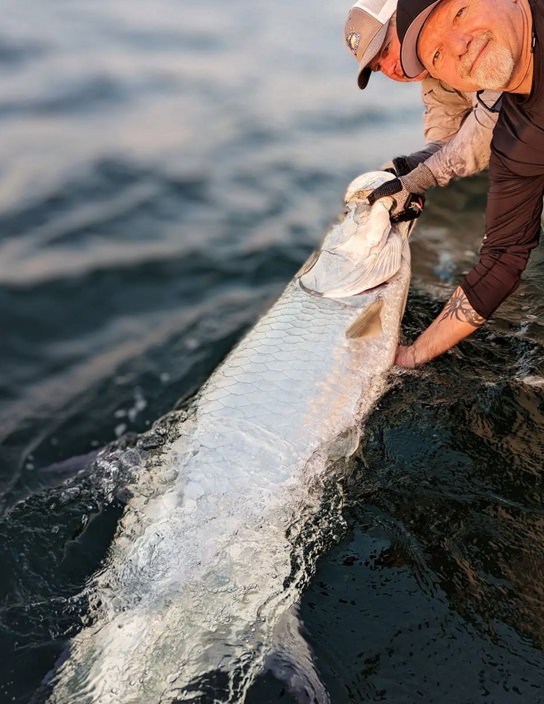
Keep a tarpon in the water whenever possible. Florida rules require fish over 40 inches to remain in the water unless the narrow state or world record exception applies with a tarpon tag. That exception is not an ordinary photo permit.
Support a smaller fish horizontally if brief handling is necessary, with wet hands and no contact with the gills or eyes. Never drag a tarpon across rocks, a beach or a boat’s gunwale. Keep the head and gills in water while removing the hook when this can be done safely.
After a hard fight, let the fish regain balance and strength with clean water moving over its gills. Do not tow it backward. Have the camera ready before the fish reaches the boat and accept an in-water photograph. The quality of the release matters more than lifting the whole fish for a picture.
Predators and difficult situations
Sharks can be attracted to a struggling tarpon. A fast, controlled fight reduces exposure, but it does not eliminate risk. Watch the water throughout the fight rather than noticing a predator only when the fish reaches the boat.
If a shark approaches, follow the captain’s plan to end the encounter. That may mean reducing tension, moving the boat safely or breaking the leader at its planned weak point. Do not lean over the side or enter the water beside an exhausted fish when predators are present.
Repeated shark attacks are a reason to stop fishing that group and relocate. Continuing to hook fish in the same situation can turn a catch-and-release trip into repeated losses. This also applies to rough water, lightning or a fatigued angler who can no longer manage the fight safely.
Florida tarpon rules and Boca Grande
Tarpon is managed primarily as a catch-and-release fishery. The limited harvest exception concerns a state or world record attempt with a tag purchased beforehand. Ordinary anglers should plan to release every fish. Hook and line is the permitted method; snagging, spearing and multiple hooks with natural bait are prohibited.
Boca Grande Pass has additional gear restrictions within defined boundaries. A weight may not hang below the hook in the prohibited arrangement described by FWC. During April, May and June, no more than three fishing lines may be deployed from a vessel there, and breakaway gear is prohibited. A familiar rig from another location may therefore be illegal in the pass.
Use the official FWC page linked below to confirm current rules, the pass boundary and handling requirements. Do not rely on a shortened summary to decide whether a particular jig is allowed. Ask an enforcement or fisheries office when the actual rig arrangement is unclear.
Check current FWC tarpon fishing rules.
Rules reviewed October 4, 2026. Confirm the requirements for your trip before fishing.
Common reasons tarpon trips fall apart
Running straight at rolling fish often pushes them out of reach. Give the fish room and intercept the route instead. Casting across another angler’s line can waste the brief feeding window and make a hookup dangerous.
Another common problem is choosing tackle for casting comfort while ignoring the fight. A light outfit may present a bait nicely but take far too long to land an adult in strong current. Match the entire setup to the expected fish, and be honest about the angler’s strength and experience.
Finally, do not confuse visible fish with a guaranteed catch. Resting or traveling tarpon can be difficult to feed. Change the angle, depth or timing, then consider another location. Patience is valuable when it is based on observed behavior, not when it means repeating an ineffective cast for hours.
Tarpon questions answered
Why do tarpon roll at the surface?
They can gulp air into a modified swim bladder. A roll helps you locate fish but does not prove they are feeding.
Are tarpon freshwater or saltwater fish?
They use saltwater, brackish water and some freshwater habitats. Their ability to tolerate different salinities lets them move through connected coastal systems.
What month is best in Florida?
Spring and early summer are popular for adults in many southern and west-coast areas. Northern areas and resident fisheries differ. Ask about current local conditions.
Can I lift a big tarpon for a photo?
Fish over 40 inches must stay in the water under Florida’s normal catch-and-release rules. The record-attempt exception requires a tag and specific conditions.
Do tarpon have teeth?
Yes, but the teeth are small. The hard mouth and abrasive surfaces are more important to hook placement and leader wear than large cutting teeth.
What does bow to the fish mean?
Lower the rod toward a jumping tarpon to reduce the sudden pull on the hook, then resume controlled pressure when the fish lands.
Can I catch one from shore?
It is possible at suitable legal access points, but you need a safe place to fight and release it. High piers, heavy current and crowded seawalls can make release difficult.
Is a smaller tarpon easy to handle?
Smaller fish can still jump violently and suffer from rough handling. Keep them wet, support them horizontally when needed and minimize time out of water.
Are all tarpon migratory?
No single movement pattern fits every fish. Some travel long distances, while others remain associated with local waters for extended periods.
Should I fish a rolling school with several hooks?
Use a deliberate feeding presentation and a suitable single-hook rig. Snagging and multiple hooks with natural bait are prohibited.
Do I need to keep a tarpon to count it as a catch?
No. Tarpon fishing is centered on release. A safe in-water release is the intended finish for an ordinary trip.
What should I tell a charter captain before booking?
Share the anglers’ experience, ages, physical needs and preferred method. Ask about tackle, weather alternatives, expected conditions and the release plan.
Plan your time on the water
Explore Florida fishing locations, check tides and weather, or find a local guide in the charter directory.