
HookCurrent Florida fishing
Redfish
Find the fish. Read the tide. Make the right cast.
Sciaenops ocellatus
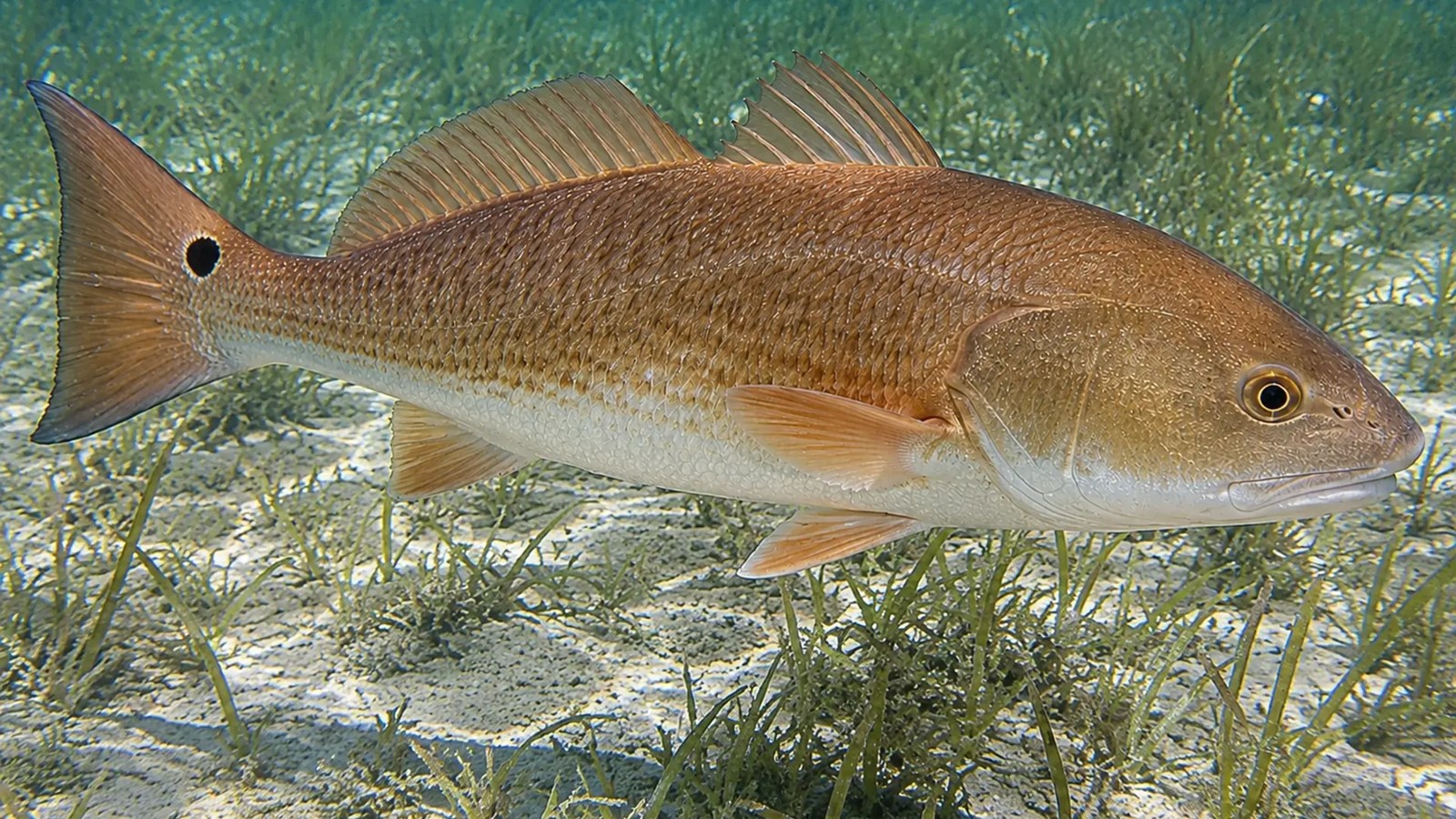
Redfish can feed in water barely deep enough to cover their backs, yet the largest adults may live beyond the beach. Learning which fish you are looking for is the first step. This guide explains how redfish live, why their location changes and how to choose a presentation that fits the water in front of you.
How to recognize a redfish
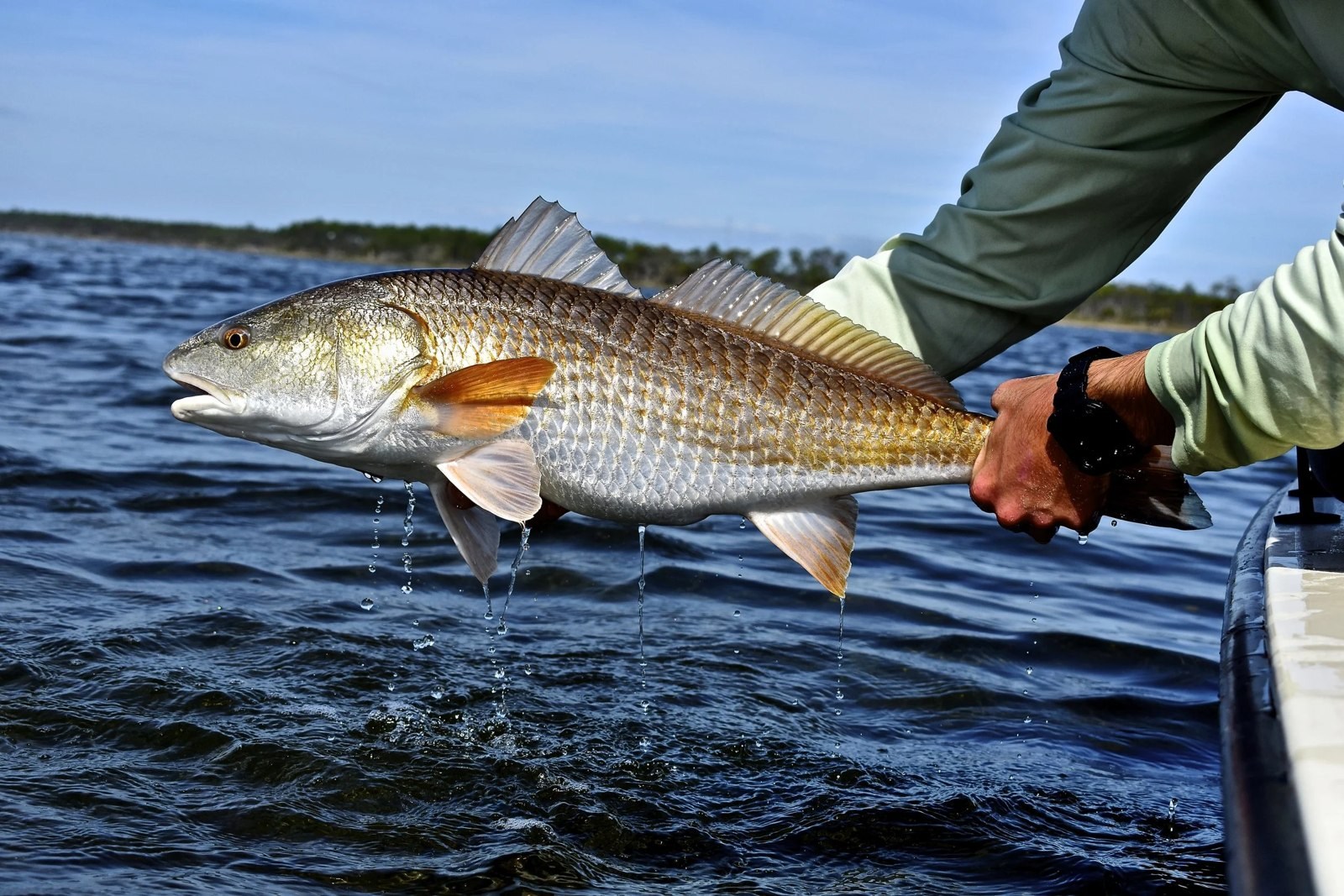
A redfish has a bronze or copper back, a pale belly and a strong, fairly deep body. The most familiar mark is a dark spot near the base of the tail. Some have several spots, and a few lack a clear spot. Use the whole fish for identification rather than counting spots alone.
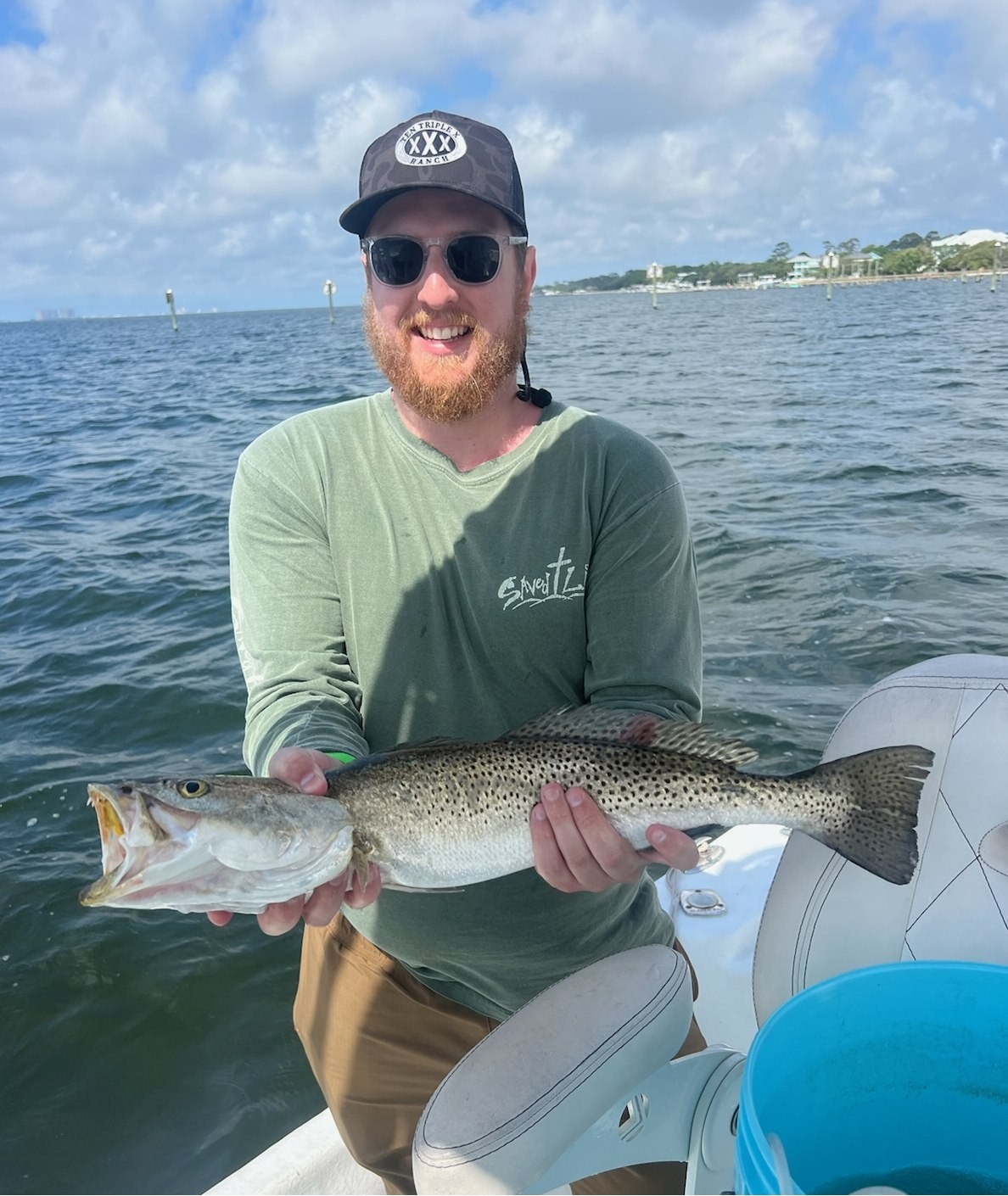
Look closely at the chin. Redfish do not have the little whiskers, called barbels, that hang beneath a black drum’s mouth. Young black drum often have broad vertical stripes. A snook has an obvious dark stripe along its side and a much larger, more forward-facing mouth. A spotted seatrout has numerous dark spots and prominent canine teeth.
Color changes with habitat and light. A redfish from dark marsh water can look richly coppery. A fish from a bright sand flat may appear much paler. Its downward-facing mouth is useful for taking food near the bottom. Watch a feeding fish tip its head down and its tail may break the surface. That behavior is called tailing.
Growth, age and the life of a red drum
Redfish belong to the drum family. Mature males use muscles associated with the swim bladder to produce the low sounds that give the family its name. Their ability to detect prey and feed around the bottom helps them use muddy creeks as well as clear flats.
Small redfish spend their early years in protected estuaries. Seagrass, marsh edges, oyster habitat and shallow backwaters provide food and shelter. As they grow, many move toward deeper bays, passes and coastal water. FWC describes the transition to the nearshore adult population at roughly four years and around 30 inches, but individual fish and estuaries differ.
This is a long-lived species. Some red drum live beyond 40 years. A large adult is therefore much more than a scaled-up version of a small creek fish. It may have survived many fishing seasons and contributed repeatedly to spawning. Treat oversized adults as valuable breeding fish and use tackle that lets you release them without a prolonged fight.
The places redfish use and why
Food, enough water to move and nearby escape cover are a useful starting combination. An oyster bar offers crabs and small fish. A grass flat shelters shrimp and baitfish. A creek mouth channels food when water drains from the marsh. Fish may move between these places during a single tide.
On an unfamiliar flat, look for differences rather than an endless stretch of uniform bottom. A pale sand hole in grass, a slightly deeper drain or the outside corner of an oyster bed can concentrate activity. Watch for mullet, disturbed shrimp, small wakes and nervous bait. Mullet are useful clues to productive water, although not every mullet school contains redfish.
Depth is relative to the area and tide. A shallow feeding route may be only a few inches deeper than its surroundings. Do not drive or paddle across it just because it looks empty. Stop at a distance and watch. A quiet approach often reveals fish that disappear when a boat is pushed too close.
| Habitat | What draws fish | Where to put the bait |
|---|---|---|
| Oyster edges | Crabs, shrimp and current breaks | Along the edge, away from exposed shell |
| Grass and sand holes | Shelter with open feeding lanes | Across the sandy opening |
| Marsh drains | Food leaving flooded cover | At the mouth or nearby deeper bend |
| Docks and seawalls | Shade and hard cover | Beside the structure, with a clear fighting lane |
| Passes and channels | Moving bait and adult schools | Outside heavy traffic and dangerous current |
Where to look around Florida
In the Panhandle, bays, grass flats and marsh shorelines give anglers many ways to find younger redfish. Pensacola Bay, Choctawhatchee Bay, St. Andrew Bay and the waters around Apalachicola are broad examples. The actual shoreline matters more than the name of the bay. Search for bait, water movement and healthy cover.
The Big Bend’s shallow coast has extensive grass, oyster habitat and tidal creeks. Around Cedar Key, Crystal River, Homosassa and Steinhatchee, water depth and access can change quickly with the tide. Plan a route back before following fish far onto a flat. A tide prediction cannot account perfectly for a strong wind that pushes water away from shore.
Tampa Bay, Sarasota Bay, Charlotte Harbor and the Ten Thousand Islands offer different mixes of grass, mangroves, oyster bars and river influence. Northeast Florida adds salt-marsh creeks and stronger tidal changes. The Indian River Lagoon can offer sight-fishing opportunities, but its redfish management rules differ from most of the state. These are fishing regions, not claims that every shoreline is public or open to harvest.
Do redfish migrate?
Redfish move, but they do not all follow one coastwide migration route. A small estuary fish may shift between a creek and a nearby flat. An adult can range more widely through nearshore water and return to a spawning area. Temperature, food, salinity and life stage all influence those movements.
FWC tracking work near Tampa Bay and Charlotte Harbor found that adult movements can cover more water than a single bay. Some tagged fish returned to the same spawning region in later years. Other research found differences in when fish from neighboring estuaries joined the adult spawning population. That is why a simple statement that all big redfish leave at one exact size is misleading.
For fishing, separate daily movement from seasonal movement. The tide can move a fish off a flooded shoreline within hours. A cold spell can shift a group into a sheltered creek or deeper basin for days. Growing into the adult population is a longer-term change. Use yesterday’s catch as a clue, then check whether today’s water still offers the same conditions.
When and how redfish spawn
Florida redfish generally spawn from late summer into fall, with regional activity extending roughly August through December. Passes, inlets, estuary mouths and nearby coastal water can hold mature fish. The exact peak varies around the state and from year to year.
Spawning takes place in the water column. Females release eggs and males release sperm, so fertilization happens outside the body. Redfish do not build a nest or guard their young. Currents carry early life stages toward nursery habitat, where shallow cover and food help young fish survive.
Large gatherings are not an invitation to exhaust fish one after another. Spawning adults support future year classes. If a school is tightly packed, avoid running through it or placing hooks where fish can be snagged. Make a normal feeding presentation, land the fish efficiently and move on if repeated catches or predators make safe release difficult.
What redfish eat
Redfish eat a changing mix of crabs, shrimp, small fish and other bottom-living animals. A fish on an oyster edge may be hunting crabs. One following mullet across a flat may pick off disturbed shrimp or smaller fish. Their diet is flexible, which explains why both live bait and artificial lures can work.
Match the meal to the setting. A small shrimp pattern is easy for a fish to take in a calm pothole. A larger paddletail can be seen and felt in stained water. Fresh cut bait releases scent and can be effective when fish are moving slowly through a defined channel or shoreline edge.
Size and placement often matter more than an exact lure color. If fish are eating tiny prey, a bulky bait may be ignored. If a lure is buried in grass, even the perfect color is hard to find. Start with a manageable bait size, keep the hook point clear and put the offering where a fish can reach it naturally.
A practical seasonal calendar
Redfish can be caught throughout the year in much of Florida. A useful calendar describes changing locations and presentations rather than promising a statewide best month. Local weather can move a pattern forward or backward by several weeks.
Winter fishing often rewards slower work near deeper refuge and nearby sun-warmed shallows. Spring brings more feeding opportunities as water warms and bait becomes active. In summer, early starts, moving water and access to slightly deeper areas can help. Fall adds bait movements and adult spawning activity, but those are not the same event everywhere.
Keep notes on water level, wind direction, clarity and where the bait was holding. Over several trips, those details become more useful than a calendar date alone. A successful October shoreline may fail the following week if a cold front removes the water that made it accessible.
| Season | Useful places to check | A sensible adjustment |
|---|---|---|
| Winter | Sheltered creeks, dark bottom, nearby deeper water | Slow the retrieve and fish during warming periods |
| Spring | Grass edges, oyster bars and feeding flats | Cover water until you locate bait and bites |
| Summer | Moving shorelines, deeper edges and early flats | Avoid the hottest stagnant shallows |
| Fall | Bait-rich estuaries, creek mouths and coastal adult areas | Match local bait and protect large spawning fish |
Tides, wind and water clarity
A rising tide can let redfish enter flooded grass and mangrove edges. A falling tide can pull them toward drains, creek mouths and the last water beside an oyster bar. Neither tide direction is automatically best. What matters is whether water movement creates a usable feeding opportunity at your location.
Watch the actual current before casting. Place a bait up-current of the likely holding spot and let it travel toward the fish. Too much weight pins it unnaturally or drags it into shell. Too little control may carry it past the target before a fish has time to react.
Wind changes the picture. It can build a little more water along one shoreline, stir a flat or make a normally protected bank difficult to fish. Clear water favors longer casts and a quiet approach. Stained water can make scent, vibration and a close presentation more useful. If the bottom is so churned that bait disappears instantly, try a nearby protected edge instead of changing lures endlessly.
Tackle that fits ordinary redfish fishing
For many flats and creek situations, a seven-foot medium or medium-heavy spinning rod is a practical starting point. Pair it with a reel that balances the rod and holds enough line for the setting. Braid in roughly the 10 to 20-pound range is common for smaller inshore fish, with a stronger setup needed around heavy cover or large adults.
A short length of leader protects the line near the bait and makes it easier to check for damage. Around open flats, anglers often start near 20 to 30-pound leader. Increase abrasion resistance near oysters and barnacles when needed. These are starting examples, not a requirement to fish the lightest possible line.
Set the drag before the first cast. It should give line smoothly while still applying useful pressure. Check knots after a snag, a hard pull or contact with shell. A tiny rough patch in a leader can matter more than buying a different rod. Carry pliers, cutters and a landing net that supports the fish rather than tangling every hook.
Live and natural bait choices
Live shrimp are a flexible first choice. They can be free-lined in quiet water, suspended beneath a float or fished near the bottom with light weight. Hook placement should keep the shrimp alive and leave the hook point exposed. Avoid burying the entire hook in the bait.
Mud minnows, small pinfish and finger mullet can suit creek edges and deeper shorelines. A small crab or a fresh piece of cut mullet can work when fish are feeding near the bottom. Match hook size to the bait, with enough gap remaining for the hook to take hold.
Circle hooks are useful with natural bait because a steady pull can bring the hook toward the mouth corner. Let the line tighten and reel smoothly instead of striking hard as you would with some lure techniques. Check current gear rules before fishing. Redfish rules prohibit multiple hooks used with live or dead natural bait, so a treble-hook bait rig is not an appropriate shortcut.
| Bait | Good use | Common mistake |
|---|---|---|
| Live shrimp | Potholes, creek mouths and floats | Using a heavy hook that overwhelms the shrimp |
| Small baitfish | Docks, edges and current seams | Allowing the bait to hide deep in cover |
| Crab | Bottom feeding around shell and channels | Covering the hook point with shell |
| Fresh cut bait | Defined travel lanes in stained water | Leaving slack so a bite goes unnoticed |
Lures, retrieves and fly fishing
A paddletail on a light jig head covers water efficiently. Choose enough weight to reach the feeding level without plowing the bottom. In shallow grass, a weedless soft plastic often stays cleaner. A spoon is useful for searching, provided you retrieve it above the cover rather than dragging it through every stem.
Topwater plugs can be exciting in low light or when fish are actively chasing bait. Keep moving the lure if a fish misses it. A sudden stop is not always the best response. In pressured, clear water, a smaller shrimp or crab imitation and a gentle presentation may draw more attention than a noisy surface lure.
Fly anglers commonly use shrimp, crab and small baitfish patterns. An eight-weight outfit is a familiar starting point for ordinary flats fish, with changes for wind and fish size. Lead the fish, let the fly settle where it can be seen and use short, controlled movements. Do not strip the fly rapidly toward a fish that is already moving away from it.
How to approach a visible fish
Stop moving as soon as you see a tail, wake or copper shape. Work out which direction the fish is facing. A cast that lands behind it may never be noticed, while a lure dropped on its head can end the chance immediately.
Aim ahead and slightly beyond the fish’s route. Bring the bait into view without crossing the line over its back. The right lead distance depends on depth, water clarity, lure sink rate and how fast the fish is traveling. Start farther away when the water is calm and clear.
If the fish follows but refuses, change one thing. Reduce the speed, shrink the offering or make a fresh presentation from a better angle. Repeatedly slapping the same lure beside it usually makes the fish less willing. When a school is moving, work an outside fish first rather than casting through the middle and disturbing the entire group.
Fishing from shore, a kayak or a boat
Shore anglers can work public creek access, permitted park shorelines, causeways and suitable beach or inlet edges. Look for a place where fish can come within casting range naturally. A long cast into featureless water is less useful than a short cast beside a drain holding bait.
Kayaks can reach quiet shallow water, but wind and tide still control the return trip. Keep a margin between yourself and strong passes or boat channels. Do not chase a fish into a route that is unsafe for your craft. Wear a flotation device and carry a way to call for help.
From a skiff, use distance as an advantage. Stop the outboard well away from a feeding area, then move quietly. Avoid propeller damage to seagrass and never force the boat across a flat that is too shallow. Whether walking, paddling or boating, respect private property, marked closures and other anglers already working a shoreline.
When the redfish will not bite
First ask whether fish are present. If there are no wakes, no bait and no signs of life, a move may be more useful than a tenth lure change. Search nearby depth changes and the next place where moving water meets cover.
If you see fish but get no response, consider the angle. A bait passing naturally in front of a fish is easier to take than one racing across its back. Check that the lure is not fouled with grass or spinning on a bent leader. With natural bait, confirm it is still lively or fresh.
Missed bites can come from an oversized offering, a hidden hook point or poor line control. Break-offs often suggest shell damage or a fish reaching cover before you apply pressure. Solve the actual failure. A stronger leader helps with abrasion, but it cannot fix a lure that never passes through the feeding lane.
Landing, photos and release
Have the release tools ready before you need them. A rubber-coated net can support a smaller fish while you remove the hook. Wet your hands before contact and keep fingers away from the gills. If a fish must be lifted briefly, support the belly and hold it horizontally.
Avoid suspending a large redfish by its jaw or tail. Keep oversized adults in the water as much as possible. A quick photograph is better than a long series of poses. If a hook is deeply embedded and removal would cause more injury, cutting the leader close may be the better choice.
Allow the fish to recover with water moving naturally through its mouth and over the gills. Do not drag it backward. Release it when it can hold itself upright and swim strongly. If sharks or other predators repeatedly attack hooked fish, change locations rather than continuing to feed them exhausted redfish.
Florida harvest rules and measuring
Check the official rule page before every trip that may involve keeping a redfish. Florida uses several management regions, and the Indian River Lagoon is catch and release under the rules reviewed for this guide. A rule from the next county or a photo of a kept fish is not enough to establish what is legal where you are fishing.
In the open regions reviewed on October 4, 2026, the general slot is 18 to 27 inches total length and the daily individual limit is one fish. Vessel limits vary: the Panhandle, Big Bend and Northeast regions list four fish, while several central and southern regions list two. Special area rules and later emergency orders can change the answer.
Total length is measured with the mouth closed and the tail compressed to its greatest length. Use a flat measuring board rather than a tape bent around the body. Know your region, the exact boundary, the current vessel limit and any park-specific rule before putting a fish in the cooler. The official link below is the place to confirm those details.
Check current FWC redfish fishing rules.
Rules reviewed October 4, 2026. Confirm the requirements for your trip before fishing.
A simple plan for your next trip
Choose one type of water to learn well: an oyster shoreline, a grass flat or a creek system. Find the legal access point and check the weather and tide. Pick two or three nearby alternatives so a wind change does not force you to fish one poor spot all day.
Bring a small set of useful offerings rather than every lure you own. A shrimp option, a weedless soft plastic and a searching lure cover many situations. Add suitable bait if you want to fish a defined lane patiently. Carry enough leader and terminal tackle to replace anything damaged by shell.
Spend the first minutes watching. Note the current direction, bait activity and where deeper water lies. Fish the best-looking section quietly, then adjust based on what happens. After the trip, record the conditions and the successful presentation. That habit turns a lucky catch into a pattern you can recognize again.
Redfish questions answered
Is a redfish the same fish as a red drum?
Yes. Redfish is the common Florida name for red drum, Sciaenops ocellatus. It is different from black drum and from unrelated fish called redfish elsewhere.
Does every redfish have one tail spot?
No. Some have several spots and some have no obvious spot. Check body shape, mouth and the absence of chin barbels too.
What is the easiest bait for a beginner?
A live shrimp is a useful starting choice. Fish it at the depth the fish are using, with a hook and weight small enough to preserve its movement.
Can redfish be caught at night?
Yes. They can feed after dark, particularly where current and bait meet. Choose safe access and do not assume a daytime shoreline is easy to navigate at night.
Is high tide always better?
No. High water can open feeding cover, while draining water can concentrate fish at exits. The best stage depends on the location.
Why are redfish tailing?
They are often feeding head-down near the bottom. A tail above the surface is a useful clue, but approach slowly before deciding where to cast.
Can I keep a large bull redfish?
Large fish above the allowed slot must be released where that slot applies. The Indian River Lagoon has a catch-and-release rule. Verify current local requirements.
Do I need a boat?
No. Suitable public shorelines and access points can produce fish. Access permission, current and a safe landing area matter more than owning a boat.
What is the difference between a slot fish and a bull?
Slot refers to a legal size range, which depends on current rules. Bull is an informal angling term for a large redfish, not a separate species or legal category.
Why do fish refuse a lure they can clearly see?
The lure may be too large, moving unnaturally or approaching from the wrong direction. Try a quieter cast and a better angle before changing everything.
Should I use wire leader?
Wire is normally unnecessary for redfish. An abrasion-resistant leader suited to shell and structure is more useful.
Are spawning fish the only redfish present in fall?
No. Younger estuary fish and mature coastal adults can be present at the same time. Their locations and reasons for moving may differ.
Plan your time on the water
Explore Florida fishing locations, check tides and weather, or find a local guide in the charter directory.