

SOUTHEAST ATLANTIC
Hobie Island Beach Park
fishing guide
Hobie Island Beach sits along the Rickenbacker Causeway in a busy bay recreation setting. Confirm shore-fishing permission at the exact section before bringing hooks, and keep any fishing plan separate from swimmers, dogs and wind-powered sports.
Explore the guide ↓Confirm the exact shoreline before selecting a rod position
Hobie Island Beach is associated with the Rickenbacker Causeway and bay recreation. It is not the same managed property as Historic Virginia Key Beach Park. The historic park's rules should not be confused with this shore, and this shore should not be assumed open to fishing everywhere.
Ask the current managing agency about the particular section and angling permission. This guide has not verified a general unrestricted shore-fishing right. If the answer is unclear, choose an explicitly designated facility elsewhere.
Shared use is obvious along the causeway. Swimming, dogs and wind-powered equipment can occupy the same shallow water. A quiet-looking gap between people is not sufficient permission to cast.
Older shoreline construction notices do not establish today's route or condition. Follow current barriers and signs rather than expecting an old photograph to describe every access point.
Look at the bay's bottom before thinking about distance
The bay-side setting differs from an Atlantic surf beach. Grass, sand and depth transitions can matter more than a breaking bar. Wind may stir the shallow bottom and change the view within a short time.
A darker patch might be vegetation, a cloud shadow or deeper water. Compare its shape as light changes. Do not walk into an unfamiliar bottom simply to decide which it is.
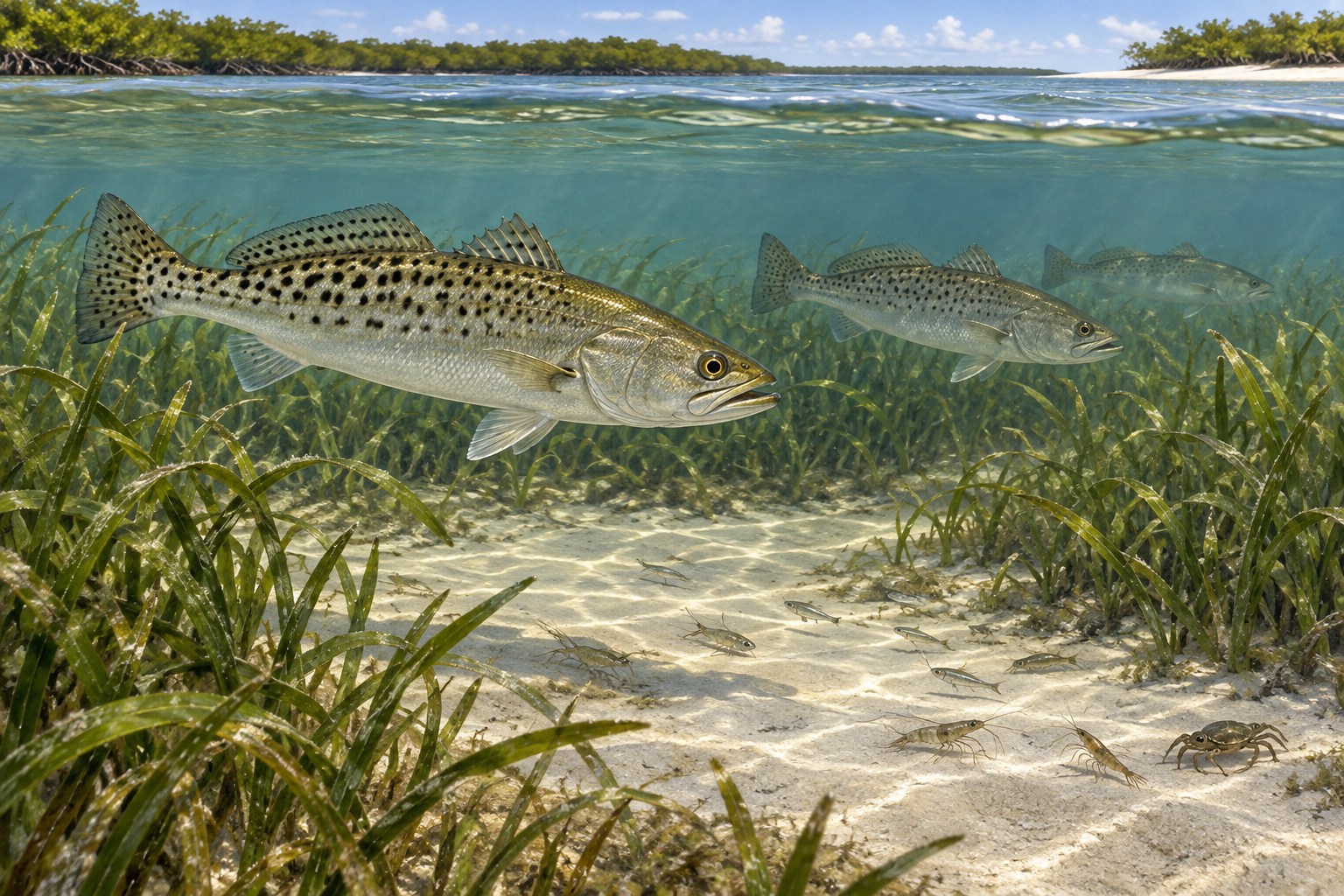
The real photograph shows the wider Rickenbacker Causeway bay and skyline context. It does not identify a fishing station. The illustration explains a general shallow-water fish relationship rather than a surveyed depth or access route.
Understand how seatrout use grass margins
Spotted seatrout can feed around suitable grass and adjacent open water. Shrimp and small fish provide useful clues to that feeding habitat. This is a habitat explanation, not a guarantee of a local catch.
At a legal bay fishing position, a soft plastic can be swum above grass instead of dragged through it. Use enough weight to control the lure without burying it in vegetation. Short pauses can help imitate prey movement.
A shrimp presentation may also suit a lawful clear lane. Keep the hook and float arrangement manageable around other users. Do not cast a rig into this shared recreation water without the required permission and separation.
Keep moving-fish tactics tied to authorized water
Jacks and snook may travel through suitable bay margins in search of small fish. A moving school can be easier to notice than a single predator. Watch prey direction and the space available beyond it.
Where fishing is allowed, a compact lure presented ahead of the route gives a restrained first test. Avoid chasing a school across someone else's activity area. A passing opportunity is not worth placing hooks near people.
Check the leader after abrasion or a toothy strike. A bite does not remove the need for a safe landing and supported release.
Select one simple presentation for a legal bay outing
Small shrimp and baitfish-shaped lures cover different parts of a bay feeding situation. Shrimp can examine a limited lane carefully, while a lure can search a larger recoverable path. The best choice depends on the confirmed destination.
Keep bait cool and discard damaged pieces before they soften beyond use. Carry a few small hooks and spare leaders rather than a large exposed tackle spread. Light organization is helpful when the visit includes walking or a separate launch.
Do not release unwanted bait or bait water without checking current requirements. Keep containers sealed around dogs and other visitors.
Separate habitat interest from usable fishing access
A beautiful bay scene can be educational even when a fishing position is not confirmed. Make the access decision before the tackle decision.
| Question | Useful check | Resulting plan |
|---|---|---|
| Is angling permitted at this section? | Ask the managing agency | Use another destination if uncertain |
| Is the water occupied by recreation? | Observe swimmers and equipment routes | Keep hooks away |
| Does a legal bay route cross grass? | Read charted depth and visible bottom | Avoid damaging shallow habitat |
| What prey is moving in authorized water? | Watch shrimp and small fish habitat | Choose a controlled small offering |
Give wind-powered users a wide clear route
A wind that attracts recreation users can also move a fishing line and lure sideways. Watch the direction of boards, sails and kites. Their travel needs more space than a still image suggests.
Do not stretch a line across an approach or landing route. A lure that seems far from a person can still intersect equipment moving quickly. Relocate to another confirmed fishing setting rather than arguing over a shared gap.
A quieter weather window can improve bottom visibility for observation. It still does not establish local angling permission.
Use a legal boat plan when shore access is unsuitable
A properly planned bay trip may provide fishing water beyond a recreation shore. Use an authorized launch, carry a chart and understand the return route. Causeway proximity does not make every bank a launching point.
Avoid propeller contact with grass and stop before entering uncertain shallow water. A known deeper route can be more practical than forcing a shortcut. Stow hooks during boarding and when passing occupied recreation space.
Prepare for changing wind and afternoon thunderstorms. Set a return time that leaves a comfortable margin instead of waiting until conditions become difficult.
Keep any separate fishing trip lawful and tidy
Verify current FWC licenses and fish rules for the legal destination. Have pliers and a suitable landing method ready. Keep release fish wet and supported rather than leaving them on a hot deck.
Pick up small line fragments and secure bait wrappers from the wind. A bay visit should end with a clean shoreline and a clear understanding of where fishing was actually authorized.
Common questions
Does this guide confirm unrestricted fishing at Hobie Beach?
No. Ask the managing agency about the exact section before placing hooks in the water.
Is Hobie Beach the historic Virginia Key park?
They are different settings. Do not transfer access or rules from one to the other.
Why is spotted seatrout discussed?
Suitable bay grass margins can explain its feeding habitat. That does not prove a catch or authorize fishing beside recreation users.
What if swimmers or wind sports occupy the water?
Keep hooks out of their routes and choose a separate confirmed fishing location.
Prepare for your visit
Check local tides and weather. Read more about snook, spotted seatrout. Check current FWC saltwater fishing rules.