
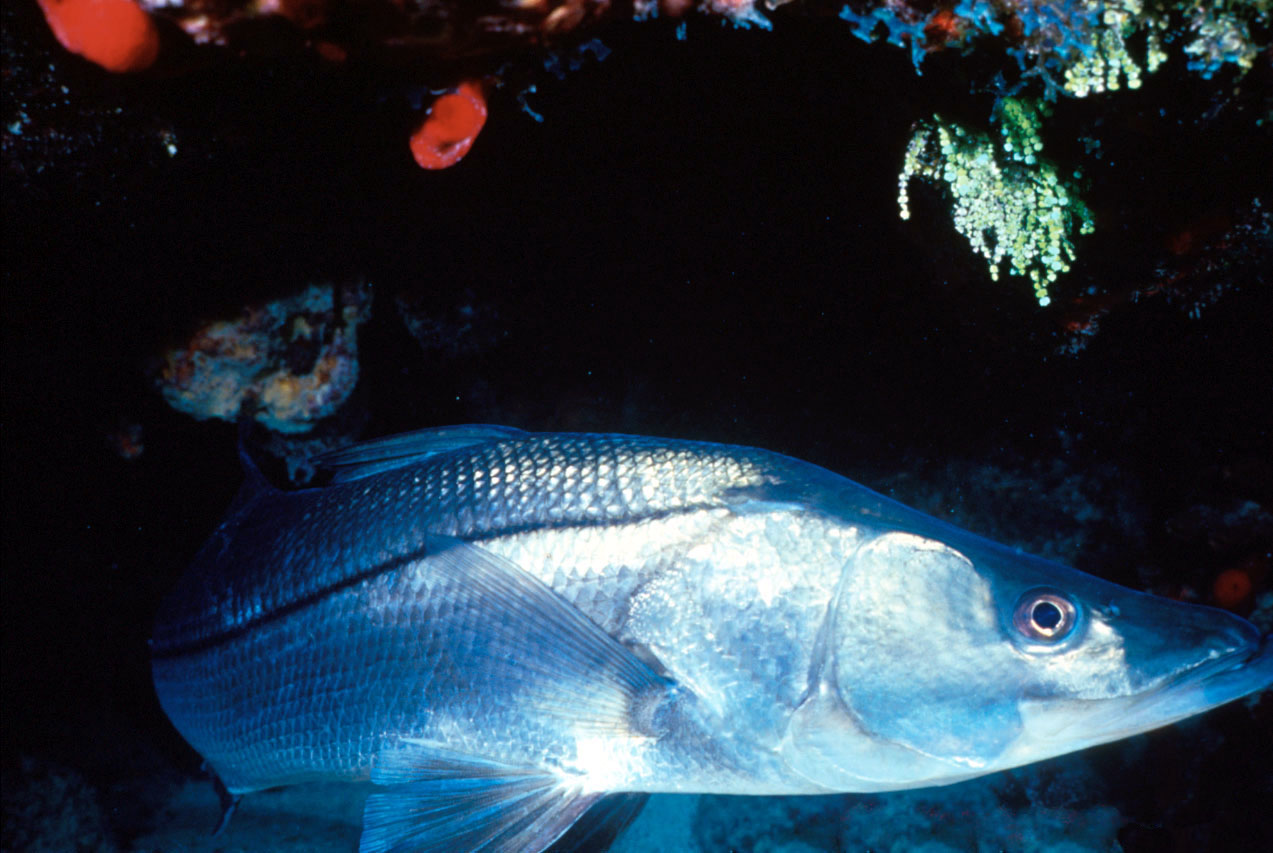
Your first trip
How to catch a snook: the quick start
Start at a public shoreline, creek mouth, or dock you may legally fish. Look for cover beside moving water. Watch before you cast. A swirl or a nervous bait school may reveal a feeding fish.
- Choose moving water you can fish safely. Watch floating grass or foam to see the actual flow. A printed high-tide time does not necessarily tell you when current turns at your spot.
- Start with one versatile setup. For general inshore fishing, try a 7-foot medium-heavy rod and a 3000–4000 class spinning reel. Add 15–20 lb braid and a leader that resists wear. Follow the rod and reel ratings. Strong current and heavy cover may need stronger gear.
- Offer familiar food. Try a healthy live shrimp or small baitfish, or a 3–5 inch soft-plastic paddletail. Choose something similar in size and shape to the forage you see.
- Cast beyond the feeding lane. Bring the offering through the edge of shade, current, or structure. Avoid landing it directly on a visible fish.
- Control slack without dragging the bait. Keep enough connection to detect a bite and prevent a fish reaching cover. Change your angle before changing every lure in the box.
- Have the release ready. Keep pliers, a landing net, and wet hands ready. Check current harvest rules before the first cast.
Tackle sizes and fishing plans in this guide are practical starting points, not guarantees or equipment requirements. Adjust for the fish, current, cover, access, and your experience.
Know your quarry
What is a snook?
The common snook is a coastal fish that eats other fish and crustaceans. It belongs to the family Centropomidae. Anglers call it a “linesider” because of its dark side stripe. “Robalo” is another name. Its large mouth and strong tail help it catch prey. It is not a type of largemouth bass.
Snook can live in fresh, brackish, and salt water. Brackish water is a mix of fresh water and seawater. Snook often move through estuaries, where rivers meet the sea. They need food, cover, suitable temperatures, and connected habitats. Not every pond or canal can support them.
Size, age, and growth
Common snook can reach about 48 inches. FWC lists the Florida record at 45 pounds, 12 ounces. That fish was caught near Sebastian. Most fish you catch will be much smaller.
Snook can live for about 20 years. Growth varies by sex, location, and conditions. Length alone does not tell you a fish’s age or exact weight. Two fish of the same length may weigh very different amounts.
How to identify a common snook
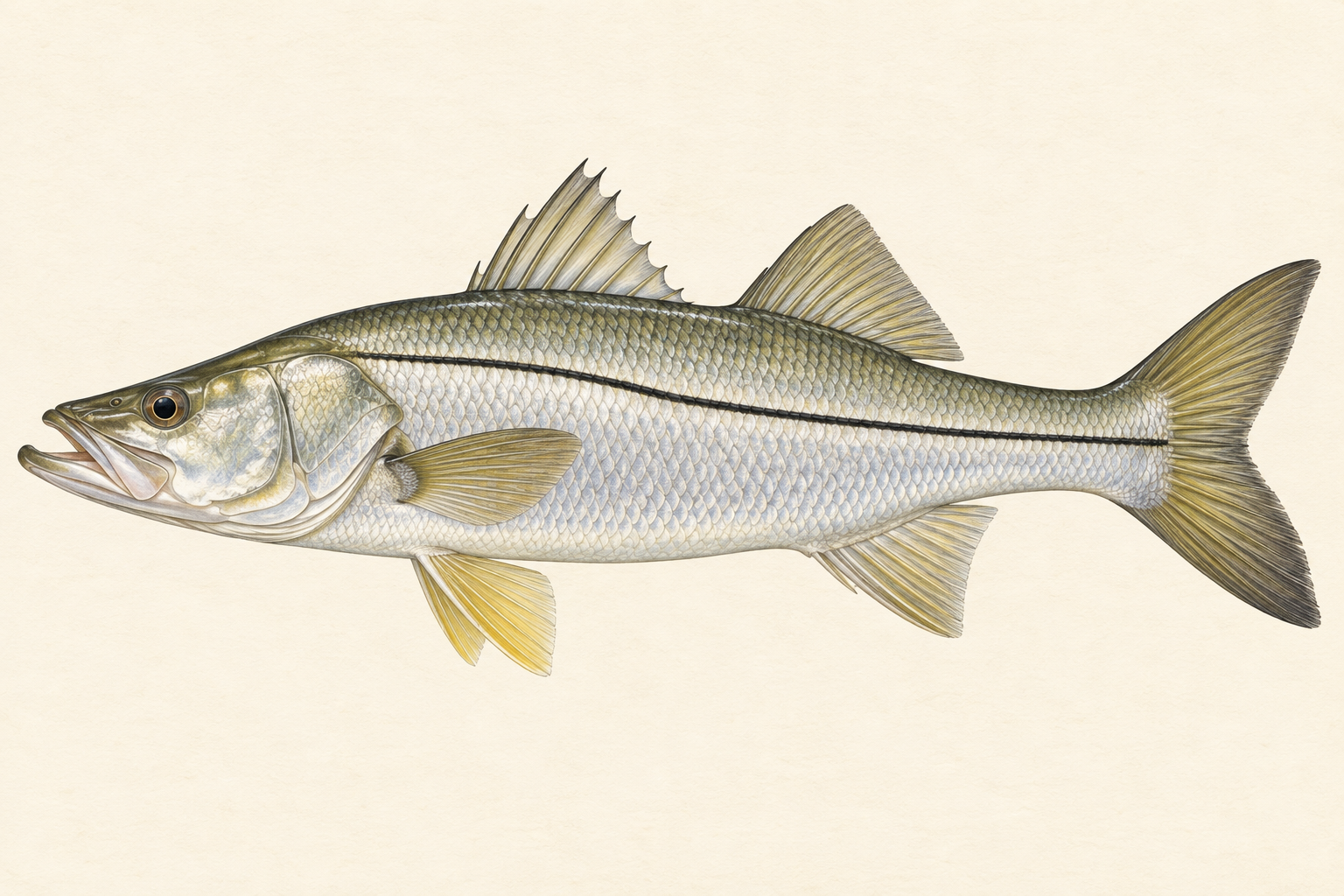
1. The dark lateral line
A strong dark stripe follows the side and extends onto the tail. This is the feature behind the nickname “linesider.”
2. The jaw and mouth
Look for a large mouth and projecting lower jaw. In common snook, the mouth reaches back beneath the rear part of the eye.
3. The body and fins
The body is elongated, with a sloping forehead and divided dorsal fin. Silver sides contrast with a darker back; some lower fins look yellowish.
Water color and lighting can change how a fish appears. Use a combination of traits, not a photograph’s exact shade of silver.
Other snook are not simply baby common snook
Florida has several smaller snook species. A small snook is not always a young common snook. Fat snook have deeper bodies and shorter mouths. Tarpon snook have an upturned lower jaw and seven anal-fin rays. Swordspine snook have a long anal fin. Use several features to identify a fish. Avoid long handling sessions if you are unsure.
Where snook live
Common snook live in warm parts of the western Atlantic, Gulf, and Caribbean. Their range extends along Central and South America. Florida is near the colder, northern edge of that range. Winter cold limits where they can survive. One unusual catch does not mean an area has a steady snook fishery.
Snook have spread farther north in Florida. UF/IFAS researchers have studied them in the Suwannee River system. Some fish use warmer spring water during cold weather. Older range maps may miss these northern fish. Cold snaps still pose a serious threat.
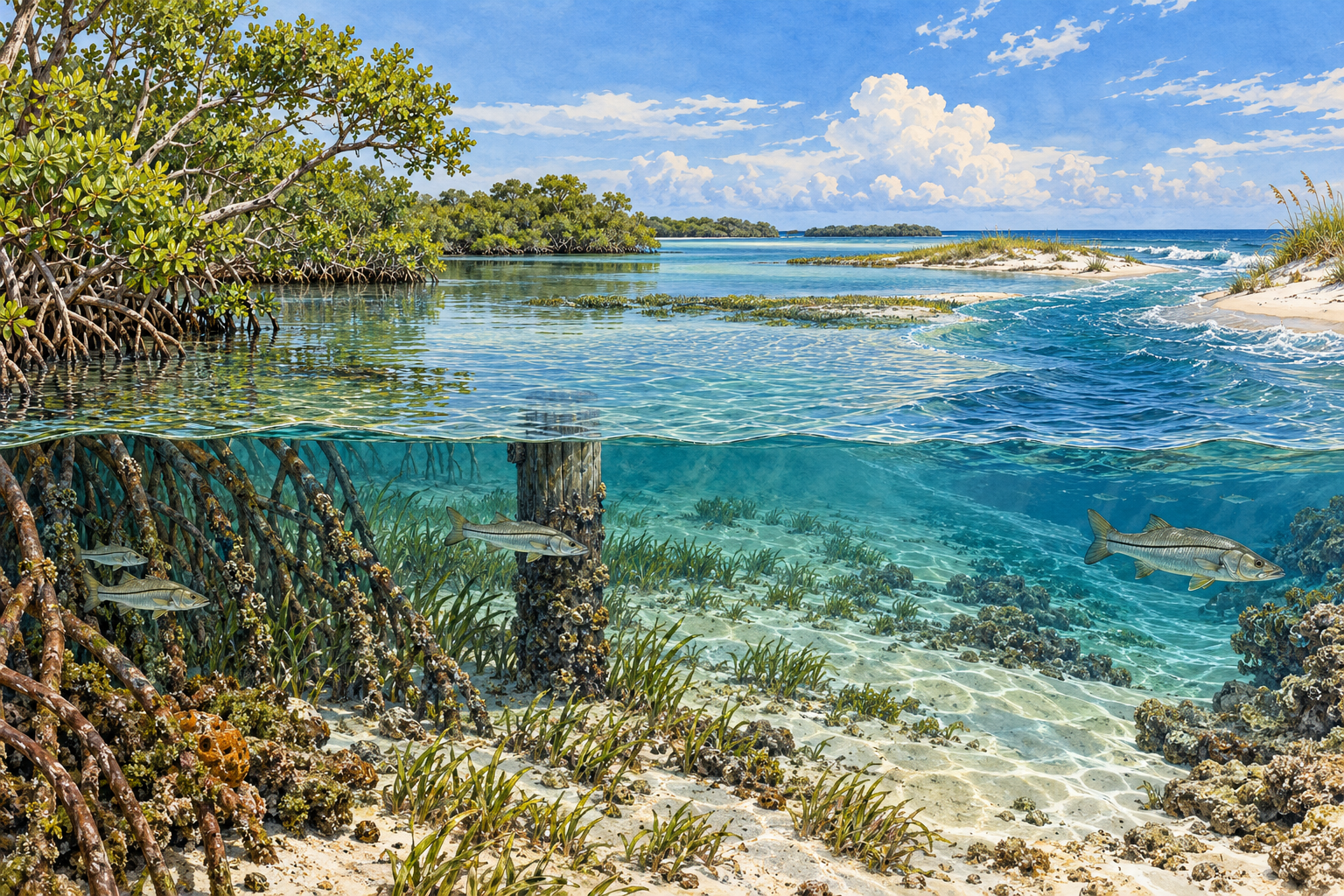
Read habitat by its job
| Habitat | What it offers | Where to look first |
|---|---|---|
| Mangrove creeks | Cover, forage, and sheltered edges | Outside bends, roots beside deeper water, and creek mouths |
| Seagrass and sand edges | Prey and open feeding lanes | Holes, potholes, drop-offs, and the edge of a bait school |
| Beaches | Shallow travel lanes and baitfish | The first trough, cuts, and beach sections near passes |
| Inlets and passes | Moving food, depth changes, and reproductive habitat | Manageable current seams and protected edges |
| Docks, bridges, seawalls | Shade, current breaks, and ambush cover | The upstream face and downstream eddy; compare both |
| Tidal rivers and canals | Connected feeding areas and sometimes thermal refuge | Deeper bends, junctions, shore cover, and bait concentrations |
Do not assume all visible fish are actively feeding. A sheltered holding area can contain snook that ignore repeated casts. A nearby travel edge may give you a better presentation without disturbing a resting group.
Why small wetlands matter
Young snook use sheltered creeks and ponds as nursery areas. These small places give them food and cover. Studies show that fish use different parts of these habitats as they grow. Keeping wetlands connected to rivers and bays helps support future adult fish.
Do snook migrate?
Yes, but they do not all follow the same route. Some snook move between rivers, bays, and coastal spawning areas. Others stay closer to home. Tracking studies in Tampa Bay found both patterns. Moving toward saltier water to breed is common, but it is not a fixed rule for every fish.
Everglades studies show that river flow helps shape snook movements. The number of fish that migrate can change from year to year. Their timing can change too. Use the season as a clue, then check local water conditions.
Warm-up movements
As conditions become favorable, investigate connections between sheltered interior water and more open feeding areas. Revisit outside points and channel edges rather than assuming winter locations stay best.
Spawning movements
Late spring and summer can bring adults toward passes, river mouths, and coastal areas. A fish seen on the beach is not necessarily feeding or spawning at that exact moment.
Cool-down movements
As cold fronts become important, reconsider interior estuary and river habitat. Look for stable conditions rather than assuming the deepest available hole is always warmer.
Not every move is a migration. A snook may switch sides of a piling when the current turns. That is a small feeding move. A seasonal trip from a river to a coastal spawning area is different. Both can change where you should cast.
When and how snook reproduce
In Florida, snook usually spawn from April or May through September or October. Timing varies by location and weather. Adults gather near suitable inlets and river mouths. Females release eggs into the water. Males release sperm to fertilize them. Snook do not build nests or guard their eggs. A female can spawn more than once in a season.
Snook can change sex
Common snook first mature as males. Some later become females. Scientists call this protandry. The change does not happen at one set age or length. Large snook are more likely to be female. You cannot reliably tell a fish’s sex by looking at it.
From eggs to nursery fish
Snook need suitable spawning water and safe places for their young to grow. Those places may be far apart. Healthy shorelines and open water connections help link them. Young fish face different feeding and survival challenges from adults.
A large school does not tell you how many snook live in the whole region. Many fish may gather in one small area. The rest of their habitat still matters. Regional research gives a better picture than one busy fishing spot.
What snook eat and how to choose bait
Snook eat different foods as they grow. Small young fish eat tiny crustaceans. Larger young snook add shrimp and small fish to their diet. Adults eat many types of fish and crustaceans. Their meals depend on what is available nearby.
Watch for small baitfish, mullet, pinfish, and shrimp. You do not need to name every baitfish to choose a useful lure. Look at its size, depth, and movement. Match those first. Tiny baitfish call for a different approach than large mullet.
Match the meal before the color
Get the lure to the right depth before worrying about its paint pattern. Match the shape and speed of the food you see. If fish follow without biting, change your cast angle. Try a smaller lure or a slower retrieve.
Why current is so useful
Snook commonly face moving water and intercept food carried toward them. Your job is to deliver the offering through that intercept point with a believable path.
A piling splits the current. A snook may wait beside it, behind it, or near its shadow. Try a few cast angles. Let each cast test a different feeding lane. Avoid hitting the piling over and over.
When to catch snook: a seasonal field calendar
This is a fishing-pattern calendar, not a legal harvest calendar. The month ranges overlap, and South Florida can behave differently from the Nature Coast. Let recent conditions decide which pattern you try.
| Period | Starting places | Useful approach | Adjustment to watch |
|---|---|---|---|
| Winter December–February | Connected rivers, protected canals, deeper bends, sheltered shorelines | Slow down; try small offerings near cover during stable weather | Cold fronts can shut down a pattern. Leave cold-stressed fish alone. |
| Spring March–May | Estuary edges, outside mangrove points, travel channels | Search with a paddletail or baitfish presentation; revisit productive edges | Warming trends help define the transition; late fronts can reverse it. |
| Summer June–August | Beaches, passes, coastal edges, shaded structure | Consider dawn, dusk, or suitable night water; prepare for quick release | Spawning, heat, storms, and harvest closures require attention. |
| Fall September–November | Bait concentrations, bay shorelines, creek mouths, river approaches | Follow forage; compare coastal and interior locations as weather changes | A bait run is local and temporary. Do not assume yesterday’s school stayed. |
Best time of day
Dawn and dusk are good times to try shoreline edges. Night fishing can work around safe, legal access to lighted water. Daylight helps you spot fish on clear beaches and flats. Snook can feed at any of these times. Let local conditions guide you.
Best tide
Neither incoming nor outgoing tide is always best. Outgoing water may carry food from a creek. Incoming water may let fish reach a shallow shoreline. Watch the bait, water level, and current. Choose a flow that lets you control your bait or lure.
Moon phase
Moon phase affects tides and night light. Use it to help plan a trip. It does not promise a bite. Food, weather, and a good cast still matter. Record what happens on your trips so you can spot local patterns.
Temperature, wind, and rain
Watch whether the water is warming or cooling. One reading tells only part of the story. Wind can change depth, waves, and water clarity. Rain can change river flow and salinity. Compare nearby spots. Wind and rain are not always good or always bad.
Where to fish for snook in Florida
Use these regions to start your search. They are not exact fishing spots or promises of a catch. Check public access and local closures. A local guide can explain recent conditions. FWC’s rule boundaries may differ from familiar town or region names.
Tampa Bay & nearby Gulf coast
Explore mangrove edges, tidal rivers, bay bridges, passes, and barrier-island beaches. This mix lets you compare sheltered and coastal patterns without assuming fish are on every shoreline. Begin with bait and current near a depth change.
Sarasota & Charlotte Harbor
Bays, creeks, mangroves, barrier islands, and river connections create varied options. The Peace, Myakka, and Caloosahatchee systems illustrate how inland and coastal habitat fit together. Choose a small area to learn well instead of racing across an entire harbor.
Southwest Florida & the Everglades
Connected rivers, mangrove islands, bays, and Gulf shorelines offer many habitat transitions. Remote travel demands careful route, weather, fuel, and tide planning. A guided trip is useful when you do not know the channels or park requirements.
Indian River Lagoon & Treasure Coast
Look at lagoon shorelines, tributaries, bridges, and inlet-associated habitat around places such as Sebastian, Fort Pierce, and Stuart. Inlet water can be powerful; a sheltered shoreline approach is a more suitable starting point for many newcomers.
Palm Beaches & Southeast Florida
Beaches, inlet systems, tidal rivers, and connected urban waterways provide different ways to fish. Access is often the limiting factor. Check posted hours, bridge restrictions, and local rules before planning a night session.
Florida Keys & Florida Bay
Consider connected backcountry and mangrove habitat. Snook are not confined to the classic mainland bridge setting, and occasional reef encounters occur. Park boundaries and regional rules need particular attention here.
Nature Coast & farther north
Snook occur in expanding northern habitat, including the Suwannee system studied by UF/IFAS. Treat this as a more temperature-sensitive and locally variable fishery. Do not assume Destin offers the same dependable snook focus as South Florida.
Find Florida Charters Check tides & weather
Regional planning suggestions synthesize the habitat and movement research linked throughout this guide. Confirm individual access points and current conditions locally.
Best live and natural baits for snook
Start with healthy bait that swims well. Bigger is not always better. Match the hook to the bait. Keep the hook point and gap clear. Check local rules before collecting or using bait.
| Bait | Good starting situation | Presentation | Common mistake |
|---|---|---|---|
| Live shrimp | Creek mouths, dock edges, smaller forage | Drift naturally; add minimal weight if needed | Too much lead makes it drag instead of drift |
| Scaled sardines / pilchards | Shorelines with small baitfish | Free-line along a feeding edge with controlled slack | A tired bait spinning in current |
| Pinfish | Deeper edges and stronger cover | Place beside the holding area without letting it bury in cover | Giving the bait and fish unlimited slack |
| Small mullet | Areas with a visible mullet presence | Work a shoreline lane or current edge | Using a bait too large for the tackle or intended presentation |
| Other local baitfish | Fish visibly feeding on a particular forage | Match the local food and swimming depth | Assuming local names identify the same bait everywhere |
| Fresh dead bait | A deliberate bottom or scent presentation | Position carefully and monitor the line | Leaving a bait unattended and allowing deep hooking |
Rigging live bait without killing its action
Use wet hands and handle live bait gently. Keep it in water when possible. Hook placement affects how it swims. A nose or lip hookup can suit a forward drift. The best placement depends on the bait. Ask a bait shop or guide to show you. Keep the hook gap clear.
An inline circle hook is useful for many natural-bait rigs. Leave the hook gap open. When a fish takes the bait, apply steady pressure. Do not use a hard, sudden hookset. Hook sizes vary by brand. Choose by the hook’s actual size and the bait you use.
Bait care is part of the rig
Do not crowd too much bait into a bucket or livewell. Keep the water moving or well aerated. Avoid sudden temperature changes. Remove dead bait. Replace a bait that rolls or spins. More bait will not fix poor livewell water.
Best snook lures and how to work them
Choose a few lures that cover different depths and actions. Learn how each one swims. You do not need every brand or color. Change one thing at a time. That makes it easier to learn what helped.
| Lure type | When to start with it | How to fish it |
|---|---|---|
| Soft-plastic paddletail | Searching shorelines, potholes, and current edges | Steady retrieve or controlled sweep. Choose the lightest jig head that reaches the intended lane. |
| Soft jerkbait | Shallow, clear water or scattered vegetation | Short twitches and pauses; rig straight so it does not spin. |
| Suspending or slow-sinking plug | Fish holding at a repeatable depth | Pause near the feeding zone; learn its behavior in the actual salinity and current. |
| Topwater plug | Shallow feeding activity and suitable surface conditions | Use a controlled walking or popping rhythm. Wait for weight before setting the hook. |
| Bucktail or other jig | Deeper water, stronger flow, or compact forage | Control depth and avoid excessive slack; do not simply bounce into every snag. |
| Shrimp imitation | Small prey, clear water, or a slower approach | Use short movements with pauses; keep it believable rather than racing it past fish. |
| Baitfish or shrimp fly | Shallow edges, sight fishing, or light lines | Match sink rate and profile; make controlled strips with a clear path for loose line. |
Color and size
Try natural or clear patterns in clear water. In cloudy water, try a lure with a stronger outline. White, baitfish colors, and dark patterns give you a simple range. Watch how fish respond. Try a smaller lure when fish follow but refuse to bite.
The retrieve that matters most
First find a likely feeding lane. Then adjust speed and depth. A good retrieve will not help if no fish can see it. Test a sinking lure in open water. Learn how quickly it sinks before using it near roots or rocks.
Rods, reels, leaders, and simple rigs
| Situation | Starting setup | Why adjust it? |
|---|---|---|
| General inshore | About 7 ft medium-heavy spinning rod; 3000–4000 reel; 15–20 lb braid; 25–40 lb leader | Balances casting and control around moderate cover. |
| Clear beach / open water | Medium to medium-heavy rod; 2500–4000 reel; 10–20 lb braid; roughly 20–30 lb leader | Presentation may benefit from lighter gear, but retain enough strength to land fish promptly. |
| Heavy structure / strong flow | Appropriately rated heavier rod and reel; often 30–50 lb braid and 40–60 lb or heavier leader | More abrasion and less room to let a fish run. Shore access may be unsuitable regardless of tackle. |
| Fly fishing | An 8–10 weight outfit is a common starting range, with a suitable abrasion section | Wind, fly size, cover, and expected fish determine the choice. |
These tackle ranges are starting points. Match the outfit to your lure, the current, and nearby cover. Reel size labels vary by brand. Check the rod’s ratings and the reel’s line capacity. Use gear you can handle well.
Why use a leader?
Braid casts well and helps you feel bites. Add a leader to protect it near the fish and rough cover. Snook can rub line against their mouths and gill covers. Pilings and rocks can damage it too. Both monofilament and fluorocarbon can work. Check the leader after each fish or snag. Retie if it feels rough.
Three rigs that cover many situations
- Free-line: main line to leader to hook, with no added sinker. Use when the bait can reach the feeding lane naturally. Manage slack continuously.
- Lightly weighted drift: add only enough weight to reach depth while keeping a natural path. Test the drift away from cover before sending it beside a piling.
- Jig-head soft plastic: main line to leader to a properly weighted jig. Thread the plastic straight and keep the hook point usable. Select the weight for depth and current, not habit.
Knots and drag
Use a leader knot you can tie well. An FG or a suitable double-uni knot can work. Pull-test every knot. Set the drag before fishing. Base it on the weakest part of your setup. Use steady rod pressure during the fight. Suddenly locking the spool can break the line.
Carry spare leader, pliers, a dehooker, line cutters, a suitable net, and a measuring device. Keep your kit simple. Put release tools where you can reach them quickly.
How to fish each type of water
Choose your setting for a focused plan. Each plan explains how to approach the water and present your bait.
Beach fishing: start closer than you think
Walk slowly and look into the first trough before wading or making a long cast. Fish may travel surprisingly close to shore. Polarized glasses can help you spot fish against the sand. Glare and choppy water can still make this hard.
Cast ahead of a cruising fish and bring the lure across its path. Avoid dropping line over its back. If you cannot see fish, cast along the trough. You do not always need a long cast offshore. Keep space around swimmers and other anglers. If the shore break makes landing and release unsafe, move.
Mangroves and creeks: work the edge of cover
Approach quietly and start with the outer edge. A fish does not have to be deep inside the roots to use their shade. Cast along roots, a creek opening, or a point. This keeps the lure near likely holding spots for longer.
Skipping a lure under branches is an advanced skill, not a requirement. Practice away from fish and people first. When a cast snags, do not repeatedly rip at vegetation or leave line behind. Before fishing a tight opening, decide whether you can actually turn and land a fish from it.
Docks and seawalls: plan the fight before casting
Look at shade, depth, current, and a safe landing position. Cast to the accessible outer edge first. A dock with food nearby is a better reason to stop than a dock that merely looks impressive.
Keep the rod positioned to apply pressure away from pilings. Loose line can let a fish reach cover. A drag that is too tight can break the line. Respect private property and occupied boats; public water does not grant access to the dock itself.
Bridges and inlets: control the drift
Watch the water long enough to identify the main flow, seams, eddies, boat traffic, and your exit route. Do not begin in the strongest water simply because it has a reputation for big fish. A protected edge can be easier to fish correctly.
Cast so the offering reaches the intended depth before it passes the holding area. Add weight only when needed. If you lose control of the drift, move or wait for the current to ease. Avoid anchoring in navigation channels or allowing lines to interfere with traffic. Have a safe, legal landing plan when fishing from a high structure. Never lift a large fish by its leader.
Night fishing: work the edge of the light
Scout the access and landing area in daylight. Snook may wait where light meets darkness. Drift your bait or retrieve your lure across that edge. Do not cast only into the brightest water. Use quiet movements and avoid shining a light directly across the feeding water.
Keep a headlamp available for footing and hooks. Keep spare trebles covered, leave casting room, and fish with a partner when the setting warrants it. Match tiny forage with a smaller offering before assuming visible fish need a larger bait.
Kayak and small-boat fishing: position for an exit
Set up so wind and current do not carry you into the cover you are casting at. Keep your landing tools within reach, your deck clear, and your flotation device on. A hooked fish can change the boat’s orientation quickly.
Choose sheltered, manageable water and avoid trying to hold position in powerful inlet current. Do not stand or lean far over the side to reach a fish. Plan how to release a fish beside the boat. Leave enough time and daylight for a safe return.
Why snook are not biting: a practical troubleshooting guide
| What you see | What to try next |
|---|---|
| Fish follow but refuse | Change the approach angle, reduce size, or pause longer. Check that the bait or lure is not spinning. |
| Baitfish everywhere, no strikes | Locate an edge or ambush point instead of casting into the densest middle. Match a smaller forage profile. |
| No signs of life | Check depth, actual flow, and nearby habitat. Move deliberately rather than changing lure colors indefinitely. |
| Repeated snags | Reduce weight, change the cast angle, or fish the outer edge. Learn the bottom away from the tightest cover. |
| Breakoffs beside structure | Inspect leader damage, improve positioning, and reassess tackle. Stop casting where you cannot land a fish responsibly. |
| Missed topwater explosions | Wait until you feel the fish, not just see the splash. Keep the lure moving naturally if it was missed. |
| Good bite stops with tide change | Recheck where the current edge moved. The useful side of a point or piling may have switched. |
| Fish look sluggish after a cold front | Avoid targeting cold-stressed concentrations. Give the area time and consider a different fishing plan. |
Keep a short fishing log
Record the date, habitat, current, and water clarity. Note the temperature if you measured it. Add your bait or lure and the results. Add a note about the cast angle. Your notes may reveal a short feeding window at one edge. Return when those conditions line up again. Keep exact marks private if sharing them would concentrate pressure on a sensitive area.
Landing, handling, and releasing a snook
Use tackle that can bring a fish in promptly. Keep the fish in the water when possible. Wet your hands before touching it. If you must lift it, support its body in a level position. Do not hang a large snook vertically by the jaw or put fingers into its gills. A knotless rubber-coated net can help support the fish. Prepare the camera before lifting, then return the fish promptly.
- Lead the fish to a safe landing position. Avoid dragging it onto sand, rocks, or a dry deck.
- Remove an accessible hook with a suitable tool. If deeply hooked, cut the leader close rather than tearing through tissue.
- Keep the release brief. A photo is optional; a long handling session is not part of a successful catch.
- Support an exhausted fish upright in water. Face it into gentle flow and let it recover. Do not force it backward through the water.
- Release when it can swim strongly. If predators repeatedly take released fish, stop fishing that concentration and move.
Catch-and-release is valuable, but release does not guarantee survival. Hook location, fight duration, handling, and conditions affect the outcome. Protecting large reproductive fish means thinking beyond whether a fish initially swims away. and
Florida snook regulations: check before you keep
| FWC regions | Slot: total length | Closed to harvest |
|---|---|---|
| Panhandle, Big Bend, Tampa Bay, Sarasota Bay | 28–33 inches | December–February; May–August |
| Charlotte Harbor, Southwest | 28–33 inches | December–February; May–September |
| Southeast, Indian River Lagoon, Northeast | 28–32 inches | December 15–January 31; June–August |
The listed bag limit is one fish per person per day during open harvest periods. Hook and line only; fish must remain whole until landed ashore. Captain and crew cannot retain a bag limit on for-hire trips. Check license and snook-permit requirements and exemptions. Special rules apply in Biscayne National Park.
Use FWC’s exact boundaries: the Keys and all Everglades National Park waters fall within its Southwest region. Do not choose a rule simply from the nearest town’s name.
Measure correctly. Close the fish’s mouth and squeeze its tail. Measure in a straight line from the tip of its head to the farthest tail tip. Prepare a suitable measuring device before fishing and avoid prolonged handling.
Cold weather, habitat, and the future of snook
Snook are tropical fish. Severe cold can kill them. Warmer, sheltered water may help them survive a cold snap. Fish do not all react at one exact temperature. Their size and recent conditions matter too. Leave visibly cold-stressed fish alone.
Small creeks, wetlands, and shoreline plants help support snook. Young fish need these places as they grow. Open water routes let them reach other habitats. Protecting one adult fishing spot is not enough.
FWC studies snook by region. It looks at fish numbers, habitat, temperature, harmful blooms, and fishing pressure. Conditions in one region may differ from another.
- Retrieve discarded line and tackle when safe to do so.
- Avoid damaging seagrass or running a boat into shallow nursery habitat.
- Give vulnerable cold-weather and spawning concentrations space.
- Move when repeated predation makes successful release unlikely.
- Report fish kills through
Build a realistic snook trip
A simple two-hour shore session
Pick a legal shore access point with a few different edges nearby. Check the weather, tide, and rules. Watch the water before casting. Try a shoreline edge, a drop-off, and a current seam. Leave enough time to get back safely. Change plans if the weather worsens.
What to ask a charter captain
- Is snook a realistic target for this location and week?
- Will the trip focus on beaches, backcountry, docks, or passes?
- Is this suitable for beginners, children, or someone with limited mobility?
- What tackle, bait, licenses, and release equipment are supplied?
- What happens if weather or water conditions make the original plan unsuitable?
- Where exactly do we meet, and what should we bring?
A good captain explains the plan and its limits. No one can promise a trophy. Tell the captain what matters most to you. That might be your first snook, learning to use lures, or a relaxed family trip.
Pack for the actual access
Bring water, sun protection, glasses, safe footwear, and basic tackle. Keep pliers and spare leader within reach. Carry a way to call for help. Boat and kayak trips need safety gear and a route plan. Shore anglers should check access hours and the return walk.
Snook questions, answered
Are snook freshwater or saltwater fish?
They can live in both, as well as brackish estuaries. Snook use several connected habitats as they grow. They can live in freshwater, but need suitable salty water to spawn.
When is the best month to catch snook?
There is no statewide best month. Choose a seasonal pattern that fits your coast and recent water conditions. Warm-season coastal fishing and cooler-season interior patterns offer different opportunities. Check harvest rules separately.
Do all snook migrate to the beach in summer?
No. Tracking studies show different movement strategies, including more resident fish. A beach pattern is useful to investigate, not a rule that empties every river and bay.
Do snook really change from male to female?
Yes. Common snook mature as males, and some later become females. The timing varies; you cannot reliably determine sex just by looking at the fish.
What is the best bait for a first snook?
A healthy live shrimp or appropriately sized local baitfish is a straightforward starting choice. Use a controllable rig and present it where current brings food past cover. A small paddletail is a useful artificial alternative.
Can I catch snook from the beach?
Yes, where snook are present and access is legal. Examine the first trough before wading. Cast ahead of visible fish and avoid crowded swimming areas.
Can I catch snook without a boat?
Yes. Public beaches, permitted piers, and accessible shorelines can provide opportunities. Choose a place where you can land and release a fish safely, not just reach it with a cast.
Is incoming or outgoing tide better?
It depends on the location. Compare the feeding lanes created by each direction. Actual current at the spot, water level, and bait position matter more than the tide label alone.
Do snook bite during the day?
They can. Dawn, dusk, and night are useful options, but daylight helps you spot fish and understand the habitat. Let conditions guide the choice.
Do I need a fluorocarbon leader?
You need appropriate abrasion protection; fluorocarbon is one option, not a universal requirement. Match leader strength to cover and fish size, and inspect it frequently.
Why do snook keep breaking my line?
Check damaged leader, weak knots, excessive drag, and the fish’s path through structure. Better positioning can solve a problem that simply buying stronger line will not.
Are big snook always females?
No. Large fish are more likely to be females, but size is not a reliable individual sex test. Treat all large fish carefully.
Can I keep a snook?
Only when the current rules for your exact water, season, fish size, gear, and licensing allow it. Use the dated summary above as a starting point and verify with FWC before harvest.
Are snook good to eat?
Snook are valued as table fish. You can also choose to release them. Strict rules control what you may keep. If retaining a legal fish, keep it whole until ashore and follow appropriate food-handling guidance. Check local fish-consumption advisories before eating your catch.
Is the black line just a color marking?
It marks the lateral-line region, part of a fish’s sensory system. It is also a useful visible identification feature, but related snook have a dark line too.
Can I fish for snook in Destin?
Do not plan around the same expectation you would have in established South Florida snook habitat. Northern occurrence is more variable. Ask a local captain what is realistically available rather than building a trip around an exceptional report.
What should I do if snook are visibly cold-stressed?
Leave them undisturbed. Avoid targeting a concentrated refuge, and report significant fish mortality through FWC’s reporting service.
Why do small creeks matter to snook?
Young snook use sheltered creeks and wetlands as nursery areas. These places provide food and cover as the fish grow.
A plain-English snook glossary
- Ambush point
- A place where a predator can wait and intercept food.
- Brackish
- A mixture of freshwater and seawater.
- Current seam
- The boundary between water moving at different speeds or directions.
- Estuary
- A coastal area where freshwater and saltwater meet.
- Free-lining
- Fishing a bait without an added sinker, while controlling the line.
- Nursery habitat
- Habitat used by young fish as they grow.
- Protandry
- A life-history pattern in which an individual first functions as male and may later become female.
- Slot limit
- The permitted size range for keeping a fish under a particular regulation.
- Total length
- A defined head-to-tail measurement used in snook regulations.
Keep learning about snook
This guide draws on FWC, university, and fisheries research. Fishing tips are starting points. Adjust them to the water, weather, and fish you find.
Before keeping a fish, read the snook rules section. It includes the official FWC link. Rules were checked on September 28, 2026.
Ready to plan a trip? Explore Florida fishing charters or check tides and weather.