

PANHANDLE
Rosemary Beach
fishing guide
Rosemary Beach is a private-access Gulf community. A fishing visit needs a confirmed property route and activity permission, or a separate public destination nearby. Once access is settled, a modest surf approach is easier to manage than a heavy, wide rod spread.
Explore the guide ↓Do not confuse the town with a public beach park
Walton County Tourism's parking guide identifies Rosemary Beach as having no public beach access. Shops, restaurants and visitor parking around the town do not grant a beach crossing. Start with an exact access right instead of assuming a public-looking green, path or empty gate provides a route to fish.
Authorized guests should confirm the terms with their property manager. Ask which beach crossing is included and whether fishing is permitted within its activity rules. Keep the answer specific to the property and the date of the visit. Access arrangements at a nearby rental or an old online account may not match your stay.
Plan a separate public fishing trip if needed
Inlet Beach's regional public access is a nearby alternative along the Gulf coast. The official public-access map also identifies other designated routes in the area. Choose one in advance and check its current parking and beach conditions. A separate destination is easier to manage than carrying tackle through town while searching for permission.
Use only lawful parking and the signed crossing at that alternative. Public access still requires a clear casting lane and compliance with local signs. Do not treat the return to a private Rosemary frontage as an option when a public beach becomes crowded. The route remains part of the fishing plan all day.
Read the surf from the authorized shore
On a permitted Gulf fishing stretch, watch the waves for the position of bars and troughs. A repeated shallow breaking line with calmer water beside it can reveal a feeding lane. Small fish and crustaceans may move through that difference in depth. Begin with a cast you can place accurately there.
More distance is not inherently better. Test the near trough and then compare another clear range if the bait remains untouched. Cloud shadows and stirred sand can imitate a dark deep patch. Observe through several wave sets. Never wade into a bar channel simply because it appears to provide access to farther water.
Prepare small baits for ordinary surf targets
Whiting and seasonally passing pompano are reasonable possibilities on this part of the Panhandle. A modest shrimp piece, sand flea or compact bait strip is a useful first selection. Choose a hook that suits the food size and leave its point clear. Large bait bundles often weaken control without improving the chance of a bite.
Keep bait fresh through transport from the accommodation to the fishing destination. A small chilled reserve is better than leaving the entire supply beside a sunny rod holder. Frequent inspections tell you whether the offering survives the wash. Shorter checks or tougher bait can help when small feeders remove shrimp without obvious rod movement.
Respond to visible prey without taking over the shore
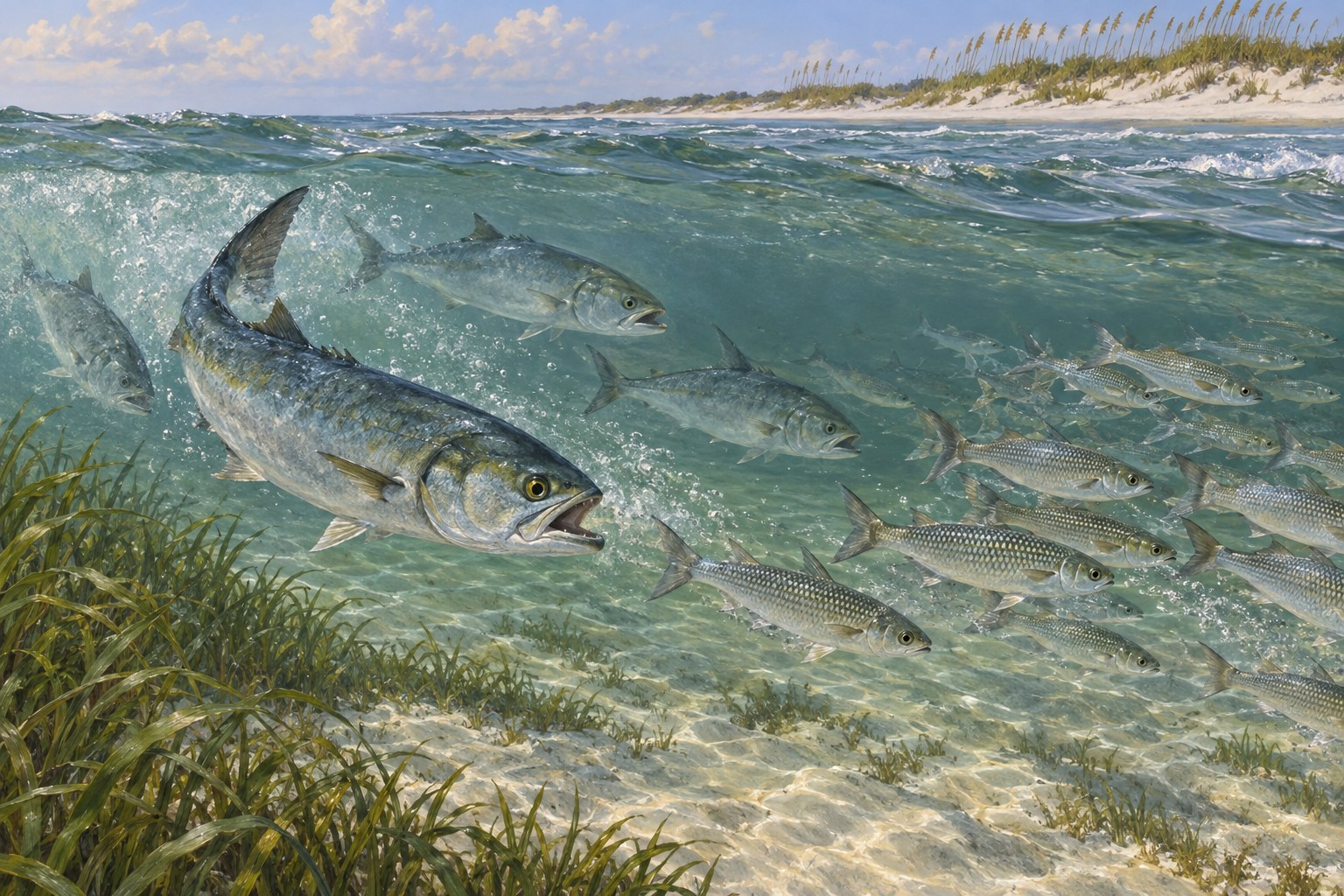
When baitfish repeatedly flee through an open lane, a small spoon or baitfish-shaped lure may interest passing predators. Match the prey you can see and vary retrieve speed gently. The method needs clear room on every cast, including a safe backswing. Property permission does not remove that responsibility.
Do not cast across swimmers, paddle craft or another group's line to follow a passing school. Fish can move faster than a beach angler can safely relocate. Put the lure away when usable space changes. Carry pliers for teeth and exposed hooks, and control the final retrieve as waves lift the lure near shore.
Keep the equipment proportional to the route
A long rod and oversized cooler may be awkward on narrow walkovers or a public alternate's parking route. Choose a manageable outfit with a safe casting range for the weight required. Start with one closely attended presentation. More rods add no value when they cannot remain within the clear permitted water.
Secure spare hooks before walking through the neighborhood. Take a measuring tool, pliers, water and a sealed container for clipped line. The following comparisons help separate access confirmation from the tackle decision. A successful permission check does not prove good fishing conditions, and a good-looking trough does not prove lawful access.
| Decision | What establishes it | What does not |
|---|---|---|
| Use a Rosemary beach route | Specific current authorization | A shopping or restaurant visit |
| Fish on a permitted stretch | Current activity rules and clear space | An old catch photograph |
| Choose a public alternative | Named open official access | An unmarked shortcut |
| Select a surf rig | Rod rating, current and target food | The number of spare rods available |
Use the weather as a reason to adapt
Spring and fall can bring seasonal pompano interest, summer adds hot crowded beaches and storms, and cooler fronts can change clarity quickly. Those broad patterns help prepare a trip. They cannot establish whether the particular stretch you may use is manageable on the day. Observe flags, waves and line movement.
A tide prediction is useful for scheduling but does not describe every bar current. If the rig sweeps out of the safe lane, retrieve it. If wind or thunder builds, leave time for the return across the authorized or public crossing. A short controlled outing is better than staying because the rental calendar leaves little flexibility.
Keep the harvest choice separate from access permission
Property access and fish harvest are two different checks. Identify the species accurately and use current size, season and bag requirements. Pompano and similar young fish can be confused. When uncertain, release promptly instead of adopting a rule that may belong to another species. Have an appropriate measuring method ready.
Remove all tackle scraps and personal belongings after the session. Do not leave an outfit for a later beach return, and follow the property manager's conditions on the way out. Rosemary can be an enjoyable base for coast exploration when fishing is anchored to a specific lawful route and responsible behavior at the water.
Common questions
Is Rosemary Beach a public fishing beach?
Walton County Tourism lists no public beach access. You need specific authorization or a separate designated public destination.
Does town parking grant access to the Gulf?
No. Parking to visit shops or restaurants does not establish a private beach route.
Can guests assume all fishing activity is permitted?
Ask the property manager about the exact access and activity conditions for the stay.
Where can someone without private access plan an alternative?
Inlet Beach Regional Beach Access is a separate public option nearby. Confirm its present conditions and clear casting space.
Prepare for your visit
Check local tides and weather. Read more about florida pompano, whiting, permit. Check current FWC saltwater fishing rules.