
PANHANDLE
Big Lagoon State Park
fishing guide
Big Lagoon offers a sheltered-water fishing plan near Pensacola. Its marsh edges, sandy shallows and tidal routes suit a different approach from the nearby Gulf surf. Check the park's closure notice before planning a visit.
Explore the guide ↓Check the park gate before choosing a fishing day
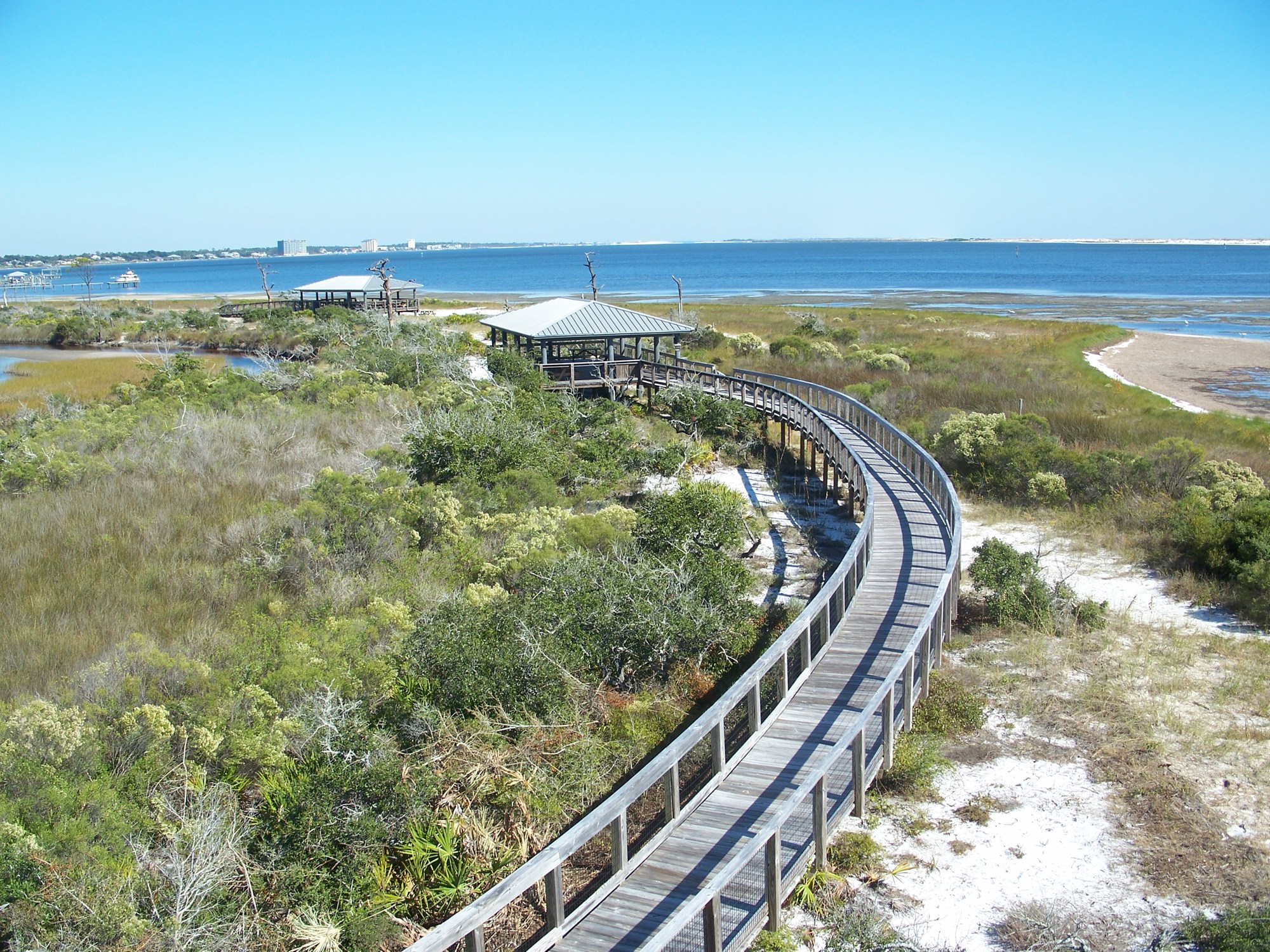
Big Lagoon State Park is on the mainland at 12301 Gulf Beach Highway. It faces sheltered coastal water north of Perdido Key. It is a separate destination from the open Gulf beaches on the barrier island.
When checked on October 11, 2026, the park's official pages displayed a storm closure notice. Treat that notice as a reason to confirm reopening with the park at 850-492-1595. The normal schedule does not override a closure.
The usual day-use schedule is 8 a.m. to sunset. The park lists shore fishing, a boat ramp and a hand launch for kayaks. Choose an open designated route after reopening. A boardwalk or observation platform is not automatically an approved casting station.
A lagoon outing begins with the return plan. Find the launch or beach access from the water before moving away. Keep an alternate open landing in mind, and do not rely on crossing marsh plants to shorten the trip.
Look for changes in the shallow bottom
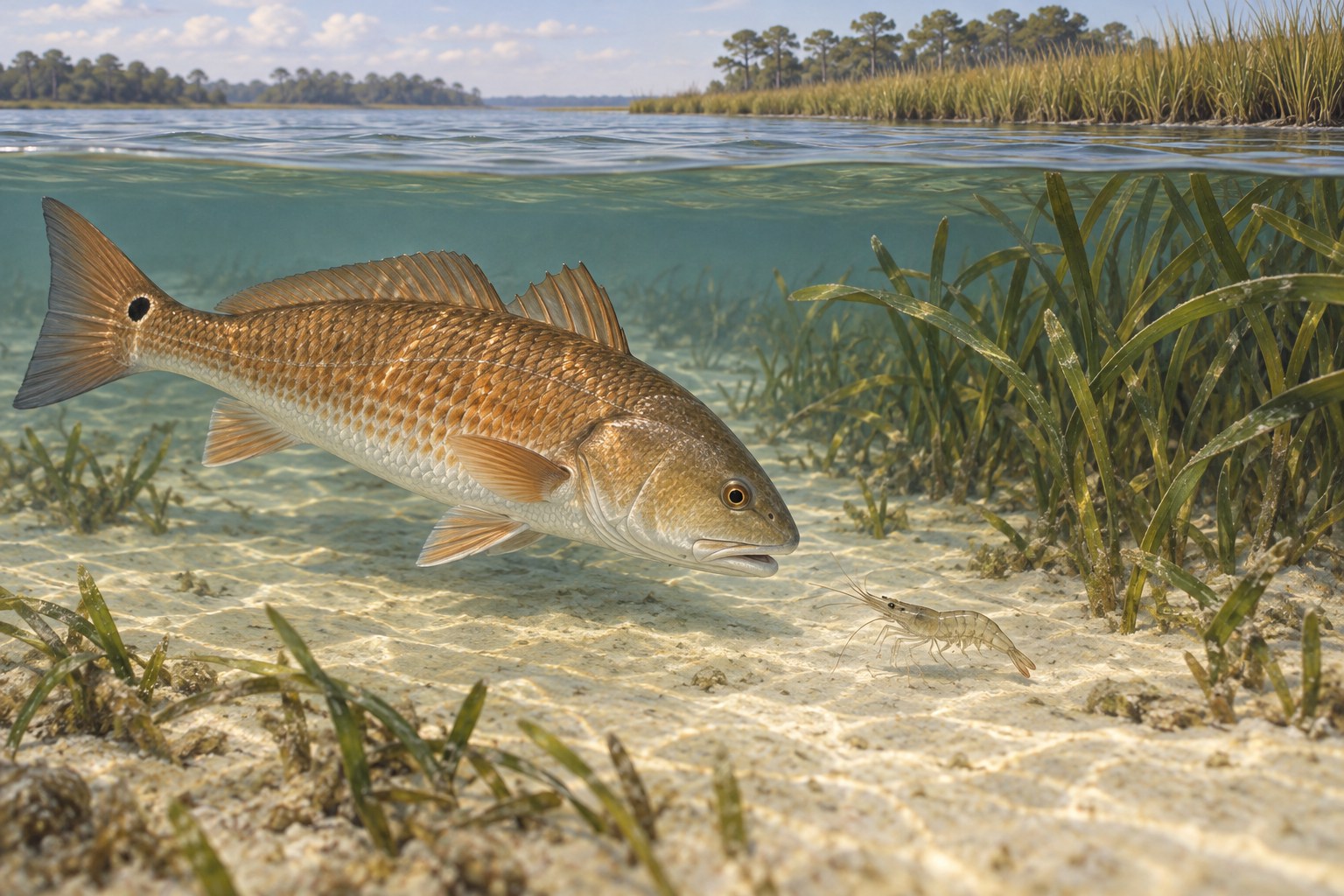
A flat surface can hide useful differences below it. A pale patch beside darker submerged vegetation may offer a feeding lane. A bank that drops into a channel can give fish a short route between shelter and moving food.
Watch for small baitfish dimpling the surface or shrimp moving near the bank. A single splash proves little. Several signs along the same edge are a better reason to slow down and work that section.
Do not drive a boat across a shallow patch simply because you can see water over it. Seagrass can be damaged by propellers and repeated grounding. In a kayak, lift the paddle clear of the bottom rather than dragging through living vegetation.
Present shrimp where redfish can find it
Redfish search coastal shallows for small fish and crustaceans. A live shrimp or a compact shrimp imitation is a sensible starting point beside a recoverable sand edge. Keep the offering close to the route the fish would use.
A float can suspend shrimp above vegetation. Set its depth so the bait hangs clear of the bottom. Cast gently, allow the rig to settle, then use small movements instead of splashing continuously.
With a soft plastic, retrieve just fast enough to avoid digging into the bottom. A tail that moves on a slow retrieve can be useful in quiet water. If the lure returns with grass on every cast, reduce its weight or choose a cleaner lane.
Give seatrout room above the grass
Spotted seatrout often hunt over mixed grass and sand. A suspended shrimp or a small baitfish-shaped lure can pass above that cover. Look for an open path through the feeding area rather than aiming into the thickest vegetation.
Begin with a steady retrieve, then try a brief pause. Keep enough line tension to feel a bite without pulling the lure upward. A small change in pace tells you more than replacing every piece of tackle at once.
Trout have mouths that can tear under heavy pressure. Use a smooth drag and a suitable landing net. Wet your hands before supporting a released fish, and keep the handling interval short.
Adjust for flounder and fast surface feeders
The park lists flounder and bluefish among its seasonal fishing opportunities. Flounder are bottom-oriented fish. A slow, controlled presentation along a sandy channel margin differs from the quicker lure used for bluefish.
Bluefish can strike small fish-shaped lures near visible prey. Their teeth make careful handling important. Use pliers to remove hooks and never put a finger into the mouth to secure the fish.
A channel edge can also be a boat route. Cast from a position that keeps the line away from navigation traffic. A promising current seam is not useful if you cannot retrieve your tackle safely.
Build a light kit around the lagoon
A medium spinning outfit is enough for many ordinary inshore presentations. Match line, leader and hook to the bait and nearby cover. Stronger tackle can help around rough structure, but it cannot make an unsafe casting position acceptable.
Carry a float rig, a small jig and a few spare leaders. Keep shrimp cool and protected from direct sun. A small bait container is easier to manage than a heavy bucket on an exposed shoreline.
Use the table as a starting guide to presentation. Fish are not guaranteed at any listed habitat, and the choice to keep a catch depends on the current rules.
| Situation | Starting approach | Useful adjustment |
|---|---|---|
| Sand beside vegetation | Shrimp under a float | Shorten depth if the hook catches grass |
| Visible bait above an edge | Small soft plastic | Try a pause between steady retrieves |
| Clean channel margin | Bottom-oriented jig | Reduce weight if it drags into snags |
| Surface fish chasing prey | Compact baitfish lure | Keep the cast clear of passing boats |
Let wind change the route, not just the lure
Sheltered water can still become rough when wind blows along a long open reach. Look at the direction of the waves before launching. A calm bank at departure may be harder to reach on the return journey.
Tide predictions describe expected water level at a station. They do not prove the exact current speed beside a marsh corner. Combine the forecast with visible movement, wind and the amount of water over the shallow route.
After a cold front, slow the presentation and examine nearby deeper water from a safe legal position. During hot weather, protect yourself from heat and keep released fish handling brief. Neither weather pattern guarantees a bite.
Keep a kayak session small and manageable
Use the hand launch only when it is open and suitable for the day's water level. Wear your life jacket from the start. Secure tackle so a hook cannot swing into your hand while entering or leaving the kayak.
Set a modest turnaround point before fishing. Carry drinking water, sun protection and a way to communicate. Share the route and expected return time with someone on land.
Avoid anchoring across a boating channel. If wind and current pull in different directions, assess the load before putting an anchor down. A drifting lure presentation may be easier to control in a suitable open area.
End the trip with a clean shoreline
Check the applicable license, species identification, size limits and open harvest season before keeping any fish. Nearby Gulf water and an inshore lagoon do not make every rule interchangeable.
Pack discarded line into a closed container. Check the launch and picnic area for loose hooks before leaving. Small tackle is easy to miss and can injure birds or the next visitor.
For a first visit after reopening, choose one open shoreline section and one simple rig. Record the water clarity, wind and successful retrieve pace. That practical note is more useful for the next outing than assuming the whole lagoon fishes alike.
Common questions
Is Big Lagoon the same as Perdido Key State Park?
No. Big Lagoon is on the mainland beside sheltered water. Perdido Key State Park faces the Gulf from the barrier island.
Can I fish during a posted park closure?
No. Confirm that the park and your intended access route have reopened before visiting.
What is a good first bait here?
A small live shrimp is a practical inshore choice. Suspend it above vegetation or present it along an open sandy margin.
Does a high tide guarantee better lagoon fishing?
No. Water movement, wind, prey and access depth matter together. Observe the actual conditions beside your chosen shoreline.
Prepare for your visit
Check local tides and weather. Read more about spotted seatrout, flounder. Check current FWC saltwater fishing rules.