
HookCurrent Florida fishing
Flounder
Find flounder along sandy edges, inlet channels and estuary drains. Learn species identification, slow presentations, useful rigs and careful landing methods.
Paralichthys species

Which flounder are you catching?
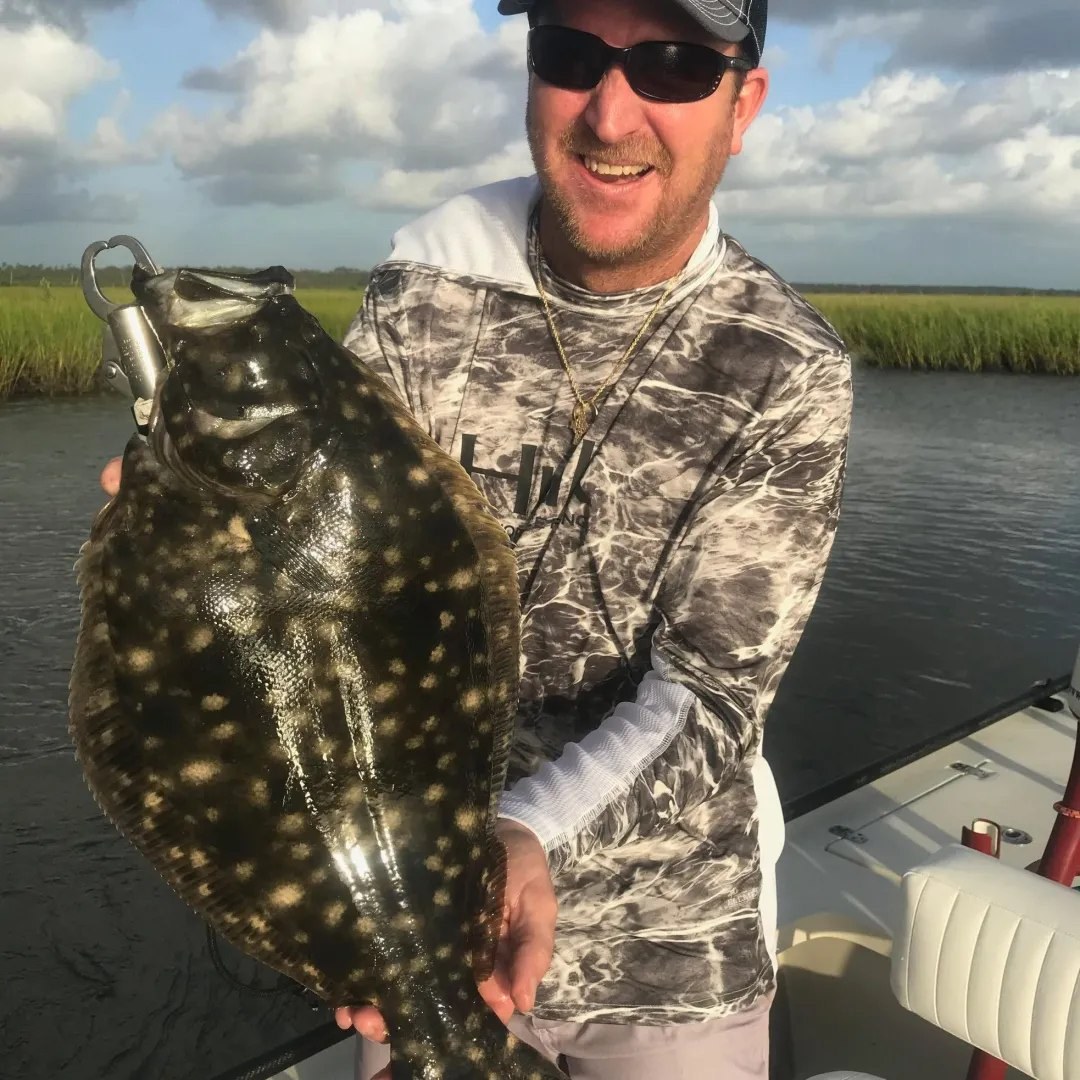
Southern flounder and Gulf flounder are important Florida species. Both are left-eyed flatfish: the adult's two eyes sit on the colored left side. Southern flounder have irregular dark blotches without the three conspicuous eye-like spots typical of Gulf flounder.
Gulf flounder usually show three prominent spots arranged in a triangle. Summer flounder, more associated with waters farther north, have a different pattern of eye-like spots. Markings can be difficult to read on a wet, partly buried or darkened fish.
Do not turn the fish over repeatedly or rub away its protective coating to inspect it. A quick side view on a wet measuring surface usually provides better information than holding it vertically while debating the pattern.
How a flatfish becomes flat
A newly hatched flounder does not begin life looking like the adult. During development, one eye moves to the other side of the head and the fish adapts to life lying on the bottom. The upper side becomes the camouflaged surface seen by predators and anglers.
The adult can adjust its appearance to the surrounding bottom. This helps it hide both from prey and from larger fish. The pale underside is not the side normally exposed while the fish rests.
The unusual body plan is practical. A buried fish can watch above the sediment, then lunge a short distance at food. Fishing advice makes more sense when it starts with that behavior rather than treating flounder as ordinary cruising fish.
Bottom features that matter
Sandy channel edges, small drop-offs, creek mouths, inlet margins and transitions between shell and softer bottom are useful places to search. A tiny change in depth can create an ambush position. The feature does not need to be large enough to appear on a basic map.
Southern flounder use estuaries and brackish water, including tidal creeks. Gulf flounder are often associated with sand near grass and coastal structure. Local habitat and species mix affect where an angler is most likely to find fish.
Look for places where prey must cross a narrow route. A drain emptying from a flat or the edge of a small channel can deliver food predictably. Randomly dragging bait across a broad featureless area may find fish, but it provides fewer clues for repeating a catch.
Seasonal movement and the fall connection
Flounder movements connect estuaries, passes and offshore spawning habitat. Seasonal cooling can increase attention on inlets and channel routes as fish move. The timing and strength of these movements vary by region and species.
Not every flounder leaves the same creek on the same tide. Weather, fish size and local conditions affect availability. Treat fall movement as a reason to examine connecting habitat, not as a guarantee that every inlet will be full of fish.
Florida's harvest closure also overlaps part of the period anglers associate with movement. Check the current dates before planning to keep fish. A traditional fall fishing story does not override today's closure.
Spawning and nursery water
Spawning occurs offshore, while estuary and shallow coastal habitats help support growing fish. Early life stages are influenced by currents and the availability of suitable settling areas. Young flounder need food and shelter long before they become a harvest-sized catch.
Changes to creek mouths, grass beds and water quality can therefore affect the fishery beyond the immediate shoreline. A productive inlet depends in part on the wider system connected to it.
Avoid disturbing shallow nursery bottom unnecessarily. Running a propeller through a small flat or anchoring repeatedly in vegetation damages more than the exact patch where the boat stops.
What flounder eat
Small fish are important prey, along with shrimp and other suitable animals. Mud minnows, small mullet, shrimp and locally available baitfish are familiar angling choices. The fish wants a meal close enough to capture with a short burst.
A bait that swims just above the bottom can be more convincing than one dragged in a heavy cloud of sediment. Keep it lively and appropriately sized. Very large baits can reduce bites from smaller fish but may also be harder to present properly.
Watch for prey moving along the shoreline or leaving a drain. If small fish repeatedly pass one sandy edge, that is a better reason to stop than a vague report that flounder live somewhere in the bay.
Tackle for feeling the bottom
A medium spinning rod with a responsive tip works well for many shallow-water situations. Around 10 to 20 pound braid can help an angler feel bottom contact and subtle changes in weight. A leader selected for shell and structure protects the final connection.
Avoid choosing a rod so stiff that every small movement jerks the bait away. At the same time, a very soft outfit may struggle with heavy current and a large sinker. Match the rod to the presentation and depth.
Use a landing net with a hoop large enough for a broad flat fish. Flounder sometimes shake loose beside the boat because the angler tries to lift them by the line. The net should be ready before the fish becomes visible.
Live-bait rigs
A sliding sinker rig lets the weight maintain bottom contact while the bait moves on a leader. Keep the leader long enough for movement but short enough to control around snags. More leader length is not automatically more natural in strong current.
A jig head can simplify the connection and provide direct feel. Choose the lightest head that reaches the useful depth with control. If it buries into soft bottom on every pause, reduce weight or change the angle.
For a dropper rig, hold the bait near the bottom rather than far above it. The exact height should fit the fish's position and the bottom type. Keep the hook point clear and use the hook style appropriate to the current rules and your method.
Working a soft plastic
A small paddletail, shrimp imitation or scented soft bait can be effective when moved slowly near the bottom. Cast beyond the target edge, let the lure settle, then move it with short controlled lifts or a gentle crawl.
The goal is contact without constant snagging. If the lure catches every rock, shorten the movement, alter the casting angle or use a more suitable head. If it never touches bottom, it may be too light or moving too quickly.
Pause when the lure enters a promising depression. A flounder may strike during that pause or as the bait begins to move again. Keep enough attention on the line to notice a sideways twitch or an unusual heaviness.
Recognizing the bite without waiting too long
A bite can feel like extra weight rather than a sharp hit. Before assuming it is weed, maintain gentle contact and see whether the resistance moves. Fish can also tap the bait clearly, especially with smaller offerings.
Old advice sometimes encourages a long wait before setting the hook. That can increase deep hooking. Instead, match the response to the hook: reel steadily into a circle hook, or use an appropriate controlled set with a conventional hook once the fish has the bait.
If fish repeatedly drop the bait, inspect its size and rigging. A compact offering with an exposed point may improve hookups without requiring a longer swallowing delay.
Fishing an inlet edge
Start with a manageable current stage and a safe position. The deepest center of an inlet may not be the best place for a small boat or a shore angler. Adjacent sand edges and slower seams can be both more fishable and more suitable for the presentation.
Cast so the bait crosses the edge naturally. A controlled drift along the contour often gives more time in the feeding zone than a cast straight across it. Keep clear of navigation routes and other vessels.
Wind opposing a strong tide can make an inlet dangerous quickly. A promising flounder pattern is not a reason to cross a breaking bar or stand on wave-washed rocks. Choose sheltered connected water when conditions demand it.
Finding fish from shore
Public shoreline beside a creek mouth, a permitted fishing pier near sand, or a beach access near a suitable channel can provide opportunities. Walk slowly and make deliberate casts across small bottom changes.
Do not assume the fish are beyond your longest cast. Flounder can sit close to an edge where bait gathers. Work the near water first before wading through it.
Wading introduces soft-bottom, drop-off and current hazards. Carry only manageable gear and keep a route back to shore. If you cannot judge the bottom safely, fish from a stable legal position instead.
Florida regions to investigate
Northeast Florida's tidal creeks and inlets provide useful flounder habitat. Panhandle bays and passes offer another set of estuary-to-coast connections. Tampa Bay and other Gulf estuaries can produce around sand, shell and channels.
The St. Augustine, Pensacola Beach, Destin and Tampa-area guides are useful starting points for comparing access. Check actual bottom conditions on arrival. A storm can move sand and change a channel edge without changing the name on the map.
Landing a broad, slippery fish
Bring the fish toward a submerged net headfirst and lift the net once the whole body is inside. Avoid chasing it repeatedly with the hoop. A last-second burst is common enough that patience matters.
Keep a release fish on a wet surface only as long as necessary to measure or unhook. Support the body rather than suspending it from the jaw. Pliers help keep fingers away from the sharp teeth.
If keeping a legal fish, chill it promptly. Thin body shape does not make a fish immune to warm weather or poor cooler care. Prepare storage before the bite becomes busy.
Florida rules and seasonal closure
Florida's flounder rules cover several flounder species. Check the current minimum size, daily limit, seasonal closure and allowed gear before heading out. The FWC page is more reliable than an undated pier sign or an old social post.
Pay attention to the closure when planning autumn trips. Catching a fish and keeping it are different decisions. Where fishing is allowed but harvest is closed, be prepared for quick release and avoid methods that cause repeated injury.
Flounder questions answered
Why are both eyes on one side?
One eye moves during early development as the fish adapts to resting on the bottom. The adult's colored side faces upward.
Is a heavy thump the normal bite?
Not necessarily. Extra weight, a small tap or sideways line movement may be the only clue.
Should I wait a long time before setting?
Long delays can lead to swallowed hooks. Use an appropriately sized bait and respond according to the hook style instead.
Can I catch them with artificial lures?
Yes. Soft plastics and jigs worked near the bottom can be effective, especially when the angler controls speed and depth carefully.
Why do I lose fish at the boat?
Their broad bodies and final head shakes make lifting by the line unreliable. A ready landing net improves control.
Is the fall run automatically open for harvest?
No. Florida has a seasonal closure. Verify the dates and current rules before planning a cooler trip.
Match your approach to the water
| What you find | An option to try | The detail that matters |
|---|---|---|
| Sand beside a channel lip | Small jig with a baitfish profile | Keep contact without plowing deeply into the bottom. |
| Gentle flow near a pass | Live bait on a controlled bottom rig | Let the bait move through the ambush lane. |
| Repeated bites at one tiny feature | Short repeat casts | Work the productive edge before making a long move. |
Plan a flounder trip
Local access guides for flounder trip planning: St. Augustine, Pensacola Beach, Tampa.
Tides and weather · Florida fishing charters
Read the current FWC rules for flounder.
Rules review: October 4, 2026.
Research and photograph credits · All fish species · Return to the beginning