

SOUTHEAST ATLANTIC
Hillsboro Beach
fishing guide
Hillsboro Beach lies beside an Atlantic shoreline and a well-known inlet lighthouse, but much of the surrounding access is private or separately managed. Plan from confirmed public entry and legal fishing space rather than treating a lighthouse view as permission to reach it.
Explore the guide ↓Separate the town beach from lighthouse and inlet property
Hillsboro Beach is a coastal town near Hillsboro Inlet. Its name appears in photos of oceanfront buildings, the lighthouse and nearby water, but those scenes do not all provide public angling access. Confirm the actual entrance and managing authority before carrying a rod.
Do not walk through private residential grounds or assume that lighthouse property is an open fishing station. Lighthouse visits have their own arrangements. A tour or photograph cannot establish permission to angle from surrounding land.
The opposite side of the inlet includes Pompano Beach facilities with separate park and pier information. A location described broadly as Hillsboro Inlet may therefore be reached through a different municipality. Choose the specific authorized facility instead of searching for an unmarked shortcut.
Ask the town or managing beach staff about current surf-fishing permission and timing at the route you intend to use. This guide explains habitat and methods without claiming unrestricted access along the entire shoreline.
Use a legal sandy lane for the simplest plan
Where beach angling is confirmed, watch several wave sets for a trough inside a bar. Small prey can move along that lower strip of sand. A close controlled cast may reach more useful water than a long cast into an uncertain patch.
Begin with a rig that can hold and return cleanly. Look for weed, shell and leader wear on retrieval. Those observations help identify the actual presentation problem.
A sandbar remembered from an earlier trip can change after storms or fronts. Re-read the water rather than using a building on land as proof of a fixed bottom lane. Keep the standing position on secure shore.
Do not wade toward inlet flow or climb hard features to extend range. A legal entrance does not make every surface beyond it a safe fishing platform.
Offer compact prey to surf feeders
Whiting and Florida pompano are possible targets over suitable coastal sand. Small shrimp pieces, sand fleas or durable prepared strip bait are practical choices. Keep the point visible and the bait from spinning on a long loose leader.
A short dropper with a steady sinker can test the near trough. Use enough weight for the current without making the cast difficult. Retrieve if the rig starts moving toward another person or outside the approved lane.
Refresh soft bait after light bites or a quiet period. Small fish can strip a hook without a strong pull. A firmer comparison or smaller neat portion may be more useful than adding extra bait.
A simple single-hook setup is a good learning tool. It is easier to inspect and pack than a multi-hook rig tangled with weed.
Search open shoreline water for snook or jacks
Snook can follow bait along suitable warm South Florida beaches. A small swimming plug or soft plastic can search an approved clear lane. Look for the direction of prey before choosing a cast.
Bring the lure ahead of a cruising fish's route rather than dropping it onto the fish. Keep it above sand and adjust pace if a fish follows without taking it. Reduce repeated splashes in calm shallow water.
Jacks or mackerel may appear with schools of small fish. Use a compact lure only where the whole route stays clear of people, birds and other lines. A school moving toward private or restricted frontage should be left alone.
Check leader damage and prepare a supported release before the bite. Do not let an uncertain access position create an equally uncertain landing plan.
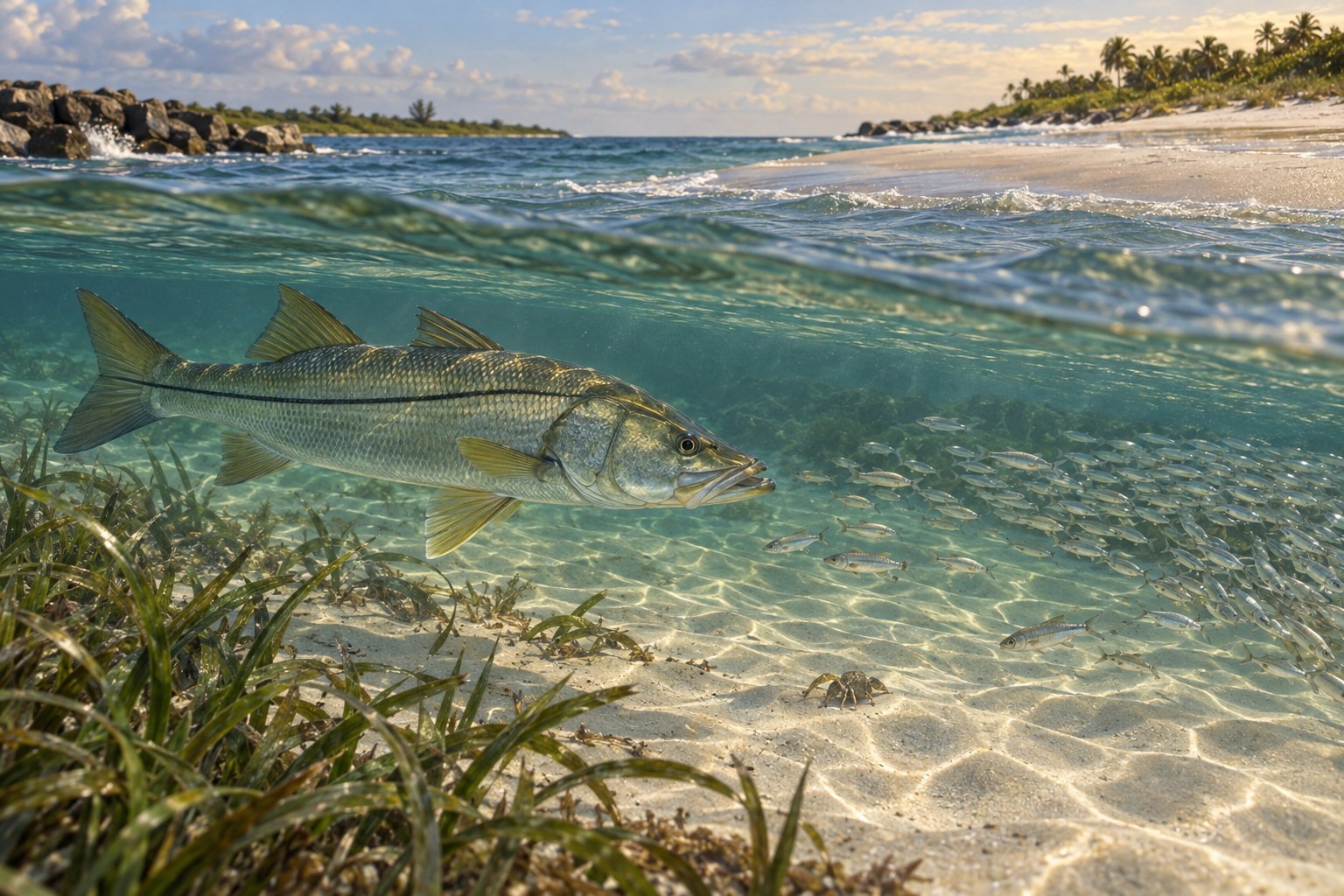
Treat the inlet as a more demanding separate setting
An inlet concentrates tidal exchange, vessel movement and structural edges. Its strongest flow may be difficult to fish safely with a light beach setup. Choose only a confirmed permitted position with secure footing and a recoverable drift.
A slow seam beside faster water can be a useful feeding-habitat idea. Watch foam and bait to see where the offering would travel. Avoid casts across a navigation route.
Never use the lighthouse view as a shortcut to inlet rocks or private land. If the approved position cannot support safe casting and fish release, select another facility. The Pompano guide covers a defined ocean fishing pier with its own rules.
The conceptual illustration describes prey moving near an inlet edge. It is not a route map or permission to stand on a particular pictured structure.
Choose a destination with a clear access answer
The best first question is where the angler can legally stand. Bait selection becomes useful after that question has a reliable answer.
| Proposed visit | Confirm first | Then plan |
|---|---|---|
| Town surf section | Public entrance and fishing permission | Compact sand-bait method |
| Lighthouse visit | Current visitor arrangement | Observation and photography |
| Inlet-edge fishing | Permitted facility and safe footing | Controlled drift and landing route |
| Pompano fishing pier | Current admission and pier rules | Facility-approved bait or lure setup |
Keep the nesting coastline undisturbed
The Hillsboro coastline is used by nesting sea turtles. Stay clear of marked nests and leave no holes, line or equipment that can obstruct wildlife. Keep lighting modest and follow local directions during turtle activity.
Do not use bait to draw birds or other animals close. Secure unused hooks and retrieve if wildlife enters the presentation lane. Contact trained help if an animal becomes hooked or entangled.
Use established paths rather than cutting through dune plants. A short route made by one visitor can become damage when others follow it.
Plan for the actual shore rather than the scenic photograph
A calm photo may have been taken in very different conditions. Wind can increase surf and move weed across the beach while inlet current remains strong nearby. Check weather, tide and the water at arrival.
Warm-weather snook and cooler-season surf patterns are broad clues. Bait, clarity and permitted space decide whether a method fits. Keep a short note specific to the access used rather than labeling every inlet-side catch as Hillsboro Beach.
Bring water, pliers and spare leader in a compact bag. Secure footwear and a practical return route matter more than another lure color when the setting is unfamiliar.
Keep the catch decision separate from the excitement
Identify potential keepers and verify current FWC licensing and harvest requirements. Support release fish with wet hands and limit air time. Avoid dragging them across rock or dry sand for a photograph.
Pack hooks before leaving the legal position and collect every clipped leader. If access was unclear or too limited, record that honestly and choose a better-defined facility next time.
Common questions
Can I fish from lighthouse property because it faces the inlet?
Do not assume that. Lighthouse visits and surrounding land have separate access arrangements, and a water view does not establish fishing permission.
Is every Hillsboro inlet fishing location in the town?
No. Nearby facilities on the opposite side can be managed by Pompano Beach. Plan around the exact authorized location.
What should I confirm before a surf trip?
Find the public entrance and ask about current fishing timing and boundaries. Then choose a method for the legal clear lane.
Does the illustration show where to climb onto inlet rocks?
No. It teaches a feeding-habitat idea and does not provide an access route or authorize a standing position.
Prepare for your visit
Check local tides and weather. Read more about snook, florida pompano, whiting. Check current FWC saltwater fishing rules.