

SPACE / TREASURE COAST
Indian Harbour Beach
fishing guide
Indian Harbour Beach fishing guide with ocean parks, Oars and Paddles launch rules, the Gleason Lake restriction and lagoon tactics.
Explore the guide ↓Choose ocean sand or a planned lagoon route
Indian Harbour Beach sits between Atlantic surf and the Banana River side of the lagoon system. Those nearby waters call for different fishing plans. The ocean favors sand-trough baits, while a lawful small-craft route can reach estuary edges with different fish and presentation needs.
Begin by choosing an access rather than simply a body of water. Public parks, launch docks and private waterfront do not all provide the same permission. A visible shoreline on a map may not offer any legal place to stand.
For a first beach session, whiting and pompano are sensible targets when the surf is manageable. Redfish, trout and black drum are possibilities in suitable estuary habitat, but reaching them requires the correct route and equipment.
Use the city’s established beach parks
Bicentennial Beach Park is listed at 2 Ocean Dunes Drive, with a boardwalk, bathrooms and outdoor showers. Millennium Beach Park is at 2155 Florida A1A and also provides a boardwalk and visitor facilities. Check current notices for any construction or temporary access change.
Use the designated crossing to reach the sand. Do not cut through dune vegetation because a cart is awkward to carry. Pack according to the actual route, with enough room to move if the beach becomes crowded.
Choose a fishing lane away from swimming and surfing activity. These parks serve many kinds of visitors, so a clear stretch early in the morning may not remain clear later.
Parking and facility conditions should be checked at the entrance. A pavilion reservation or general park listing does not establish permission to fish from every structure or at every hour.
Gleason Park’s lake is not a fishing substitute
The city’s Gleason Park information states that fishing is not allowed in its lake. Do not treat it as an easy freshwater backup when ocean conditions are poor.
This distinction matters because a park can have attractive water, wildlife and walking paths without being a fishing access. Read the activity rules before unpacking a rod.
If the planned beach session is unsuitable, choose another verified fishing location or enjoy the park without fishing. Changing the activity is better than assuming a nearby pond is available.
Oars and Paddles is a launch facility
Oars and Paddles Park at 1329 Banana River Drive provides a floating public launch for paddling and rowing, with access through Whiting Waterway toward the Banana River. The city does not offer canoe or kayak rentals there.
The dock’s stated purpose is launching, so do not assume it is a fishing platform. Keep it clear for paddlers and the rowing program. Confirm the current fishing and launch arrangements before bringing equipment.
The city prohibits motorized boats from mooring or docking at that dock, even though privately owned motorized boats may use the canal. A launch designed for paddling should not become a tie-up point for a powered fishing boat.
A fishing kayak outing begins after the launch question is settled. It still needs a safe route, suitable weather and permission for the water and activities involved.
Think about the bottom when targeting black drum
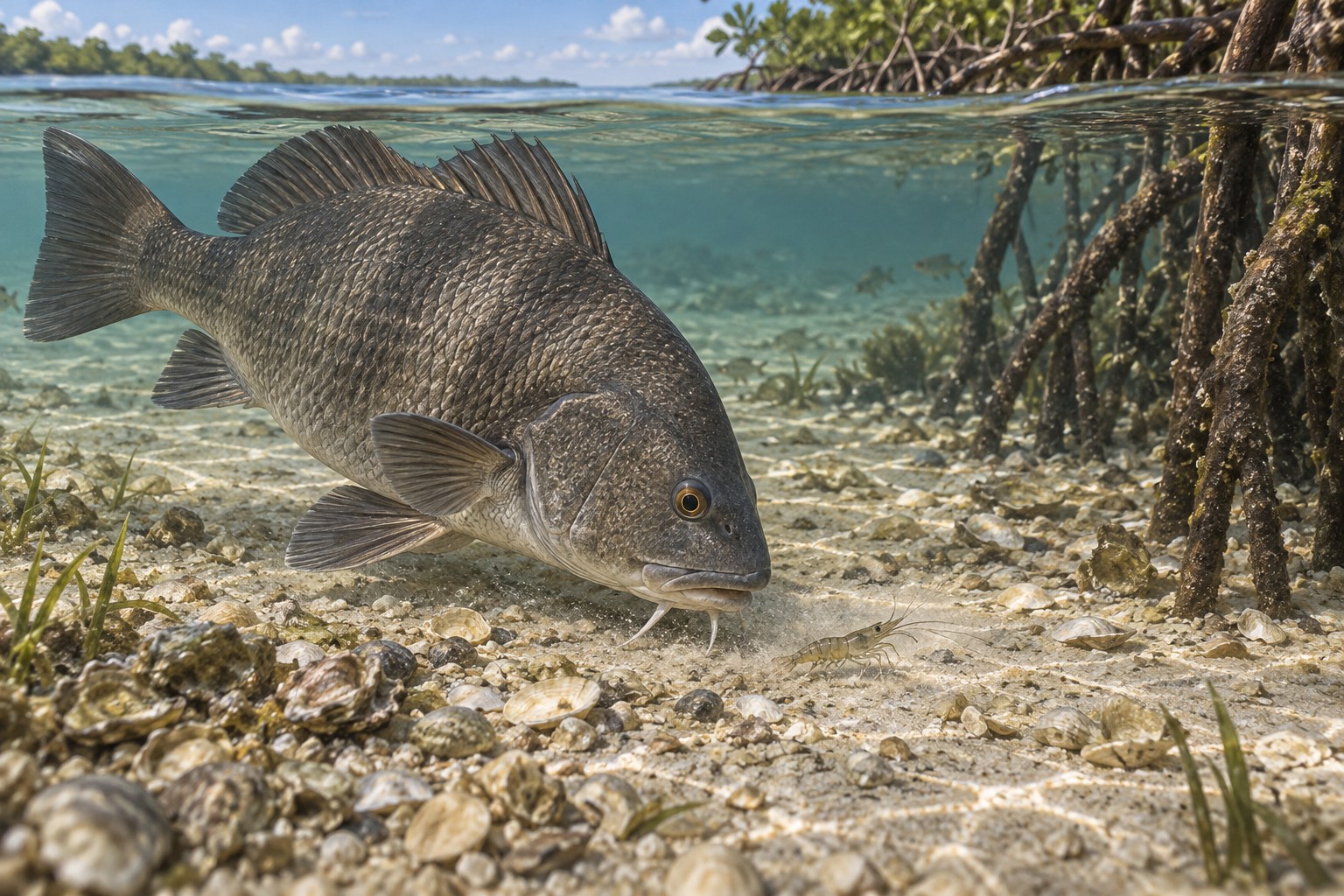
In suitable lagoon habitat, black drum may search near shell, edges and other bottom features for food. A shrimp bait presented close to the lower water can be useful. The illustration describes that habitat relationship rather than a guaranteed catch at a named dock.
Keep the bait compact and allow time for it to be found. Too much drifting can move it away from the intended area, while excessive weight can bury it in soft bottom. Adjust according to the actual lane.
When the line tightens, apply steady pressure and keep the fish clear of nearby cover. Do not assume a large drum can be safely handled with a small landing tool. Match the target to the equipment.
Inspect the leader after shell contact. A frayed section deserves replacement before the next cast.
Keep each location’s role clear
| Place or setting | Useful role | What not to assume |
|---|---|---|
| Bicentennial or Millennium beach access | Reach the Atlantic through a marked crossing | Fishing is suitable beside swimmers |
| Oars and Paddles launch | Begin an authorized paddling route | The dock is a fishing pier or motorboat berth |
| Gleason Park lake | Non-fishing park visit | A visible pond is open to anglers |
| Lawfully reached lagoon edge | Explore suitable estuary habitat | All residential shoreline is public |
Separating these roles avoids a common mistake: arriving at the nearest water with a rod and expecting the facility to fit the activity.
Start the ocean session close to shore
A first trough may sit inside the main breaking bar. Watch several wave sets to locate it, then make a moderate cast with a small shrimp bait. Whiting can feed in water that does not require a long-distance outfit.
Check for bait loss after small taps. Use a short piece with the hook point clear rather than a soft bundle that hides it. Repeat a successful distance before moving the next bait farther away.
Pompano may take a compact bait suspended above the sand. Sand fleas can be tried where gathering is allowed, with shrimp or prepared bait as alternatives. Keep the rig tidy and easy to cast smoothly.
If weed or current pulls the line sideways, retrieve before it enters another person’s space. A heavier sinker is useful only within the rod’s limits and only if the conditions remain safe.
Search an estuary edge with a quiet presentation
From an authorized craft, look for small prey beside a depth change. A light swimming lure can cover the open lane without dragging through plants. Slow down when the lure reaches the most promising boundary.
Redfish may travel along a shallow margin, while trout can feed in adjacent open water. Cast ahead of a route rather than directly onto visible fish. Keep noise low and avoid pressing the craft into habitat.
A shrimp under a float can stay above bottom clutter. Set the depth for the actual water and adjust if the bait drags. A fixed setting that worked elsewhere may be wrong here.
Do not use soft mud as an exit route if the craft runs shallow. Plan enough water for the return and turn around before a narrow passage becomes unusable.
Wind can change both options
An easterly wind may make the ocean rough while leaving some lagoon edges apparently sheltered. That appearance does not describe the entire paddling route. Consider exposed crossings and the direction of the return trip.
Wear a life jacket when paddling and keep communication equipment reachable. Stow loose hooks before moving. Give rowing shells, other boats and wildlife a predictable amount of room.
Check the local weather and water-planning page. For another nearby ocean access comparison, read the Satellite Beach guide.
Thunder ends either plan. Pack with a quick retreat in mind and do not let a late bite delay the return to shelter.
Finish with clean tackle and careful releases
Bring a measuring device and pliers before starting. Support a released fish with wet hands and avoid leaving it on a hot deck or sand. Keep the handling routine short and organized.
Check FWC’s saltwater licensing and harvest requirements for the species and location. A public launch or beach park does not automatically supply a fishing license.
Carry clipped line, worn hooks and bait containers home or place them in appropriate bins. Keep launch space clean for the next paddler and leave vegetation undisturbed.
Keep a launch visit different from a bank visit
A kayak carries more than tackle. Before leaving shore, make sure the life jacket fits, the paddle is secure and essential communication equipment can be reached without opening several bags. A spare hook should not be loose beside a hand used for balance.
Practice organizing the fishing outfit on land. Decide where the rod rests during launching and where the lure is secured while paddling. Keeping the launch sequence simple helps avoid blocking other users at Oars and Paddles.
Once afloat, stop in a suitable clear place before changing rigs. Do not drift into another craft or a private dock while concentrating on a knot. Check the direction of travel regularly.
If the route or wind feels beyond your comfort, return early while the launch remains easy to reach. A short reconnaissance trip can still teach the layout without requiring a full fishing session.
Put the plan into practice
Before a paddle trip, test whether the loaded craft remains easy to handle at the launch. Extra rods and a heavy cooler can complicate a return in wind even when the outward trip feels simple.
Indian Harbour Beach fishing questions
Can I fish the lake at Gleason Park?
No. The city’s park information prohibits fishing in the lake.
Does Oars and Paddles rent kayaks?
The city listing says rentals are not offered. Bring suitable equipment and confirm the current launch arrangement.
Can I tie a motorboat to its dock?
No. The city’s rules prohibit motorized boats from docking or mooring there.
Which beach parks have visitor facilities?
Bicentennial and Millennium are established city options with boardwalk access and bathrooms. Check current notices before relying on a particular facility.