

BIG BEND / NATURE COAST
Keaton Beach
fishing guide
Put a careful route first on this shallow coast. Learn how grass, sand and limestone shape fishing around Keaton Beach.
Explore the guide ↓BIG BEND GRASS FLATS WITH A ROCKY SIDE
Plan the route before choosing the fishing flat
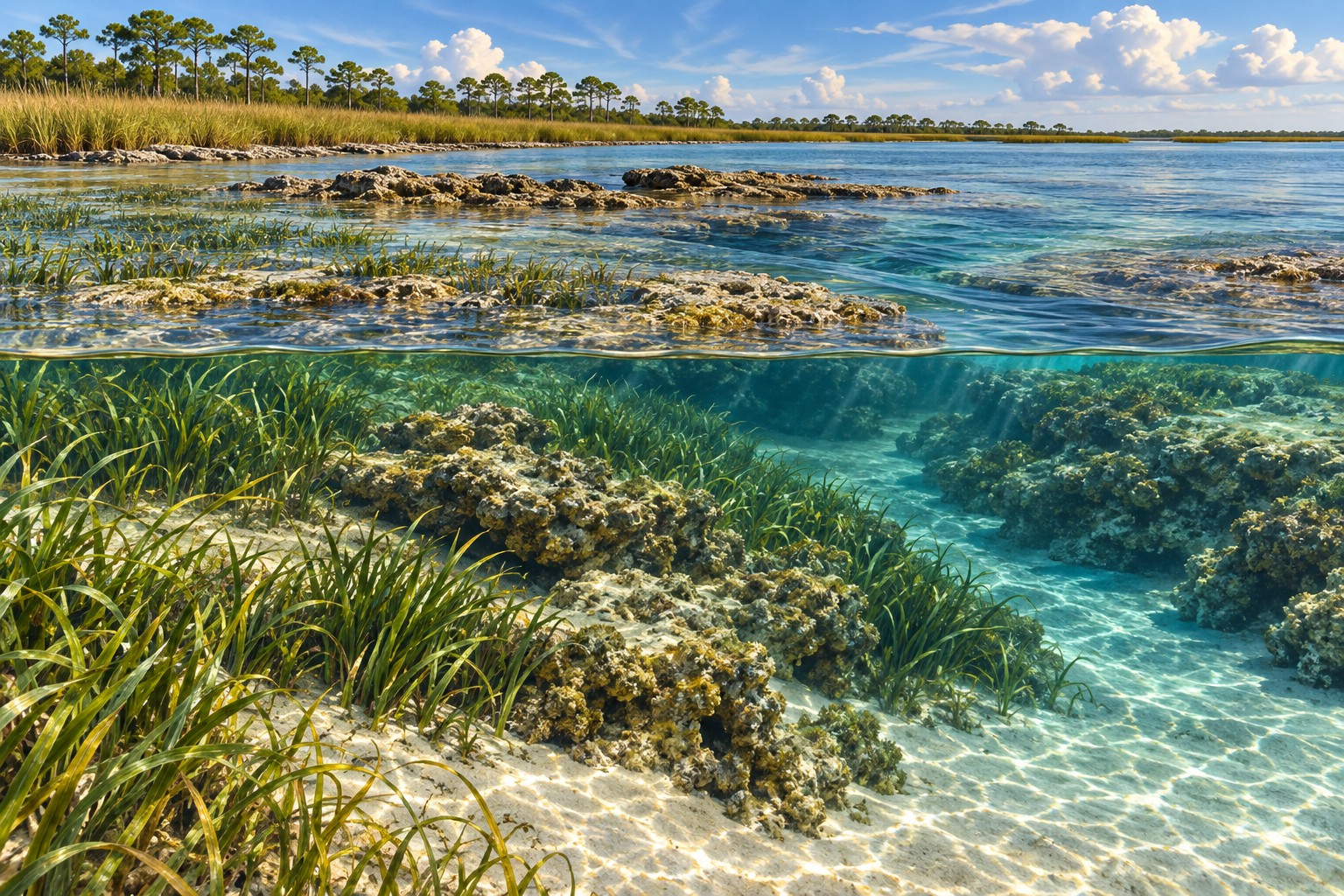
Keaton Beach is a small Taylor County Gulf community beside broad shallow water. Grass, sand and limestone create an inshore setting where a careful route is part of the fishing skill.
This is not a place to assume that open water is deep water. A distant-looking patch may still be shallow enough to damage a motor or strand a boat. Begin with current navigation information, a suitable launch and a route you understand.
The real photograph in this guide dates from 2017. It shows the coastal setting before later storms. It should not be used to judge today’s pier, buildings or launch condition.
Confirm the exact facility before driving
Taylor County’s ramp-permit information includes Keaton Beach. Check the permit that applies to your visit and the current ramp condition before arriving with a trailer. A permit listing is not a same-day guarantee that every facility is operating normally.
Hodges Park and its pier appear in older descriptions of the area. This guide has not confirmed the pier’s current operating condition. If shore fishing depends on that structure, contact the county first and have another plan.
Keep launch preparations out of the ramp lane. Loading tackle, fitting electronics and organizing passengers should happen before backing down. On busy days, a few minutes of preparation can prevent a much longer queue.
Private canals and docks are not substitute public access. If the intended public place is unavailable, change the outing rather than using someone’s property.
Understand what the bottom is telling you
Grass beds shelter food. Sand patches create openings. Limestone adds hard edges and hazards. Fish can use the transitions, but a boat should not be driven over them blindly.
Stay within suitable marked routes until you have a safe reason to leave them. Reduce speed before uncertainty becomes a problem. Do not follow another boat as proof of clearance; its draft and operator’s knowledge may differ from yours.
When fishing shallow habitat, position the craft without contacting the grass. If water falls below a safe depth, leave early. Using engine power to push through a flat can damage both the habitat and the boat.
Cover a grass edge with purpose
Spotted seatrout are a reasonable inshore target around suitable grass and depth changes. Start with a small paddletail on a light head. Retrieve fast enough to clear the grass and slowly enough to remain in the useful water.
If the lure fouls repeatedly, do not simply speed it through the surface. Try a lighter head or a different drift. The aim is a clean presentation just above the habitat.
A shrimp beneath a float is another practical method. Set the bait depth after checking the water you will cross. A float rig can drift from a deeper lane into shallow grass, so inspect and adjust as the route changes.
When several bites occur along one edge, repeat that path carefully. Avoid driving through it on the way back. The location of a bite is useful information only if you remember what the lure was doing there.
Other targets and the changes they require
| Fish | Focus | How to change the approach |
|---|---|---|
| Redfish | Shallow shore edges and feeding lanes | Use quiet casts with a weed-resistant lure or shrimp |
| Flounder | Sandy pockets beside deeper water | Slow down and keep the lure near the sand |
| Sheepshead | Suitable hard structure | Present a small crustacean bait close to the feature |
| Spanish mackerel | Active bait schools in open water | Use a compact lure and a quicker retrieve |
Do not make grouper or other offshore targets part of a casual shallow-water plan. Different depth, equipment, regulations and boating experience are involved.
Water level can change faster than the plan
Wind has a strong effect on this shallow coast. A forecast tide does not guarantee the exact depth you need at a rock or bar. Check conditions at the launch and leave a generous return margin.
Use the local tide and weather outlook before choosing the route. Pay particular attention to wind direction and a building afternoon breeze. A smooth outward trip can become a much less comfortable return.
Mark the intended route with proper navigation tools. A line on an old fishing screenshot is not enough to establish safe passage. Stay alert even when traveling a route you used on a previous visit.
Fishing through the seasons
Spring offers a chance to search warming grass with a nearby depth change. Let the first bites tell you whether fish prefer a slow swim or a longer pause. Do not assume every flat warms at the same pace.
Summer brings heat, storms and more recreational boat activity. Stay aware of swimmers and divers where present. Keep the fishing route separate from crowded water and make your own boat easy to see.
Fall can provide pleasant conditions for working several close features. A small area with bait deserves time. Long runs between familiar names may waste a short feeding window.
Winter often favors protected depth and careful timing around low water. Some days are better suited to checking access and preparing tackle than venturing onto exposed flats.
What earns space in the boat
Bring spare leader, several light lure weights and a small selection of natural-looking soft plastics. Add a float rig if using shrimp. A measuring board and landing net should be easy to reach, not buried under bags.
Required safety gear, reliable navigation and communication take priority over extra rods. Carry water and sun protection for a delay. Let someone know the intended launch and return time.
For a kayak, keep the first route short and avoid committing to a long open-water crossing. Wear a life jacket and keep a paddle available even if the craft has another means of propulsion.
Keep the shallow habitat intact
A grass scar can last longer than a fishing trip. Stop before the motor contacts the bottom and use a safe alternative route. Do not anchor directly into sensitive vegetation when a suitable sandy position is available.
Identify fish before harvest and use the Florida Fish and Wildlife Conservation Commission’s current rules to check requirements. Handle releases quickly with wet hands and avoid lifting them by the jaw alone.
Separate the travel route from the fishing drift
The path that safely reaches a fishing area may be quite different from the direction you drift through it. Plan both. Know where you can move under power and where you need to stop before entering shallower habitat.
Do not choose a return line by simply pointing at the launch. The shortest visible direction may cross rock or grass. Use the known safe route, with enough time and depth to follow it.
Keep a sensible margin around the boat’s draft. Waves, passenger movement and lower-than-expected water can remove a small amount of clearance. Barely floating over a flat is not a comfortable travel plan.
If you are unsure of a feature, slow down while still in known water and reassess. Waiting until the motor strikes leaves fewer options. Local navigation knowledge should be learned carefully, not borrowed from the wake of a stranger’s boat.
Make the first few casts diagnostic
Begin with a light lure and a consistent retrieve across a grass edge. Notice how often it touches vegetation. A clean return suggests you can fairly compare the next cast. A grass-covered hook means the lure’s path needs attention.
Over a sandy pocket, let the lure sink a little farther before moving it. Near thicker grass, begin swimming it sooner. Those small depth changes can make one lure useful across a mixed area.
If fish tap the tail without taking the hook, shorten the lure profile or reduce the pause. If a fish pulls free near the boat, use steadier pressure and a net on the next one. The answer is not always a larger hook or heavier line.
For redfish near a shallow edge, place the cast ahead of the likely travel direction. A quiet landing matters. Avoid repeated casts directly onto a visible fish that has already moved away.
Know what to save in your notes
Write down the water level, wind and type of bottom associated with bites. Note the route separately. A productive fishing point does not tell you how to reach it safely at another tide.
Keep the current facility condition in those notes too, with the date checked. A ramp that was unavailable after a storm may reopen, while an older photo may remain online indefinitely. Treat your notes as a record to update, not a permanent claim about access.
Before the next visit, check the forecast and local access again. Then choose whether the earlier plan still fits. This coast rewards good preparation as much as an attractive lure.
Keaton Beach questions
Is the Hodges Park pier confirmed open?
Not by this guide’s current research. Verify its condition before making it the reason for your trip.
Why mention the age of the photograph?
Storms have changed local facilities since it was taken. The image shows the coast, not current access conditions.
Can I follow another boat out of the channel?
That is not a reliable navigation method. Different boats need different clearance, and the other operator may know hazards you cannot see.
What is a useful first target?
Seatrout around safely reachable grass edges provide a sensible starting plan with light lures or suspended shrimp.