

TAMPA BAY / SUNCOAST
Lido Key
fishing guide
Choose a Gulf beach walk or a sheltered mangrove outing, with South Lido access details and a careful approach to Big Sarasota Pass.
Explore the guide ↓Choose between beach, lagoon and pass
Lido Key puts Gulf sand, mangrove lagoons and Big Sarasota Pass close together. That variety is useful, but it should not tempt a beginner to treat every part as equally easy water. A sheltered lagoon paddle and a pass-side fishing trip are very different undertakings.
The Gulf beach suits a walking angler with light tackle when conditions and beach use allow. South Lido provides public park access and a view of the pass. The mangrove side offers quiet habitat, with paddling routes that require attention to tide and other users.
Start with the simplest setting that fits the day. You do not need to cover the entire island to find a worthwhile fishing lesson.
Use Ted Sperling Park as a planned destination
Sarasota County lists fishing among the activities at Ted Sperling Park at South Lido Beach, at 2201 Benjamin Franklin Drive. Its published hours are 6 a.m. to 10 p.m. Check current notices and follow signs for any restricted or temporarily closed section.
The park includes beach access and other recreation facilities. Choose a fishing area that does not conflict with swimming, picnicking or people moving along the shore. A public beach address does not make every patch suitable for hooks.
Big Sarasota Pass is nearby. Stay out of the fast channel and do not wade toward deeper water to improve a cast. Current can be much stronger than it appears from the sand.
If paddling, confirm the designated launch and your planned route separately from the beach entrance. Arriving at a parking area does not automatically place you at the right launch.
Fish outside the mangrove tunnel
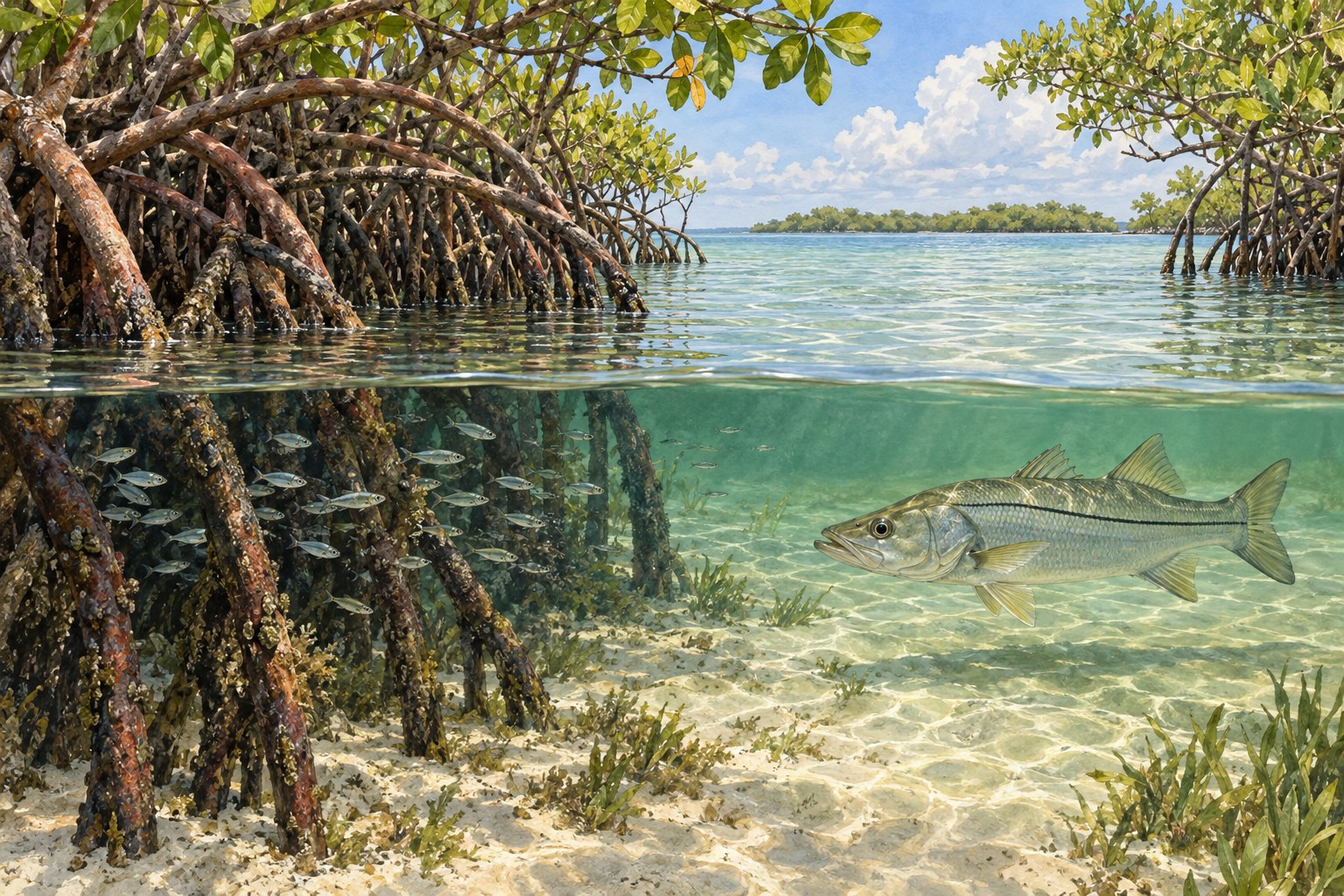
Mangrove roots provide shelter for small fish and crustaceans. The tunnel itself is often a poor place to swing a rod, especially with paddlers passing through. The wider opening outside the roots can offer a cleaner presentation and more room.
Watch the boundary between shade and sunlight. Small prey may hold close to cover while predators wait just outside. A lightly weighted lure brought past the opening can stay in view without landing deep in branches.
Keep casts low and controlled only where there is a clear lane. Secure hooks while moving through narrow passages. Do not use a fishing rod to push away branches or pull a kayak along roots.
Read the Gulf beach at walking speed
Look for a darker lane close to shore, a shell patch or a small break in the sandbar. Those features can hold food for whiting and pompano. Begin with a short cast before testing water farther out.
Warm clear conditions may reveal snook following the shoreline. Stand back from the wash, watch their direction and place a lure ahead of them. A quiet pause often works better than walking quickly after a visible fish.
Keep away from swimmers and any marked bird nesting areas. If the available beach is busy, return at a quieter legal time. An early start helps with space but does not override park hours or local rules.
Targets that fit Lido’s different waters
| Fish | Setting to consider | Useful presentation |
|---|---|---|
| Snook | Mangrove openings and warm beach shallows | A small paddletail or baitfish |
| Redfish | Quiet grass and mangrove edges | Weedless soft plastic |
| Spotted seatrout | Grass with clean sand gaps | Light jig above the bed |
| Whiting | First Gulf trough | A small fresh shrimp piece |
| Pompano | Clear sandy beach lanes | Sand flea or small jig |
Fast-moving jacks and mackerel may show up around bait. Keep any lure cast clear of birds, boats and other people using the shore.
Choose bait for the amount of cover
On open sand, a small shrimp bait near bottom is uncomplicated. Keep the hook point exposed and use enough weight to hold a safe position. Retrieve if the rig drifts into a swimming area.
Near mangroves, live shrimp can work well when presented outside the roots. A float may hold it above vegetation, but only if the drift remains within a clean lane. Do not let the float disappear into a tunnel or under a moored boat.
Soft plastics are convenient for a paddle outing because they avoid managing a live-bait container. A weedless hook reduces snagging in patchy grass. Rig the body straight so it swims naturally.
Replace damaged or weed-covered lures promptly. A bait that no longer moves correctly can waste a good opportunity without making the problem obvious.
A light kit for narrow spaces
A medium spinning rod with roughly 10 to 15-pound braid handles many lagoon and beach presentations. Choose a rod length you can control from your craft. A long rod can be awkward beneath branches or when another paddler passes close.
Carry leader material for open water and a stronger option for snook or rough cover. Check it after each fish and any contact with roots. Use pliers and a small net to shorten handling.
Keep loose hooks inside a box during travel. In a kayak, secure the rod so it does not become a hazard during a turn or an unexpected wave. Wear a properly fitted flotation device throughout the paddle.
Water level changes the lagoon route
A mangrove opening can be easy at one tide and awkward at another. Low water exposes soft bottom and can reduce clearance beneath the craft. Higher water may bring branches closer to your head. Plan with the whole route in mind.
Check the Lido-area tides and weather before launching. Allow for wind changing the actual water level. Do not depend on dragging a kayak through vegetation if the return becomes too shallow.
Keep the first trip within sheltered water you can leave easily. Big Sarasota Pass is not a required extension of a lagoon outing. Wind, tide and boat wakes can make it unsuitable for a casual paddle.
Match the day to the season
Spring can bring more bait and active shallow-water fish as temperatures rise. Summer offers early opportunities but requires a close watch for lightning and heat. Shorter outings leave a better margin than a distant midday paddle.
Fall may produce mobile bait and a changing mix of predators. Winter often favors a slower approach in protected water after cold fronts. A warm afternoon can be more useful than the coldest part of the morning.
Beach clarity can change independently of the lagoon. If the Gulf is stirred up, that does not prove the inland water is suitable, but it gives you a reason to inspect an authorized alternative.
A first outing with one clear purpose
For a beach visit, choose a permitted uncrowded section and fish one trough carefully. Test close and slightly farther water with the same small bait. Move only when you have learned something about the first patch.
For a lagoon visit, confirm the launch, choose a short route and fish the open edge of a mangrove area. Keep casting lanes clear for other paddlers. Return with daylight and energy to spare.
If you hoped to use a Sarasota city pier nearby, verify its current condition separately. Storm-recovery work affects several city waterfront facilities. Do not substitute a closed structure for the park plan.
Give wildlife a quiet margin
Mangrove water is habitat first. Avoid bumping roots, pursuing manatees or approaching resting birds. Keep line clippings sealed away so they cannot blow into branches.
Handle fish gently and release them close to the water. Review the FWC saltwater regulations and licensing information before your visit, including current limits for any intended harvest.
Keep a paddle-fishing lane clear
A mangrove opening often serves wildlife and passing paddlers at the same time. Before casting, look through the route and listen for an approaching group. Choose an open pocket outside the travel lane so your line does not become a barrier.
Secure the lure whenever you move through narrow water. Leaving a hook swinging from the rod tip can catch branches or clothing. A few seconds spent stowing it makes the next section easier to navigate.
At a wider opening, position the kayak before picking up the rod. If the wind keeps turning the craft, choose a more sheltered angle rather than casting while spinning. A stable short presentation usually reaches the useful edge more accurately.
Fish the shade boundary with a small lure and a modest retrieve. If it catches roots, change the cast angle toward open water. Do not pull hard enough to break branches or leave a long section of line inside the habitat.
When another paddler approaches, retrieve and let them pass. The fish may remain after the brief interruption, and the shared route stays safe. Avoid treating a narrow tunnel as a private fishing area.
At the end of the outing, compare the water level with the start. That observation helps you plan the next route and understand why some openings were easier than others. Tide affects navigation here as much as the movement of feeding fish.
Lido Key fishing questions
Should I cast inside a busy mangrove tunnel?
No. Secure the tackle while passing through narrow shared routes. Fish a wider permitted opening with a clear casting lane instead.
Is Big Sarasota Pass part of a beginner paddle?
It does not need to be. Stay in suitable sheltered water and avoid turning a quiet outing into an exposed crossing.
Can I fish from the beach without a kayak?
Yes, where allowed and safely separated from recreation. A small bait rig can reach useful water close to shore.