
Every year, it’s the same question that pops up right before that first trip: Am I buying the right license, or just throwing money away? For a serious angler, this isn’t just a chore. It’s a strategic decision that separates those who plan from those who just hope for the best. Your fishing plan dictates your license needs, and understanding the annual Florida fishing license costs is the first step to making a smart investment. What you fish for, where you fish, and how often you go are the real factors that determine the most cost-effective setup for your season on the water.
This isn’t about navigating bureaucracy. It’s about matching your license to your passion so you can save money for more tackle, fuel, or another box of live shrimp. Forget the confusing government manuals. This guide cuts through the noise and gives you a straight-up breakdown of annual licenses, essential add-on permits, and the all-in-one packages. By the end, you’ll know exactly which combination to buy, whether you’re a local who lives on the flats or a visitor who makes a few serious offshore trips a year. You’ll have the confidence to make the right call and get back to focusing on the fish.
Understanding Florida Fishing License Costs
Before you even think about which license to buy, you need to know your status. This single factor has the biggest impact on what you’ll pay. The Florida Fish and Wildlife Conservation Commission (FWC) keeps it simple. If you have a valid Florida driver’s license or identification card, you are a resident. That piece of plastic is your ticket to significant savings. For any angler planning to spend time on the water here, understanding the full scope of the florida fishing license system is the foundation of smart trip planning.
Defining Your Status: Are You a Resident?
Your residency is the dividing line between two very different price points. If you’ve lived in Florida for six continuous months, have a Florida driver’s license, or are a member of the U.S. Armed Forces stationed in the state, you qualify for resident rates. For everyone else, you’ll be purchasing a non-resident license. There’s no gray area here. It’s a clear distinction that directly affects your annual budget for fishing.
Resident Annual License Options
For those who call Florida home, the options are straightforward and affordable. A Florida resident fishing license is one of the best deals in the country. Your core choices are:
- Annual Saltwater License: $17.00
- Annual Freshwater License: $17.00
- Annual Combination Saltwater/Freshwater License: $32.50
If you fish both the coastal waters and inland lakes, the combination license saves you a couple of bucks. It’s a small but real savings that can go toward a new spool of leader.
Non-Resident Annual License Costs
If you’re visiting Florida to fish, you’ll pay more for the privilege. The annual Florida fishing license for non-residents reflects the high demand for our world-class fisheries. The costs are:
- Annual Saltwater License: $47.00
- Annual Freshwater License: $47.00
Notice there is no combination discount for non-residents. You’ll have to purchase each license separately if you plan to fish both salt and fresh water, making it a more significant investment.
The Shoreline Exception for Residents
Here’s a point of common confusion we need to clear up. Florida residents who only fish from land or a structure fixed to land, like a pier, bridge, or jetty, can get a no-cost Resident Shoreline Fishing License. However, its limitations are critical. This license does not cover you if you are fishing from any vessel, including a kayak, canoe, or even a float tube. It also doesn’t cover you if you fish from a location that requires an entrance fee, such as some state park piers. If you step onto a boat, you need a paid saltwater license.
| License Type | Florida Resident Cost | Non-Resident Cost | Notes for Anglers |
|---|---|---|---|
| Annual Saltwater License | $17.00 | $47.00 | The fundamental license for any boat or vessel-based saltwater fishing. |
| Annual Freshwater License | $17.00 | $47.00 | Required for fishing in Florida’s lakes, rivers, and canals. |
| Combination Saltwater/Freshwater | $32.50 | N/A | Offers a $1.50 savings for residents who fish both. Not available to non-residents. |
| 5-Year Saltwater License | $79.00 | N/A | A ‘set it and forget it’ option for committed residents, offering a $6 savings over 5 years. |
Note: These costs reflect the base licenses only and do not include processing fees or required species-specific permits. Prices are based on FWC data for the current year and are subject to change.
The All-In-One: Is the Gold Sportsman’s License for You?
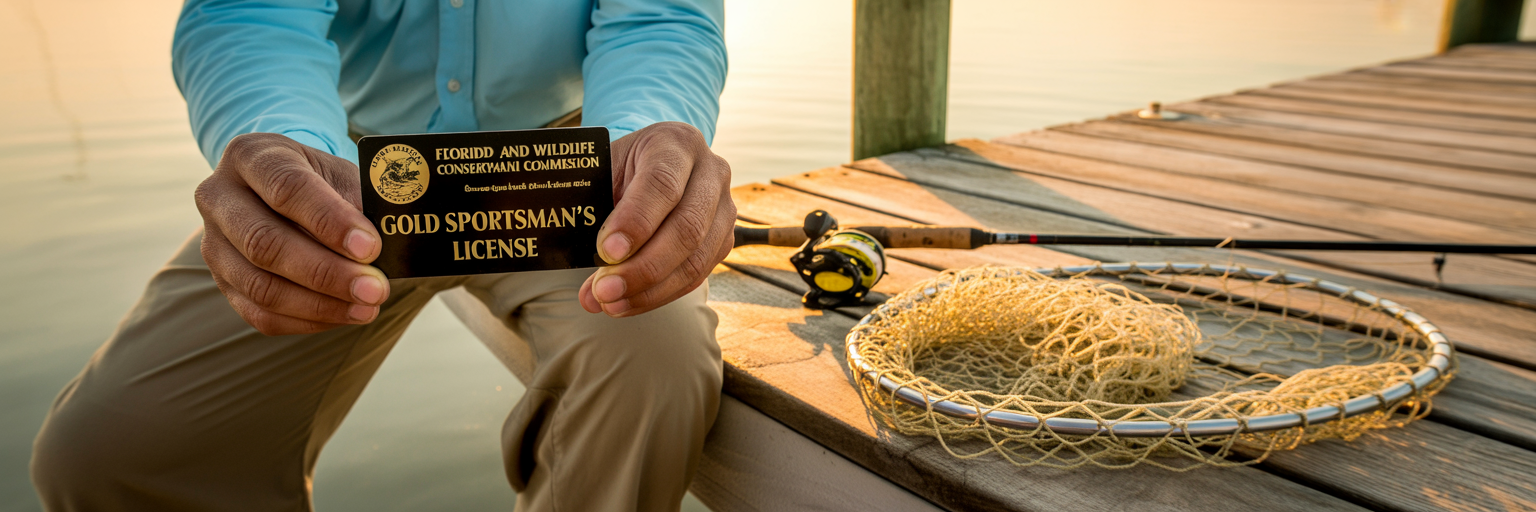
For the serious Florida outdoorsman, there’s the “all-in” package: the Gold Sportsman’s License Florida. Priced at $100 for residents, this license is designed for convenience and covers a wide range of activities in a single purchase. It’s the one-and-done solution for anglers who do more than just fish.
What is the Gold Sportsman’s License?
Think of the Gold License as your master key to Florida’s woods and waters. It bundles several key privileges into one card, simplifying your annual renewals. Specifically, it includes:
- Annual Saltwater Fishing License
- Annual Freshwater Fishing License
- Hunting License
- Permits for Deer, Turkey, Waterfowl, Snook, and Spiny Lobster
The Built-In Value: Included Permits
The real value of the Gold License becomes clear when you do the math on the included permits. If you’re a saltwater angler who targets snook and lobster, you’d normally buy these à la carte: a Saltwater License ($17) plus a Snook Permit ($10) and a Spiny Lobster Permit ($5). That’s $32 right there. The Gold License covers all of that, plus your freshwater and hunting privileges, for $100. If you take advantage of all its benefits, the value is undeniable.
Who Benefits Most from the Gold License?
This license was made for a specific type of person. It’s for the resident who truly does it all. You’re the ideal candidate if you spend your winters hunting ducks, your springs chasing bass in Lake Kissimmee, your summers stalking snook along the coast, and your late-summer days “bug hunting” for lobster in the Keys. If you value the simplicity of one purchase, one renewal date, and one card in your wallet that covers nearly everything, the Gold License is your best bet.
When to Skip the Gold License
A good guide tells you what not to buy, too. For the pure saltwater angler who doesn’t hunt or fish freshwater, the Gold License is overkill. If you only chase snook but never go for lobster, or vice-versa, buying your license and permits individually is almost always cheaper. This license is about comprehensive coverage. If your outdoor activities are more specialized, stick to the à la carte approach to save money for things you’ll actually use.
Essential Add-Ons: Species-Specific Permits
Holding a saltwater license is step one, but it doesn’t give you a free pass to keep every fish you catch. For some of Florida’s most prized species, an additional permit is non-negotiable. Getting caught without one will ruin your day and your wallet, so pay close attention here. A basic Florida saltwater fishing permit gets you on the water, but these add-ons let you target specific trophies.
The Snook Permit ($10)
The Florida snook permit cost is $10, and it is mandatory for anyone who wants to harvest a snook. This rule applies to everyone, regardless of age or other exemptions. Even if you are a resident fishing from the shoreline for free, you must have this permit to keep a linesider. No permit, no keeper snook. Period. It’s that simple.
The Spiny Lobster Permit ($5)
If you plan on participating in the annual “bug hunting” frenzy during the two-day mini-season or the regular season, the Spiny Lobster Permit is a must-have. For just $5, this permit allows you to harvest spiny lobster. Hitting the water in late July or August without one means you’re just along for the boat ride. Make sure this is in your wallet before you get your dive gear ready.
The Tarpon Tag ($51.50): A Special Case
This is where many anglers get confused. The Tarpon Tag is very different from the other permits. It is not required to simply fish for tarpon. You can fight and release the silver king all day long with just your standard saltwater license. The $51.50 tag is only required if you intend to possess and harvest a tarpon, which is almost exclusively done by anglers pursuing a state or world record. For 99% of us, this tag is an unnecessary expense. Save your money for a good tarpon jig instead. For the most current rules, it’s always a good idea to check the official FWC Saltwater Recreational Licenses and Permits page.
Long-Term Savings: The Five-Year License Option
Here’s a pro-tip for the committed Florida angler. If you know you’ll be fishing these waters for years to come, the five-year license is a smart, convenient option. This is a resident-only perk, reinforcing the value of establishing residency if you plan to make Florida your long-term fishing home. It’s designed for the angler who is fully invested in our fishery.
Let’s do the simple math. A five-year saltwater license costs $79. Buying an annual Florida fishing license at $17 each year for five years adds up to $85. The $6 savings isn’t going to change your life, but it’s a small reward for your commitment. The real benefit is the convenience. It’s a “set it and forget it” solution that means no more worrying about your license expiring mid-season for five full years. You buy it once and you’re covered.
This option is perfect for the established Florida resident. You have a boat in the driveway, you know your local waters like the back of your hand, and you are certain you’ll be fishing consistently for the next half-decade. It’s for the person who values their time on the water more than the annual hassle of online renewals. It simplifies your life so you can focus on tides and tackle, not paperwork.
However, there is one critical detail you cannot overlook. The five-year license only covers the base license. Any required species permits, like the Snook or Spiny Lobster permit, must still be purchased and renewed every single year. This is a common and costly misunderstanding. Your five-year pass gets you on the water, but you still need to stay current on your species-specific add-ons annually.
When Short-Term Permits Still Make Sense
While this guide focuses on frequent anglers, it’s important to know when an annual license isn’t the right call. For certain situations, short-term permits are the more practical and economical choice. It all comes down to an honest assessment of your time on the water.
The most common use case is the non-resident vacationer. If you’re planning one week-long fishing trip to Florida this year, the 7-day non-resident license ($30) is a clear winner over the annual non-resident license ($47). However, the math changes quickly. If you plan to make two separate week-long trips, buying two 7-day licenses ($60) costs more than the single annual license. It’s all about matching the license to your itinerary.
Another scenario is the “testing the waters” resident. Perhaps you just moved to Florida or are new to fishing and aren’t sure how committed you’ll be. Buying a 3-day ($17) or 7-day license for your first couple of outings is a smart, low-cost way to gauge your interest. It lets you get a feel for the fishery without committing to a full year. Once you’re hooked, you can upgrade to an annual pass.
The final advice is simple: do the math. Before you buy, take a realistic look at your calendar. Estimate how many days you’ll actually fish this year and compare the cost of multiple short-term permits versus a single annual one. For the frequent angler, the annual license will almost always come out on top, saving you both money and hassle in the long run.
Putting It All Together: Real-World Cost Scenarios
Theory is one thing, but seeing the numbers in black and white makes the decision easy. Let’s walk through a few common angler profiles to see how these license costs play out in the real world. Find the scenario that best matches your habits to see your most logical and cost-effective setup.
- Scenario 1: The Resident Inshore Specialist. You live in the Tampa Bay area and spend your weekends chasing snook and redfish from your flats boat. You don’t hunt or fish freshwater. Your setup is simple: Annual Saltwater License ($17) + Snook Permit ($10) = $27 Total Annual Cost. The Gold Sportsman’s License would be a waste of money.
- Scenario 2: The Offshore Keys Adventurer (Resident). You live in South Florida and run offshore for mahi, tuna, and wahoo. You don’t chase snook, but you never miss lobster season. Your cost is straightforward: Annual Saltwater License ($17) + Spiny Lobster Permit ($5) = $22 Total Annual Cost. This targeted purchase is far more economical than the Gold License.
- Scenario 3: The Visiting Pro (Non-Resident). You’re a serious angler from out of state who trailers your boat down for three separate 10-day trips a year to fish tournaments. Buying multiple short-term licenses would be a costly mistake. Your best bet is the Non-Resident Annual Saltwater License ($47). If you target snook, add the Snook Permit ($10) for a $57 Total Annual Cost.
- Scenario 4: The Ultimate Florida Outdoorsman (Resident). You are the person the Gold License was made for. You hunt deer and ducks, fish for bass in the lakes, chase snook on the coast, and dive for lobster in the Keys. For you, the $100 Gold Sportsman’s License is the clear winner for both cost and convenience.
| Angler Profile | Typical Fishing Plan | Recommended License & Permits | Total Annual Cost |
|---|---|---|---|
| Resident Inshore Specialist | Year-round snook & redfish fishing from a boat in local bays. | Annual Saltwater License + Snook Permit | $27.00 |
| Resident Offshore Adventurer | Frequent offshore trips for mahi/tuna; participates in lobster season. | Annual Saltwater License + Spiny Lobster Permit | $22.00 |
| Visiting Pro (Non-Resident) | Multiple (3+) week-long trips per year for tournaments, targeting snook. | Non-Resident Annual Saltwater License + Snook Permit | $57.00 |
| The Ultimate Florida Outdoorsman | Does it all: hunts, fishes freshwater, saltwater, and targets snook & lobster. | Gold Sportsman’s License | $100.00 |
Note: These scenarios are examples to guide your decision. Your total cost may vary based on your specific fishing targets and any additional permits required. Costs do not include processing fees.
Stay Legal, Stay Fishing
Regulations, seasons, and costs can change. Before you buy anything, you should always verify the latest information directly from the source. The most reliable place to do that is the official FWC licensing site. We strongly recommend visiting the GoOutdoorsFlorida.com catalog before every purchase to see the most current options and prices. It’s the best way to protect yourself and ensure you’re compliant.
In 2026, there’s no excuse for not having proof of your license. Keep a screenshot on your phone, use the official FWC app, or stick a printed copy in a waterproof bag in your console. The format doesn’t matter. What matters is being able to show it to an FWC officer immediately when asked. It’s a simple step that prevents a lot of potential headaches on the water.
Ultimately, choosing the right Florida fishing license isn’t about finding loopholes. It’s about taking an honest look at your own fishing habits and making a smart purchase. By matching your license to your plan, you save money, eliminate stress, and can focus on what really matters: finding the bite.
Now get your license sorted and get on the water. Tight lines.