
SOUTHEAST ATLANTIC
Lauderdale-by-the-Sea
fishing guide
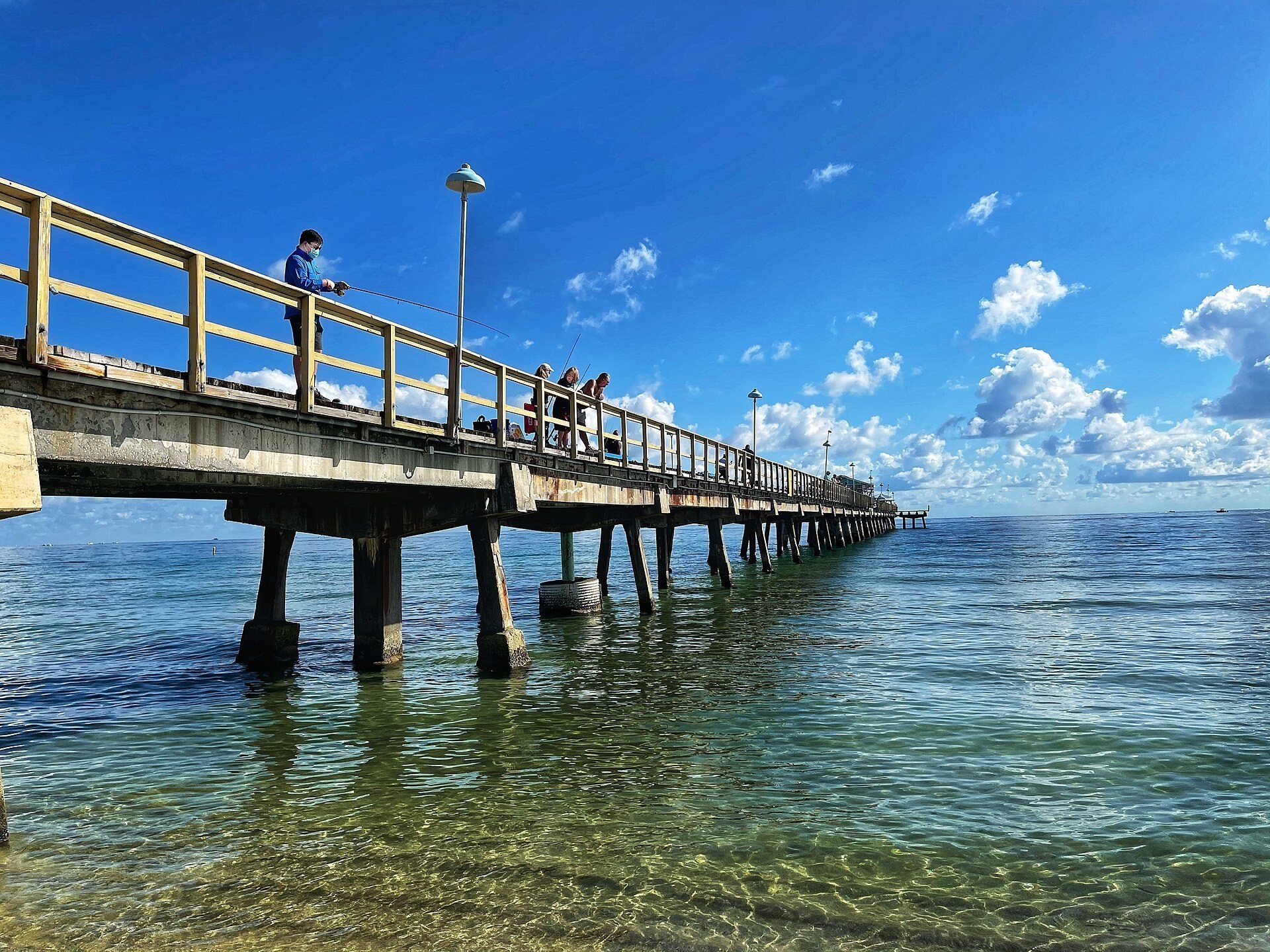
Lauderdale-by-the-Sea combines a reef-oriented beach with detailed surf-casting rules. Anglin's Pier is closed to public access under the town's current guidance, so build the visit around a permitted beach section rather than an assumed pier reopening.
Explore the guide ↓Do not plan a fishing session on the closed pier
Anglin's Pier is a recognizable feature of Lauderdale-by-the-Sea, but the town's current FAQ lists it as closed to the public. It is privately owned. A restaurant operating nearby does not mean the fishing structure has reopened.
Check the latest notice rather than assuming that a planned repair or permit establishes a reopening date. A historic photograph can show the pier and shoreline without describing their current access. Follow barriers and do not enter to recover a lure.
The town has a separate set of surf-casting rules. That permission is limited by timing, distance from the pier and nearby water users. Use those details to decide whether a beach session is possible.
If the approved beach space is unavailable, choose another confirmed fishing facility. The Pompano Beach pier is a different destination with its own admission and tackle rules.
Use the town's weekday and weekend limits
The reviewed town fishing guidance excludes surf fishing from 9 a.m. to 4 p.m. on weekdays and from 9 a.m. to 6 p.m. on weekends and national holidays. Temporary restrictions can also apply. Confirm posted directions for the section and day.
Surf casting and surface diving are restricted within 300 feet of Fishermen's Pier under the town's guidance. Do not assume that a closed pier removes that surrounding restriction. Ask staff if the boundary is unclear.
Fishing must stay away from swimmers, snorkelers, scuba divers and bathers. Chumming is prohibited, and the town prohibits landing or exhibiting sharks, barracudas or stingrays on the public beach. Plan a modest method that fits those limits.
Check licensing through current FWC guidance. A legal license and a permitted hour do not erase the town's spatial or activity restrictions.
Keep hooks above or beside rough habitat
Nearshore hard features make this coast attractive to divers and can support prey. They also snag rigs. Choose recoverable open water beside a feature rather than dropping a hook into its cracks.
Look for a clear sandy opening and observe where people enter for snorkeling or diving. Underwater visitors may surface away from the point first seen. Keep a generous separation and follow local directions.
A lure worked above the bottom can search an approved edge without resting in cover. Adjust its running depth after hard contact. Leader wear is a warning to change the route before tackle is lost.
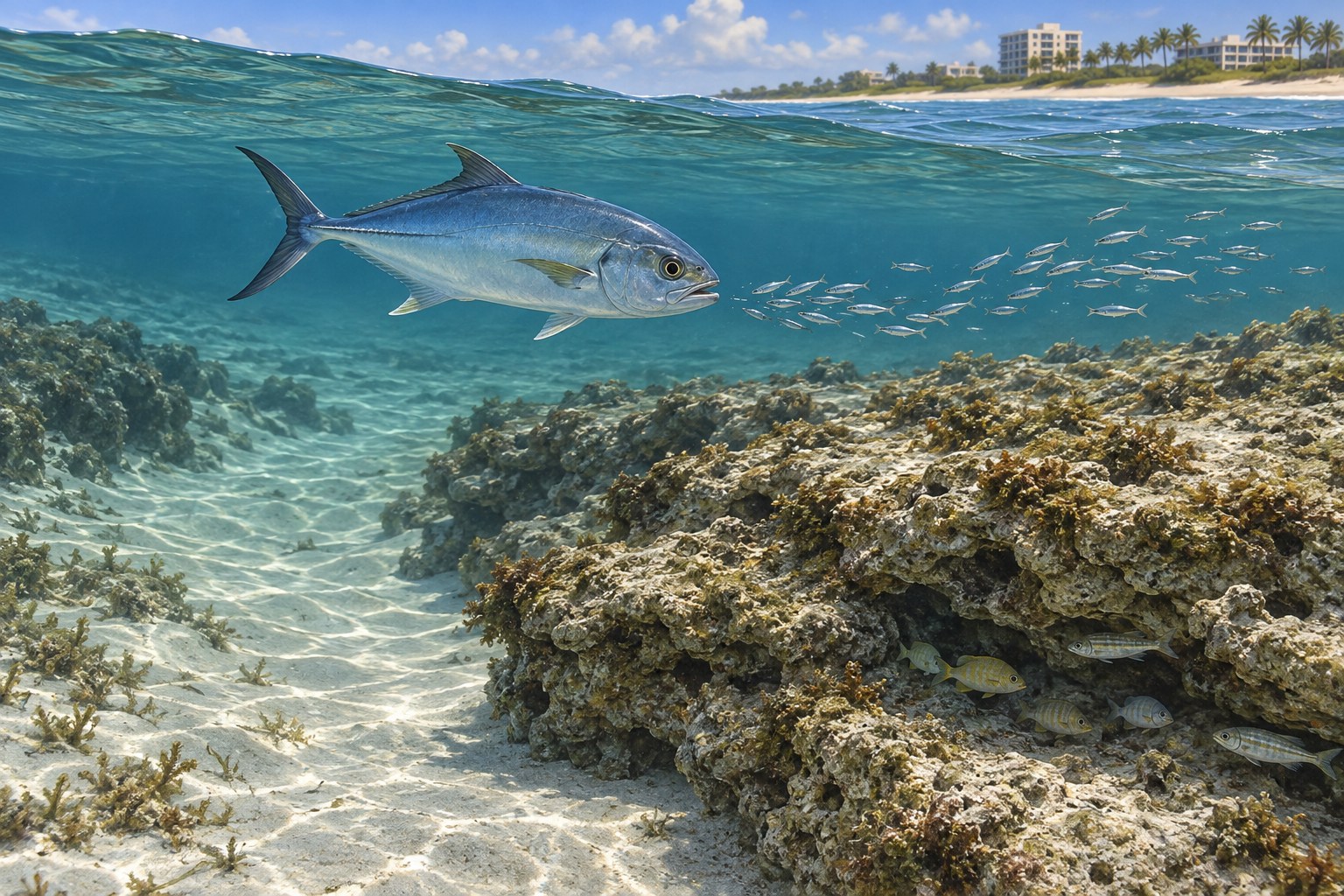
The habitat illustration shows fish using open water beside hard bottom. It is not a map of the local reef or a recommendation to cast into a diving area.
Use a small bait where sand gives clean recovery
Whiting and pompano can feed over suitable surf sand. Compact shrimp pieces, sand fleas or durable strip bait can test an approved clean trough. Keep the point uncovered and the leader untangled.
Use a short dropper with weight that holds under the actual wave conditions. A sinker rolling toward a hard patch needs retrieval before it wedges. More weight does not fix a cast aimed at an unsuitable bottom lane.
Check whether soft bait has been stripped after light bites. Compare a firmer offering or reduce the portion instead of building a large bait bundle. A clear small hook-up is easier to handle on a shared beach.
Keep a measuring tool ready if retention is intended. Accurate species identification matters before a mixed surf catch enters the cooler.
Follow permitted shoreline prey routes
Snook and jacks can use suitable coastal feeding lanes. A small swimming lure can search a clear approved section during the applicable period. Watch for bait and a fish's direction rather than casting simply because a reef is nearby.
Place the lure ahead of a cruising target and keep it above rough contact. Slow the retrieve if the fish follows without taking it. Repeated splashes on the same fish can interrupt its route.
Spanish mackerel may appear with bait schools, but the presentation must remain clear of divers, birds and other lines. Use suitable leader checks and pliers for toothy catches. Stop the search if it would create a prohibited landing or handling situation.
Do not deliberately pursue the beach-prohibited shark, barracuda or stingray display scenario. Understand the town's rule before selecting bait and equipment likely to create that problem.
Plan from the restriction that applies to the day
A small difference between weekday and weekend timing can change the usable evening session. Check the day's category before choosing the arrival time.
| Planning detail | Reviewed guidance | Practical action |
|---|---|---|
| Weekday daytime | Fishing excluded 9 a.m. to 4 p.m. | Choose a confirmed permitted window |
| Weekend or national holiday | Fishing excluded 9 a.m. to 6 p.m. | Do not borrow the weekday cutoff |
| Pier vicinity | 300-foot surf-casting restriction | Confirm the boundary |
| Anglin's Pier | Closed to public access | Use another authorized destination |
Use weather to decide whether the window is worthwhile
A legal window can still be too rough, weed-filled or busy for fishing. Check wind and lightning before visiting, then observe the actual surf. A pleasant street-level breeze does not describe the waves over nearshore hard bottom.
Tide changes the water over features and sand lanes. Use the forecast to anticipate depth, without treating it as a navigation chart. Never wade onto an unfamiliar reef to reach a lure path.
Warm shoreline-snook and cooler-season surf patterns are broad clues. Prey movement, permission and a clean presentation decide the immediate opportunity. Note those observations for the next visit.
Keep gear easy to move and easy to secure
Carry a small bag with pliers, spare leader, water and a closed waste container. One controlled rod suits a limited legal lane better than a wide spread. Keep hooks covered while passing beach businesses or walking entrances.
A family fishing lesson should be short and separate from swimming or diving. Explain the hook position and safe retrieve before handing over the rod. Put tackle away when the approved lane becomes busy.
Do not leave bait where birds or dogs can reach it. Pick up every line offcut before it blows toward vegetation or the water.
Leave with correct fish handling and no lost line
Confirm current FWC harvest and license requirements as well as the town's handling restrictions. Support release fish and minimize time out of water. Avoid dragging a catch across reef or dry beach for a photograph.
Pack while there is enough time to comply with the applicable schedule. Record the actual permitted section and method, and check the pier notice again before any future plan that depends on its access.
Common questions
Is Anglin's Pier currently available for fishing?
The reviewed town FAQ lists it as closed to the public. Nearby restaurant access does not establish that the pier has reopened.
Do weekday and weekend surf-fishing limits differ?
Yes. The town excludes 9 a.m. to 4 p.m. on weekdays and 9 a.m. to 6 p.m. on weekends and national holidays, subject to current restrictions.
Can I cast immediately beside the closed pier?
The town guidance includes a 300-foot surf-casting restriction around Fishermen's Pier. Confirm the current boundary rather than assuming closure removes it.
Can I chum to attract fish to the beach?
The town prohibits chumming. It also has specific restrictions on landing or exhibiting sharks, barracudas and stingrays on public beaches.
Prepare for your visit
Check local tides and weather. Read more about snook, florida pompano, whiting. Check current FWC saltwater fishing rules.