

PANHANDLE
Old Carrabelle Beach
fishing guide
Old Carrabelle Beach is a quiet St. George Sound shoreline near the Carrabelle Bridge. Its limited access and lack of facilities call for a light, short fishing plan.
Explore the guide ↓Find the old beach rather than the main public beach
Old Carrabelle Beach is the shoreline reached from Gulf Beach Road just west of the Carrabelle Bridge. It is distinct from the better-equipped Carrabelle Beach farther west along U.S. 98. Using the wrong name can send a visitor to a different parking area and fishing setting.
County tourism information describes no formal parking area and no facilities at the old beach. Confirm a lawful place to stop and an open public route before unloading. Do not block driveways, roadside travel or private entrances. If legal parking is uncertain, choose an established alternative rather than treating the quiet setting as permission to leave a vehicle anywhere.
Use the sound-side habitat to set expectations
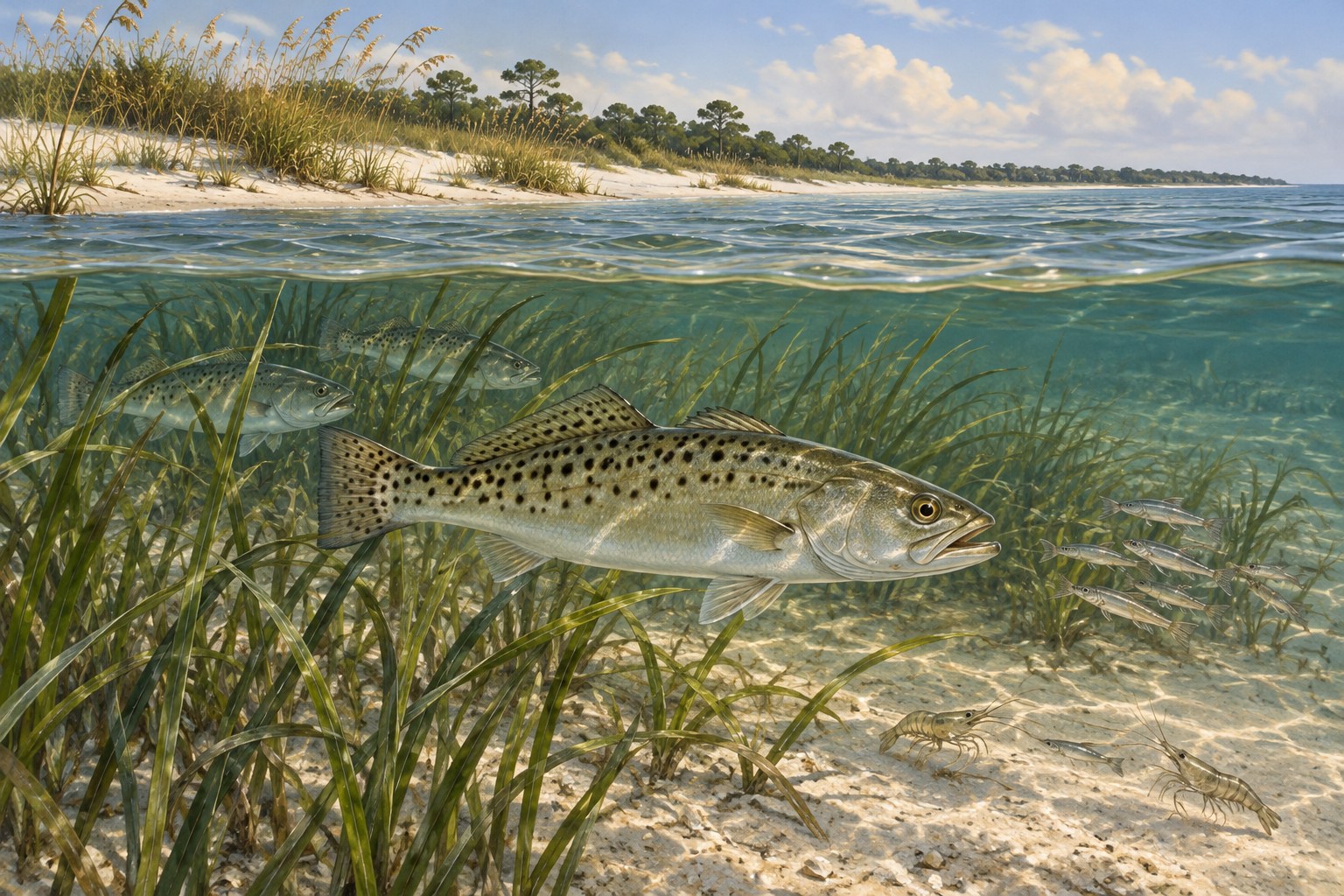
The beach faces St. George Sound, with barrier islands influencing the broader water setting. Nearby grass beds provide shelter for small fish and shrimp. This is a different plan from fishing heavy open-Gulf breakers with a long surf rod and a large sinker.
Watch where clearer sand meets darker vegetation from the lawful shore. Several dimples, bait movements or repeated wakes can identify an active lane. One dark patch alone may come from light or depth. Test a reachable area that allows the rig to return cleanly, rather than trying to cast across an entire grass bed without knowing its depth.
Suspend shrimp above the feeding cover
Spotted seatrout can hunt over mixed grass-and-sand water. A small shrimp suspended under a float gives a useful way to test that habitat from an approved position. Set the depth so the hook remains above the plants rather than settling into them.
Make a gentle cast, let the float settle and use brief movements. Continuous splashing can make a quiet shore more disturbed than it needs to be. If the bait comes back wrapped in grass, shorten the depth or change lanes. When a trout connects, use smooth pressure and wet hands for support instead of gripping it tightly against hot dry sand.
Offer food along a cleaner shallow margin
Redfish look for shrimp, crabs and small baitfish near shallow transitions. A compact soft plastic or a modest natural bait can suit an open lane beside vegetation. Choose a position that permits both a clean cast and a safe landing.
Try a slow retrieve with an occasional pause over cleaner sand. Increase weight only when control truly requires it. Repeated snags mean the presentation is poorly matched to that lane, not that the fish need more lead. Watch for a quiet moving wake, and avoid charging along the shore toward it. An undisturbed edge is often more useful than a closer casting position reached noisily.
Keep bottom presentations small and deliberate
Whiting and drum can use sandy coastal water, while flounder may wait beside a depth transition. These are possibilities to investigate in the wider setting rather than fixed residents promised at Old Carrabelle. A trimmed shrimp piece can make a simple opening bottom presentation where the sand is recoverable.
Let the bait remain in a controllable lane and inspect it between trials. Small fish can remove soft bait without a clear heavy bite. Use a tougher small piece when that happens. Before keeping a fish, identify it by more than general color. Bring a current rule reference and release uncertain catches carefully rather than guessing a legal size.
Take a kit you can carry without facilities
A medium spinning outfit, a float, a few light jigs and small bait hooks cover many first-visit choices. Keep spare leader and modest weights together in a closed container. Heavy extra equipment adds little when legal access and the usable shoreline are limited.
Bring drinking water, shade protection, pliers, a ruler and a waste bag. Keep bait cold enough for the planned interval. There is no public facility here to assume will provide ice, a restroom or a fish-cleaning table. If visiting with children, plan those needs before arriving and select another access if the basic arrangements are unsuitable.
| Reachable habitat | Opening presentation | What to learn |
|---|---|---|
| Sand beside grass | Shrimp under float | Depth that clears plants |
| Clean shallow lane | Small soft plastic | Retrieve pace without snags |
| Open sandy bottom | Trimmed shrimp bottom bait | Bait survival and drift |
Look at wind and summer heat before tide labels
County information highlights the nearby grass habitat as a summer and fall fishing interest. Treat that as seasonal context rather than a catch forecast. Early warm-weather sessions can offer a more comfortable walk, while cooler fronts can move fish away from the shallowest water.
Water level changes which lanes remain usable from shore. Wind can affect both local level and clarity, even in a sound sheltered by islands. Compare a tide prediction with what you can see. End the trip if thunder develops or waves make the footing uncertain. A simple short visit is easier to repeat than a long attempt made in unsuitable conditions.
Avoid turning a bank visit into an unplanned wade
An attractive grass edge may lie beyond mud, shell or a sudden depth change. Do not step into unknown water simply to make a lure reach it. Soft sediment can trap a foot, while shell can cut skin and damage light tackle.
Use closed protective footwear on the approved walking route and keep away from unstable banks. Watch for wildlife without approaching it. Leave birds room to feed, and do not discard bait to draw them close. A stable shore position with a modest casting distance is more practical here than a risky approach toward water you have not inspected.
Keep the first session brief and observable
Begin with one clean lane and a single offering. Note whether the shrimp stays intact, the float depth clears cover and the line moves steadily or erratically. Change one factor at a time so the result teaches something about the shore.
Confirm license and harvest requirements ahead of time. Finish by collecting leader scraps and checking the parking route for dropped tackle. Record the exact beach used, because Old Carrabelle and the main Carrabelle Beach have different visitor arrangements. Accurate access notes make a return trip easier and help avoid recommending facilities this quieter beach does not have.
Common questions
Is Old Carrabelle Beach the main beach on U.S. 98?
No. It is a separate Gulf Beach Road shoreline near the Carrabelle Bridge with more limited arrangements.
Are restrooms and formal parking available?
County visitor information lists no facilities and no formal parking area. Confirm lawful parking before unloading.
What bait fits nearby grass water?
A small shrimp suspended above vegetation is a practical trout-habitat presentation where fishing is allowed.
Should I wade to reach the grass edge?
Do not enter unknown mud, shell or depth. Use a secure legal shore position and keep casts manageable.
Prepare for your visit
Check local tides and weather. Read more about whiting, permit, spotted seatrout. Check current FWC saltwater fishing rules.