
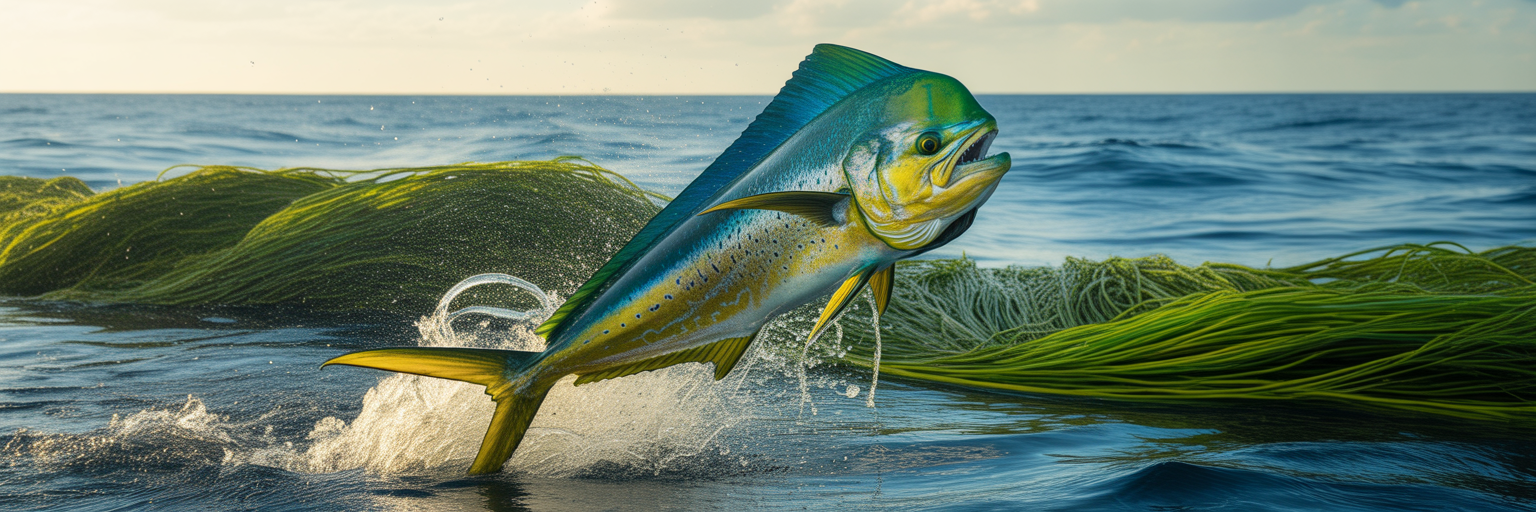
Offshore, the deep blue can feel like an empty desert. Yet, a golden-brown line of sargassum stretching across the horizon changes everything. This floating ecosystem is the single most important piece of structure for mahi-mahi, concentrating the entire food chain into a defined hunting ground. Mastering the art of finding mahi weed lines is not about luck. It is a repeatable skill built on understanding ocean dynamics, reading the signs, and executing a disciplined game plan.
The Basics of Finding Mahi Weed Lines
Before you burn fuel running offshore, you need to understand why a simple patch of seaweed is the key to consistent action. It is not just floating grass. It is a complete, living structure that provides both food and shelter, turning an empty patch of ocean into a vibrant city teeming with life.
Why Weed Lines are Mahi Magnets
Think of a sargassum line as a floating reef and an all-you-can-eat buffet. It is a nursery for countless juvenile fish, crabs, and shrimp. This concentration of food attracts baitfish like flying fish and small jacks, which in turn draw in predators. For mahi, these weed lines are their primary hunting grounds. They use the cover to ambush prey and patrol the edges looking for an easy meal. A healthy line is a self-contained food web, and mahi are at the top of it.
Understanding the Sargassum Ecosystem
Not all weed is created equal. The skill in fishing sargassum weed lines lies in telling a productive line from a dead one. You are looking for healthy, vibrant weed. It should be thick, clumpy, and golden-brown with a fresh, briny smell. This is the stuff that holds life. Sparse, stringy, or dark, decaying weed is often barren. It lacks the structure to hold bait and offers little value to a hunting mahi. The best lines are often a mix of scattered patches and thick, matted sections that provide different types of cover and ambush points.
The Seasonal Push vs. Daily Conditions
While spring and early summer are known as peak mahi season in Florida, experienced anglers know that conditions trump the calendar. The large seasonal push of sargassum from the south is important, but the daily formation of weed lines is driven by wind and current. A steady wind blowing for a couple of days can stack up a beautiful line against a current edge any time of year. Focusing on finding the right setup, a combination of wind, current, and water temperature, will put you on fish when others are waiting for the calendar to tell them it is time.
Setting Realistic Expectations
Let’s be direct: you will find plenty of weed lines that are completely empty. The ocean is a big place, and finding a line holding fish is the entire challenge. Do not get discouraged by a few barren patches. The goal is not to fish every piece of weed you see. The goal is to learn how to identify the high-percentage spots. The rest of this guide is designed to show you exactly how to tell a fish-filled bonanza from a worthless patch of grass before you even wet a line.
Using Forecasts to Pinpoint Productive Zones
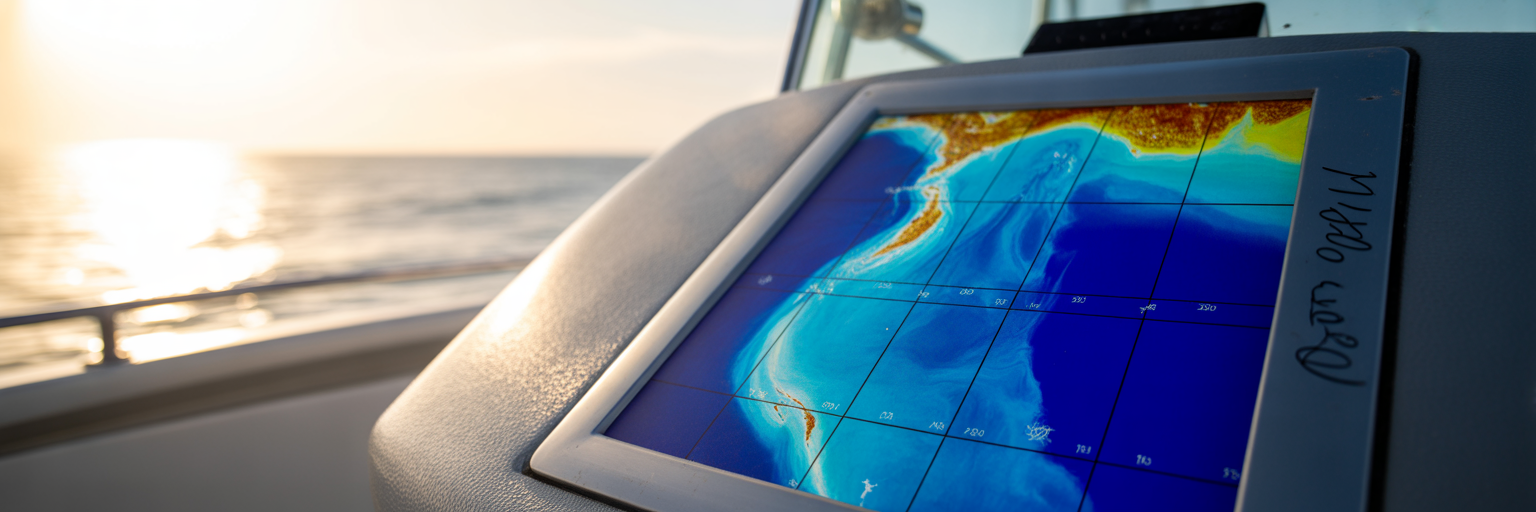
The most successful offshore trips begin the night before at your computer. Modern forecasting tools give you the ability to find productive water before you even leave the dock. This is your homework. Learning to interpret wind, current, and satellite data will eliminate guesswork and put you on a direct course to the fish.
Harnessing Wind and Current Data
Wind and current are the architects of every weed line. They push, gather, and concentrate floating sargassum into predictable zones. A steady 15-knot southeast wind blowing for two days will push weed against the western edge of a north-flowing current. That is a classic, predictable setup. Before every trip, look at the wind history for the past 48 hours. Consistent direction is what builds a defined, fishable line. Shifting, variable winds create scattered, unorganized weed that is difficult to fish effectively.
The Power of the Gulf Stream
The Gulf Stream is a massive river of warm water flowing north through the Atlantic. Its edges are where the magic happens. The most productive weed lines form where the warm, deep blue water of the Stream collides with cooler, greener inshore water. This collision creates a current shear, or rip, that acts as a natural barrier, trapping sargassum and any baitfish traveling with it. Mastering Gulf Stream fishing tactics means learning to identify and fish these powerful edges.
Decoding Satellite Imagery for Offshore Anglers
Sea Surface Temperature (SST) and chlorophyll charts are no longer just for commercial fleets. These are your offshore roadmaps. They show you exactly where those temperature breaks and color changes are happening. You are looking for high-contrast zones, a sharp break from 78-degree water to 82-degree water, for example. These breaks signal a strong current edge where weed will accumulate. Tools from sources like the NOAA provide daily updates on sea surface temperatures, which are invaluable for figuring out how to find mahi in Florida.
Putting It All Together: Your Pre-Trip Game Plan
Here is a simple pre-trip walkthrough. First, pull up the latest SST chart to find a hard temperature break within the mahi’s preferred range. Mark the coordinates of that edge. Next, check the wind forecast. If you have a west wind pushing against that northbound current, you know to focus your search on the east side of that temperature break. That is your starting waypoint. You are no longer just running offshore hoping to get lucky. You are heading to a specific zone with a high probability of holding fish.
Finding Gold: Recognizing Eddies and Upwellings
Eddies and upwellings are advanced features that create incredible fishing opportunities. An eddy is a large, swirling pocket of water that breaks off from the main current. These can trap huge fields of sargassum and bait for days, becoming a massive, stationary feeding zone. An upwelling is where nutrient-rich cold water from the deep is pushed to the surface, kicking the entire food chain into overdrive. On an SST chart, an eddy might look like a circular pocket of warm water, while an upwelling appears as a patch of cooler water. Finding one of these is often worth a longer run offshore.
On-the-Water Clues to a Live Weed Line
Your homework is done, and the charts have pointed you to a promising zone. Now it is time to use your eyes. On-the-water observation is what confirms the potential of a weed line. A seasoned angler is constantly scanning the water, the sky, and the weed itself for subtle clues that scream “fish here.”
Bird Watching for Anglers: The Frigate Connection
Frigatebirds are the ultimate tattletales of the offshore world. If you see them, pay close attention. A frigate circling high in the sky is searching, which is a good sign. But a frigatebird diving low and aggressively is the jackpot. That means it has found baitfish being pushed to the surface by predators below. That predator is very often a school of mahi. Follow the birds, and they will lead you to the bite.
The Importance of Bait: No Bait, No Mahi
This is the most simple and critical rule: a weed line without bait is a dead line. As you approach a line, slow down and look for signs of life. Are flying fish taking flight from the edge of the weed? Do you see small schools of baitfish showering on the surface? Does the water have that “nervous” look that signals something big is lurking below? If the water around the weed is still and lifeless, keep moving. The presence of bait is a non-negotiable requirement.
Reading the Weed Itself: Fresh vs. Dead
Just as you analyzed the forecasts, you need to analyze the weed in front of you. Get close and look at its condition. Is it the thick, clumpy, golden-brown sargassum you are looking for? Or is it sparse, dark, and stringy? A healthy line has a distinct, briny smell of the ocean. A dead line often looks and smells stagnant. Trust your senses. A living ecosystem looks, feels, and smells alive.
More Than Just Weed: Debris as a Super-Magnet
While scanning a weed line, keep your eyes peeled for anything else mixed in with the sargassum. A floating log, a five-gallon bucket, a wooden pallet, or any piece of solid floating debris acts as a super-magnet for bait and game fish. These objects provide more substantial structure and shade than the weed alone. They often hold the largest fish on the line, particularly big bull dolphin. Always make a few extra passes around any solid debris you find.
The Color Change: Where Blue Meets Green
The color change you identified on the satellite chart is even more dramatic in person. The sight of the deep, cobalt blue of the Gulf Stream hitting the greener, nutrient-rich inshore water is a clear sign you are in the right place. This edge is a highway for pelagic species. Even if the weed is sparse along this edge, trolling the color change itself can be extremely productive. The visual contrast is a clear indicator that you are in a transition zone where predators hunt.
Reading the Signs: Live Line vs. Dead Line
| Indicator | Live Weed Line (Fish On!) | Dead Weed Line (Keep Moving) |
|---|---|---|
| Birds | Frigatebirds diving low and aggressively | Seagulls sitting on the water; no frigates |
| Bait | Flying fish skittering; showering baitfish | No visible surface activity; ‘dead’ water |
| Weed Appearance | Thick, clumpy, golden-brown | Sparse, stringy, dark brown or bleached |
| Floating Debris | Logs, pallets, buckets mixed in | Only scattered, decaying weed |
| Water Color | Sharp color change; deep blue meets green | Monotone water color; murky or uniform |
This table provides a quick reference for anglers to assess a weed line’s potential in real-time. A line showing multiple ‘Live’ indicators is a high-priority spot worth fishing thoroughly.
The Stealthy Approach to Avoid Spooking Fish
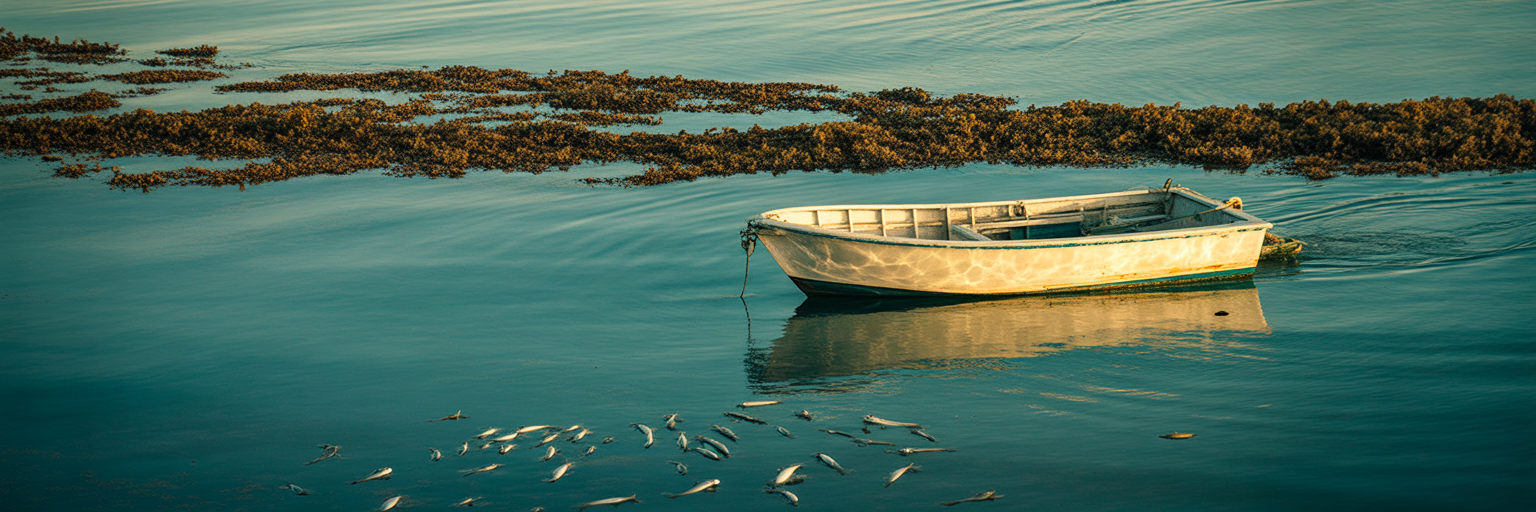
You have done the work and found a perfect, live-looking weed line. Do not ruin it now. A sloppy, loud approach will scatter bait and push mahi deep, shutting down the bite before it even starts. Discipline and a stealthy technique are what separate the pros who fill the fish box from the amateurs who wonder why they are not getting bit.
The Cardinal Rule: Never Drive Over the Line
This is the single biggest mistake in offshore fishing. Never, ever drive your boat over the section of weed line you intend to fish. The engine noise and hull pressure send a shockwave through the water that spooks every living thing. It scatters the bait, sends the mahi running for deep water, and can ruin a productive spot for hours. Always treat the weed line with respect and approach it from the side.
Use the Current as Your Conveyor Belt
The correct approach uses the elements to your advantage. Position your boat up-current and upwind of the section you want to fish. Cut your engines at least 100 yards away and let the wind and current push you down onto the spot. This allows you to drift silently and naturally into the strike zone, presenting your baits without alerting the fish to your presence. It is a quiet, methodical approach that pays huge dividends.
Drifting Parallel for Maximum Coverage
Your goal is to drift alongside the weed line, not across it. A parallel drift keeps your baits and lures in the most productive zone for the longest possible time. This allows your anglers to cast directly to the weed edge or lets you run trolled baits perfectly along the outside of the line. It is an efficient way to cover ground while ensuring your presentation is always in the sweet spot.
Engine Noise Discipline
A quiet approach goes beyond just cutting the main engines. Mahi are incredibly sensitive to sound and pressure changes in the water. Avoid slamming hatches, dropping items on the deck, or yelling. Even the sound of a generator or the constant shifting of gears can be enough to make wary fish cautious. The more you can minimize your acoustic footprint, the more aggressive the fish will be.
Leaving and Repositioning Without Blowing Up the Spot
After a successful drift, you will want to do it again. The way you reposition is critical. Do not just fire up the engines and run straight back up the line. Instead, motor out and away from the weed in a wide, looping arc. Get well clear of the productive zone before you run back up-current to start your next drift. This preserves the integrity of the spot and ensures you do not spook the fish you just worked so hard to find.
Trolling Tactics to Cover Water Effectively
Trolling is the primary hunting method for locating mahi along a weed line. It allows you to cover ground efficiently, present multiple baits at once, and pinpoint the exact location of a school. A simple, well-planned trolling spread is far more effective than a complicated mess of lines.
Finding the Right Trolling Speed
The ideal trolling speed for mahi is typically between 6 and 8 knots. This is fast enough to cover water and trigger a reaction strike, but slow enough for your baits and lures to perform correctly. Watch your lures. Are they swimming naturally or are they tumbling and blowing out of the water? Adjust your speed based on the sea state and what your spread is telling you. In rougher seas, you may need to slow down to keep your baits in the water.
Setting a Simple, Effective Spread
You do not need a 10-rod spread to be effective. A simple 4-rod setup is manageable and deadly. A great starting point is two flat lines running just behind the transom with skirted ballyhoo, and two lines running from your outriggers with small lures or additional ballyhoo further back in the spread. This creates a staggered presentation that covers different water columns and distances from the boat, increasing your chances of a strike.
Lure and Bait Selection for Weed Lines
Skirted ballyhoo is the undisputed king of mahi baits. Rigged correctly, its natural swimming action is irresistible. For artificials, focus on lures that imitate the local forage. Small chuggers, jet heads, and flying-fish pattern lures are all excellent choices. Key colors are often blue and white, pink, and chartreuse, which mimic the baitfish found in the sargassum. These trolling methods are a fundamental part of successful mahi mahi fishing in Florida.
Working the Edges and Pockets
Do not just troll in a straight line. Actively work the structure. Troll in a gentle zig-zag pattern, moving your spread from the clean water just off the weed into the edge and back out again. Pay close attention when your baits pass any points, pockets, or thicker clumps in the line. These irregularities are natural ambush points where mahi will be waiting. This active approach is a key tactic for successful offshore fishing for mahi.
The Turn After a Strike: Triggering a Frenzy
When a rod goes down, your first instinct might be to stop the boat. Resist that urge. Instead, keep the boat moving forward and begin a slow, wide turn back towards the spot where you got the bite. This does two things. It keeps the other lures in the water, swimming enticingly, and it keeps pressure on the hooked fish. Very often, the rest of the school will follow the hooked fish, and this maneuver will trigger multiple hookups, turning a single strike into a full-blown frenzy.
Working the School After the First Hookup
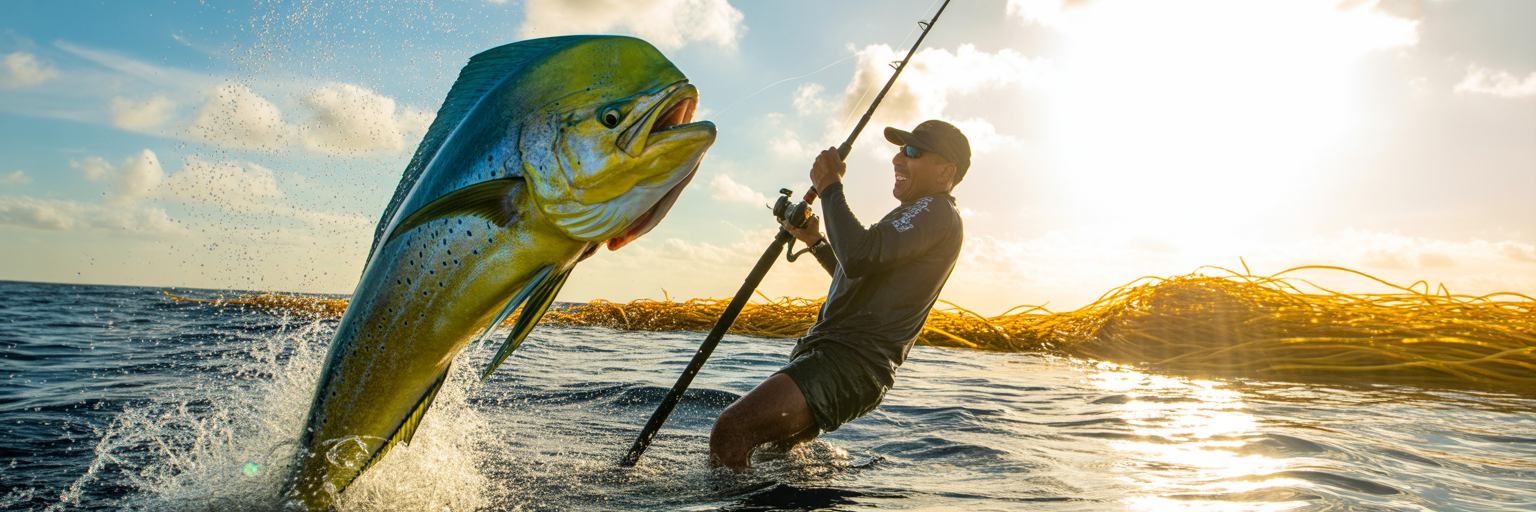
The first hookup is just the beginning. The moments that follow are what define a great day of mahi fishing. This is when the chaos begins, and having a plan is critical to capitalizing on the opportunity. A well-orchestrated response can turn one fish into twenty.
Keep the First Fish in the Water: The Ultimate Decoy
This is one of the most important mahi fishing tips Florida anglers need to know. Do not immediately gaff and boat the first fish you hook, especially if it is a smaller schoolie. Leave it in the water near the boat, still on the line. Its frantic movements and distress signals act as the ultimate live decoy, firing up the entire school and drawing them right to your transom. The school will stick around as long as that first fish is there.
The Power of the Pitch Rod
While the trolling rods are getting cleared, this is when the spinning rods come out. Every boat should have at least two “pitch rods” rigged and ready. These are typically spinning setups ready to be baited with a live pilchard, a chunk of cut bait, or a small jig. As the school swarms the boat, anglers can pitch baits directly to visible fish. This is fast-paced, visual fishing at its finest and is how you put big numbers in the boat.
Bailing Schoolies vs. Casting to Gaffer Dolphin
You need to adapt your technique to the size of the fish. When small “schoolie” mahi are swarming the boat in a frenzy, you can often “bail” them by simply dropping a baited hook over the side. They are aggressive and not leader-shy. The larger, more cautious “gaffer” sized fish will often hang on the edges of the chaos. Targeting them requires a more deliberate approach, like a well-aimed cast with a live bait to the outside of the school.
Targeting the Big Bull: Going Deep
In almost every school, the largest bull dolphin will be holding deeper, underneath the frantic schoolies feeding on the surface. While the other anglers are bailing the smaller fish, have one angler pitch a live bait or a naked, un-skirted ballyhoo and let it sink. Free-line it down 20 to 30 feet below the boat. This is often what it takes to tempt the big, cautious bull that is waiting for an easy meal to drop down to him.
Knowing When to Move On
All good things come to an end. A hot bite will eventually cool off. The signs are usually clear. The bites become less frequent, the fish you hook are no longer followed by others, or the school simply vanishes from sight. When the action dies for more than 10 or 15 minutes, it is time to make a decision. Put the trolling gear back out, leave the now-empty spot, and resume the hunt for the next productive section of the weed line.
Essential Gear for Weed Line Mahi Fishing
Having the right gear is not about spending the most money. It is about having reliable equipment that is properly matched to the task. When a 30-pound bull mahi erupts on a bait, it is too late to wonder if your tackle is up to the job. Here is a practical checklist of the essential gear you need.
- Trolling Setups: These are your workhorses. You want conventional reels in the 20-30lb class, like a Shimano Talica or Penn Fathom, paired with 6’6″ to 7′ rods. Lever-drag reels are superior here because they allow for precise drag adjustments during the fight, which is critical for managing a powerful, acrobatic fish.
- Spinning Setups for Pitching: Your pitch bait combo needs to be ready for instant action. A high-quality 6000 to 8000-size spinning reel on a 7-foot medium-heavy rod is ideal. The setup needs enough backbone to stop a green mahi from running back into the weed, and the quality of a reel like the Shimano Stella SW 6000XG is the caliber of gear that ensures you have the stopping power when you need it most.
- Line and Leader Strategy: Spool your reels with 30-50lb braided mainline. Braid offers superior strength with a thin diameter and has no stretch, which helps with solid hooksets and feeling the bite. For leaders, 40-60lb fluorocarbon is the standard. Fluorocarbon is less visible to fish and more abrasion-resistant than monofilament, a crucial advantage when a hooked mahi dives for the thick sargassum.
- Terminal Tackle and Hooks: Do not compromise on the small stuff. Use high-quality 7/0 to 8/0 J-hooks for rigging ballyhoo and sharp 4/0 to 5/0 circle hooks for pitching live or chunk baits. Ensure your hooks are strong and will not bend out under the pressure of a powerful fish.
- Essential Tools on Board: A few key accessories make all the difference. A quality gaff is a must for safely landing any fish over 15 pounds. For smaller schoolies, a dehooker allows for a quick and safe release. Finally, a good pair of saltwater pliers is non-negotiable for cutting heavy leaders, rigging baits, and removing stubborn hooks.