
The Florida Fishing License Rules for Shore Anglers
There is nothing quite like that first cast from the sand as the sun cracks the horizon. Whether you are throwing a topwater plug for snook or soaking a piece of shrimp for pompano, the anticipation is the same. But a nagging question often follows that first cast: do I need a Florida fishing license for this? The answer is not a simple yes or no. It depends on several factors, and this guide will clear up the confusion for good.
Florida’s rules are a balancing act. The state manages a world-class fishery that draws anglers from across the globe while also ensuring public access to its incredible waters. This is why the regulations can seem complicated at first glance. Understanding the Florida fishing regulations is about more than just avoiding a costly ticket from a Florida Fish and Wildlife Conservation Commission (FWC) officer. It is about being a responsible angler who contributes to the health of the sport we all love.
The answer to the license question comes down to a few key variables. Your residency status and your age are the first pieces of the puzzle. Next is exactly where your feet are planted, whether that is a beach, a public pier, a jetty, or wading in the water. Finally, what you are trying to catch can require additional permits. Think of this guide as a practical walkthrough of these factors, just like a conversation with a trusted fishing buddy laying out the day’s plan before you hit the water.
The No-Cost Resident Shoreline License Explained
For most Florida residents who fish from land, there is one piece of regulation that is more important than any other: the Resident Recreational Saltwater Shoreline Fishing License. While it is called a “no-cost” license, it is still a mandatory requirement that you must have. Getting this right is the first step to staying legal while fishing from shore.
Who is Eligible for the Resident Shoreline License?
This license is exclusively for Florida residents. The FWC has a clear definition of what that means. You generally qualify if you have a Florida driver’s license or ID card, or if you have lived in the state for six continuous months. Simply owning property in Florida does not automatically make you a resident for licensing purposes. You must meet the FWC’s specific criteria to be eligible for this no-cost license.
What Fishing Activities Does It Cover?
The saltwater shoreline fishing license covers you for saltwater fishing from land or from a structure fixed to land. This includes fishing from beaches, seawalls, jetties, and most bridges. It also covers you if you are wading in the water from the shore. What it absolutely does not cover is fishing from any type of vessel. This means if you are in a kayak, canoe, paddleboard, or even a float tube, this license is not valid. You would need a standard resident saltwater fishing license for that.
How to Get Your No-Cost License
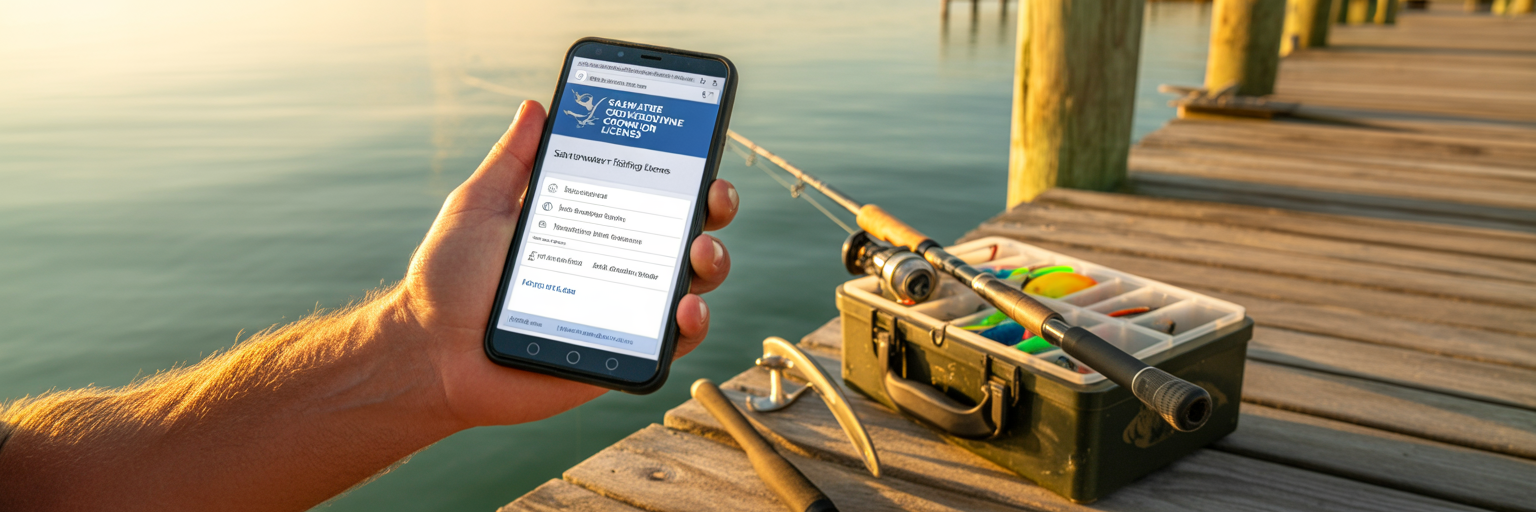
Even though it is free, you must actively obtain this license and have it with you, either physically or digitally on your phone, while fishing. The process is straightforward. You can get your no-cost shoreline license online through the FWC’s official portal at GoOutdoorsFlorida.com or by using the Fish|Hunt FL mobile app. You can also obtain it over the phone or in person at a local tax collector’s office. The FWC provides a detailed FAQ page to answer common questions about the saltwater shoreline fishing license. You can review it at the official FWC website to ensure you are compliant.
Defining Shore-Based Fishing Locations
The term “shore-based” can cause confusion, but the FWC’s definition is based on a simple principle. If you can access your fishing spot without a boat, you are likely considered a shore-based angler. This distinction is critical because it determines which license you need. Understanding this line in the sand prevents a simple mistake from turning into a serious violation.
Think about the classic Florida fishing scenarios. Casting spoons for Spanish mackerel from a Gulf coast beach is shore-based fishing. The same goes for dangling shrimp for sheepshead along an Intracoastal Waterway seawall or throwing plugs for snook around the shadow lines of a jetty at high tide. These are all activities covered by the resident shoreline license because you are standing on land or a structure fixed to it.
A common question revolves around wading. The rule is clear: as long as your feet are on the bottom and you did not use a vessel to get to your spot, you are considered a shore-based angler. If you park your truck, walk across the beach, and wade out onto a flat to sight-fish for redfish, you are covered by the shoreline license. Your feet are touching the ground, and no boat was involved.
The hard line is drawn at any type of floating vessel. This is what is not shore-based fishing. If you launch a kayak from the beach and paddle out 50 yards to fish, you are no longer a shore-based angler. The same applies to canoes, paddleboards, jon boats, and any other craft that floats. The moment you are in or on a vessel, the shoreline license becomes invalid, and you need a standard saltwater fishing license that covers vessel-based fishing. This is a common but costly mistake that an experienced guide would point out to help you stay on the right side of the law.
License Rules for Non-Resident Anglers

The rules for visiting anglers are direct and unmistakable. If you are not a Florida resident, you must purchase a saltwater fishing license to fish from the shore, a pier, or a bridge. The no-cost shoreline license is strictly for Florida residents and is not an option for visitors. This is a frequent point of confusion, so it bears repeating: every non-resident angler needs to buy a license.
Fortunately, the FWC offers several straightforward options for visitors. The choice depends on the length of your stay and how often you plan to fish in Florida. A non-resident Florida fishing license is easy to obtain and ensures you are compliant from your first cast to your last. Planning ahead makes the process seamless.
Here is a breakdown of the most common choices for visiting anglers:
| License Type | Duration | Typical Cost (Subject to Change) | Best For |
|---|---|---|---|
| 3-Day Saltwater | 3 consecutive days | $17.00 | A weekend fishing trip or short vacation. |
| 7-Day Saltwater | 7 consecutive days | $30.00 | A week-long fishing holiday. |
| Annual Saltwater | 12 months from date of purchase | $47.00 | Frequent visitors or snowbirds. |
Note: Prices are based on FWC data at the time of writing but are subject to change. Always verify current pricing on the official FWC website before purchasing.
For practical purposes, we recommend purchasing your license online before your trip. You can view the current costs and purchase your non-resident Florida fishing license directly from the FWC’s portal for visitors. This saves time and ensures you are legal the moment you arrive. These licenses are also readily available at most tackle shops and major sporting goods retailers throughout the state if you prefer to buy one in person.
Key Exemptions from a Florida Fishing License
While most anglers need a license, there are specific exemptions. A strong note of caution is necessary here: these exemptions are narrowly defined, and the burden of proof is always on you, the angler. You must be 100% certain you qualify and have the required documentation with you before fishing without a license. Making an assumption can lead to a significant fine.
Age-Based Exemptions: Under 16 and Over 65
The most common Florida fishing license exemptions are based on age. Children under the age of 16 are not required to have a saltwater fishing license. For senior anglers, Florida residents who are age 65 or older are also exempt. However, a resident senior must carry proof of age and residency, such as a Florida Driver’s License or ID card, at all times while fishing.
Exemptions for Military Personnel and Residents with Disabilities
Certain military members and residents with disabilities also qualify for exemptions. Florida residents who are certified as totally and permanently disabled or who possess a Florida Resident Disabled Person’s Hunting and Fishing License are exempt. Additionally, active-duty military members who are Florida residents and are home on leave for 30 days or less can fish without a license. In all these cases, you must carry the proper documentation, such as your military orders or disability certification, as proof of your exempt status.
The Limited ‘Cane Pole’ Exemption
This is a very specific and often misunderstood rule. A Florida resident can fish for saltwater species in their home county using a cane pole without a license. A “cane pole” is defined as a pole or line that does not have a reel or any other line retrieval mechanism. This exemption is extremely narrow. The moment you use any modern rod and reel setup, this exemption becomes void, and you need a license. It is a throwback rule that applies to very few modern fishing situations.
Finally, it is critical to remember that being exempt from needing a license does not exempt you from the law. You must still strictly adhere to all bag limits, size limits, seasons, and gear restrictions for every species. The FWC has a helpful online questionnaire to determine if you need a license. It is the best way to confirm if you qualify for one of the Florida fishing license exemptions, and you can find it on their website.
The Licensed Public Pier Exception
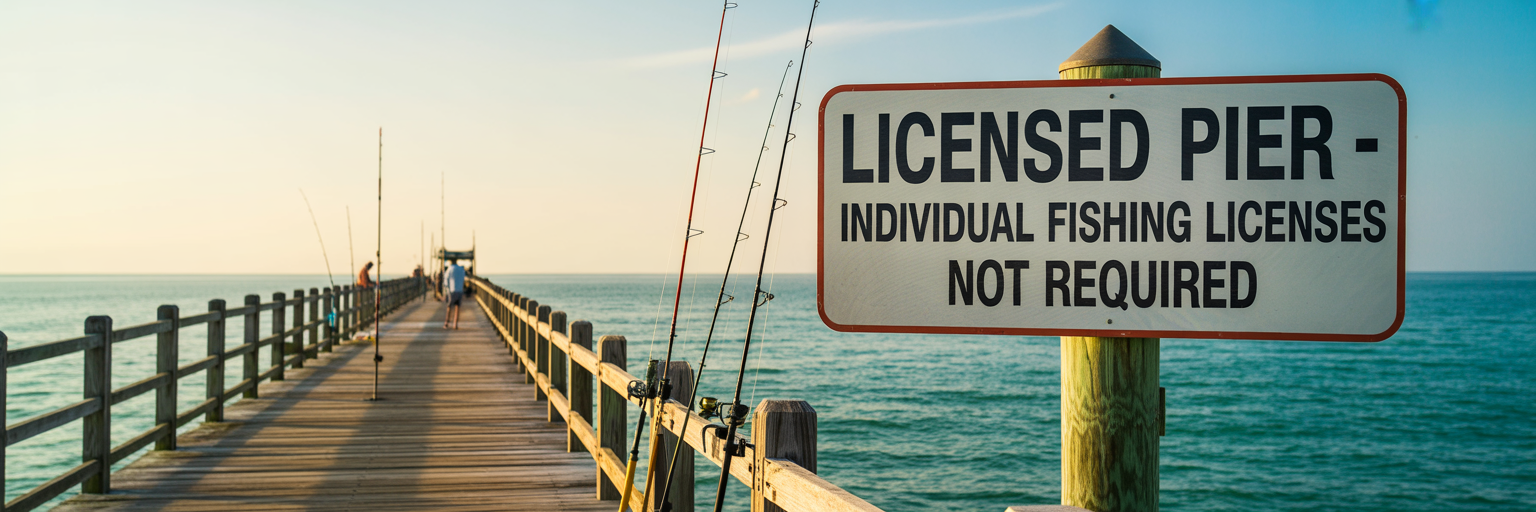
There is a unique rule that applies specifically to fishing from a pier in Florida. Certain public fishing piers across the state hold a special pier-wide license. This bulk license is purchased by the pier operator from the FWC and covers every angler fishing on that pier. This means that if you are fishing on a properly licensed pier, you do not need to have your own individual saltwater fishing license.
The most important, actionable advice for any pier angler is this: look for the sign. A pier that holds this FWC license is required to post its license number in a visible location. The sign will clearly state that individual anglers are covered. You cannot make assumptions. Just because a pier is public, juts out over the water, or charges an admission fee does not guarantee it has this specific FWC license. The responsibility is on you to find and verify the sign before you start fishing.
If you cannot find a sign, you must assume the pier is not covered and that you need your own license. Ask an employee if you are unsure, but always try to visually confirm the FWC pier license number yourself. This simple check can save you from a costly ticket.
It is also crucial to understand the physical limits of this exception. The pier license is only valid while you are on the pier structure itself. If you step off the pier to fish from the beach below or wade in the surf next to the pilings, you are no longer covered. At that point, you are considered a shore-based angler and must have your own individual license, such as the no-cost resident shoreline license. This is a critical detail that prevents a common and expensive mistake.
Permits Needed Beyond a Basic License
A general saltwater license or a valid exemption is often just the first step. For certain species and activities, Florida requires additional permits. Think of your basic license as the foundation, with these permits being necessary add-ons for specific types of fishing. Being a responsible angler means knowing the rules for your target species before you make a cast.
The Mandatory Shore-Based Shark Fishing Permit
This is a major point of emphasis for the FWC. Anyone, regardless of age or license status, who intends to target sharks from shore must complete the free online Shore-Based Shark Fishing course and obtain the permit. This applies even if you are under 16 or a resident over 65. If you plan to fish for sharks from a beach, jetty, or bridge, you need this permit. It is a no-cost educational requirement designed to improve shark survival rates.
Required Permits for Snook and Spiny Lobster
Snook and spiny lobster are two of Florida’s most prized inshore species, and harvesting them requires specific permits. These are paid add-ons to your general license. Here is a critical point: even if you are exempt from needing a general license, you still must purchase and possess the snook and lobster permits if you plan to keep one. For example, a resident over 65 does not need a general saltwater license, but if they want to harvest a legal snook, they must buy the snook permit.
Understanding the Layers of Florida’s Regulations
The permit system illustrates the layered nature of Florida fishing regulations. While shore anglers do not need it, another example is the State Reef Fish Angler designation, which is required for anglers harvesting certain reef fish from a private boat in the Gulf. This reinforces the core theme of angler responsibility. It is up to you to know the specific rules for your location, your gear, and your target species. You can find the latest requirements and costs for Snook, Lobster, and other permits on the FWC’s primary saltwater license and permits page.
Why You Must Always Verify the Rules Yourself
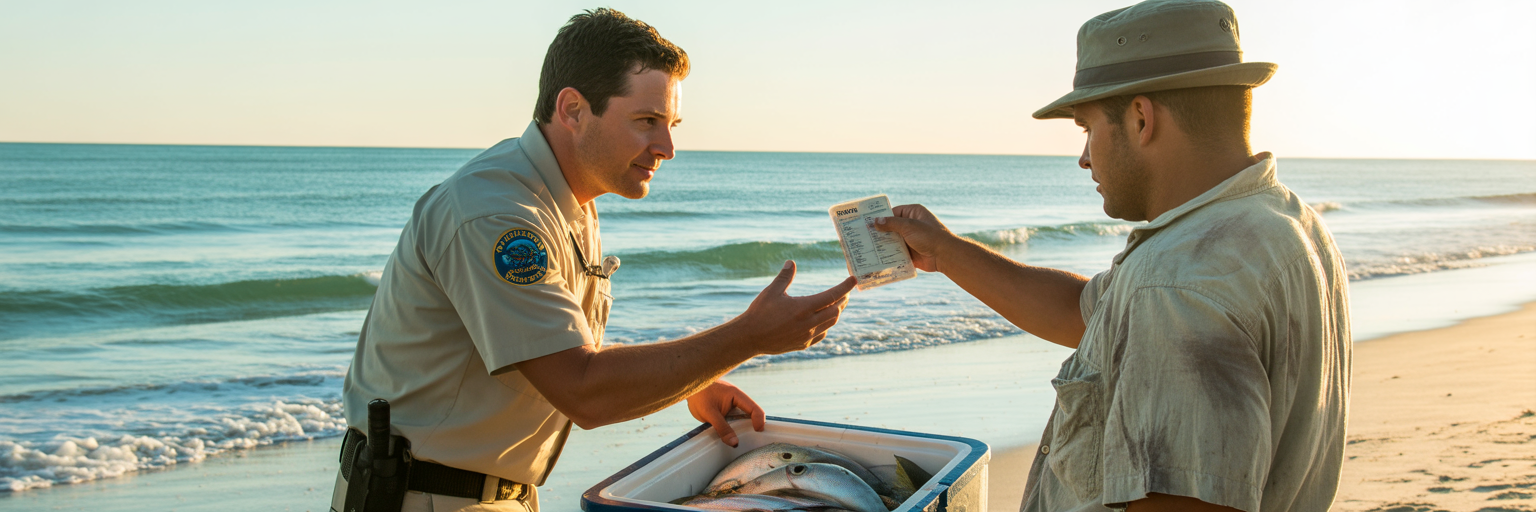
Regulations change, and online information can become outdated. The only way to be certain you are compliant is to check the rules yourself directly with the FWC. Ignorance of the law is never an excuse, and an FWC officer has heard it all before. The consequences of getting it wrong are more than just a fine. It can mean the confiscation of your expensive rod and reel, a mandatory court appearance, and a mark on your record that could affect future licensing.
Position the FWC as your single source of truth. We strongly recommend that every Florida angler download the official Fish|Hunt FL app. It puts the most current regulations, bag limits, and seasons right in your pocket, even when you are offshore without cell service. Before any trip, especially if you are fishing a new location or targeting a new species, take five minutes to check the FWC website for the latest updates.
Think of it this way: just like you check the tides and weather before you leave the house, a quick check of the regulations should be part of every angler’s pre-trip routine. It is the mark of a prepared, serious fisherman. Taking that extra step ensures your day on the water is memorable for the right reasons, not for an avoidable legal issue. A valid Florida fishing license and knowledge of the rules are the most important pieces of gear you can have.
Your Pre-Trip License Checklist
This simple checklist is a mental tool to run through before every shore-based fishing trip in Florida. It summarizes the key decisions to ensure you are always compliant.
- Am I a Florida Resident? If yes, move to step 2. If no, stop and buy a non-resident Florida fishing license. There are no exceptions for visitors fishing from shore.
- Do I Qualify for an Exemption? If you are a resident under 16 or over 65, you are likely exempt from the general license. If you qualify for another reason (disability, military leave), confirm you have the required proof of status with you before you go. If you are not exempt, move to step 3.
- Where Exactly Am I Fishing? If you are fishing from the shore, a jetty, a seawall, or a bridge, get the no-cost resident saltwater shoreline fishing license. If you are on a public pier, look for the sign indicating a pier-wide license is in effect. If you are in any vessel, including a kayak or paddleboard, the shoreline license is not valid and you need a standard resident saltwater vessel license.
- What Am I Targeting? If sharks are a possibility, do you have your mandatory Shore-Based Shark Fishing permit? If you plan to keep snook or spiny lobster, do you have those specific, paid permits? Remember, these permits are required even if you are otherwise exempt from holding a general license.
Running through these four questions will cover your bases and let you focus on what matters: catching fish.