
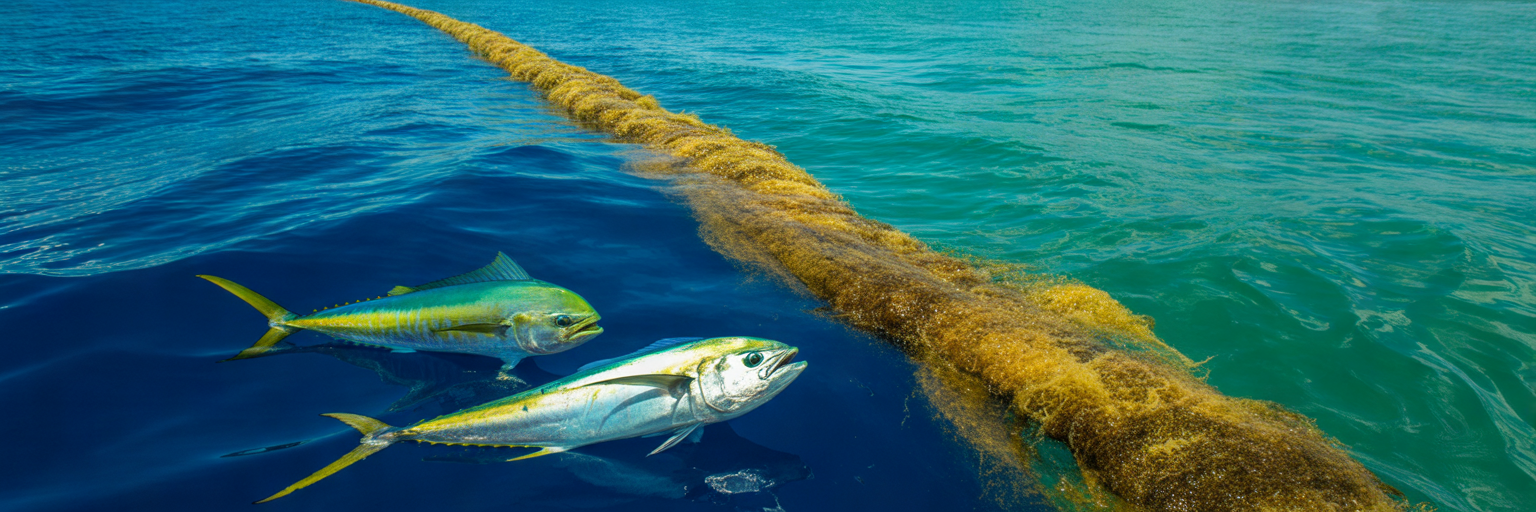
Pelagic dolphinfish can double their body weight in just a few weeks, driving an insatiable appetite that forces them to patrol floating sargassum canopies for calories. Understanding how to read these moving offshore edges is what separates a quiet ride home from a plugged fishbox. When you clear the inlet and point the bow toward blue water, locating productive mahi weed lines becomes your primary objective.
Reading Mahi Weed Lines and Offshore Liquid Structure in Florida
Walk down any Florida marina dock in June and you will hear two very different reports from boats that fished the exact same depth. One crew burned ninety gallons of fuel trolling past miles of floating grass without a knockdown, while the boat two slips down plugged the box by 11 a.m. Out past the reef line, pelagic predators do not have fixed bridge pilings or shallow oyster bars to relate to. Instead, they rely on offshore liquid structure. In an otherwise featureless ocean, floating sargassum canopies provide the only overhead shade, ambush points, and forage concentration for miles.
The Mechanics of Convergence Zones and Current Edges
Productive sargassum rarely sits still. The best lines form along active convergence zones where opposing water masses collide and force buoyant material into tight, defined lanes. On the Atlantic side, the northward push of the Gulf Stream rubs against slower continental shelf water, while upwelling along steep seafloor bathymetry like the Islamorada Hump or the Charleston Bump forces deep water toward the surface. Over in the Gulf, eddies spinning off the Loop Current create similar colliding boundaries. When sustained winds blow against or across these currents, scattered clumps of grass compress into thick, winding highways that trap baitfish and draw hungry pelagics from miles around.
Water Color Transitions and Micro-Temperature Breaks
Finding grass is only step one. The real skill lies in reading the water holding that grass. Keep your eyes on the surface for sharp color transitions where milky green coastal water slams into cobalt blue offshore water. You want to see a distinct surface rip line featuring churning foam, slick calm patches, and visible current shear. Watch your transducer graph closely as you cross these boundaries. A micro-temperature break of just 0.5 to 2 degrees Fahrenheit along a weed line acts like a brick wall that concentrates bait and triggers aggressive feeding. Connecting these foundational edge-reading skills with broader offshore strategies is the backbone of our complete guide to mahi mahi fishing across the state.
Why Massive Mats Can Be Completely Dead
More grass does not always equal more fish. Every experienced captain has pulled up to a massive, acre-wide carpet of sargassum expecting chaos, only to find zero life underneath. When huge mats drift into slack water away from a current edge, they stop moving and lose their oxygen-rich interface. Decaying vegetation underneath a stagnant mat actually depletes dissolved oxygen and pushes baitfish away. Always prioritize active water movement, sharp edge definition, and visible current shear over the sheer volume of floating grass.
Pre-Trip Satellite Intelligence and Seasonal Timing
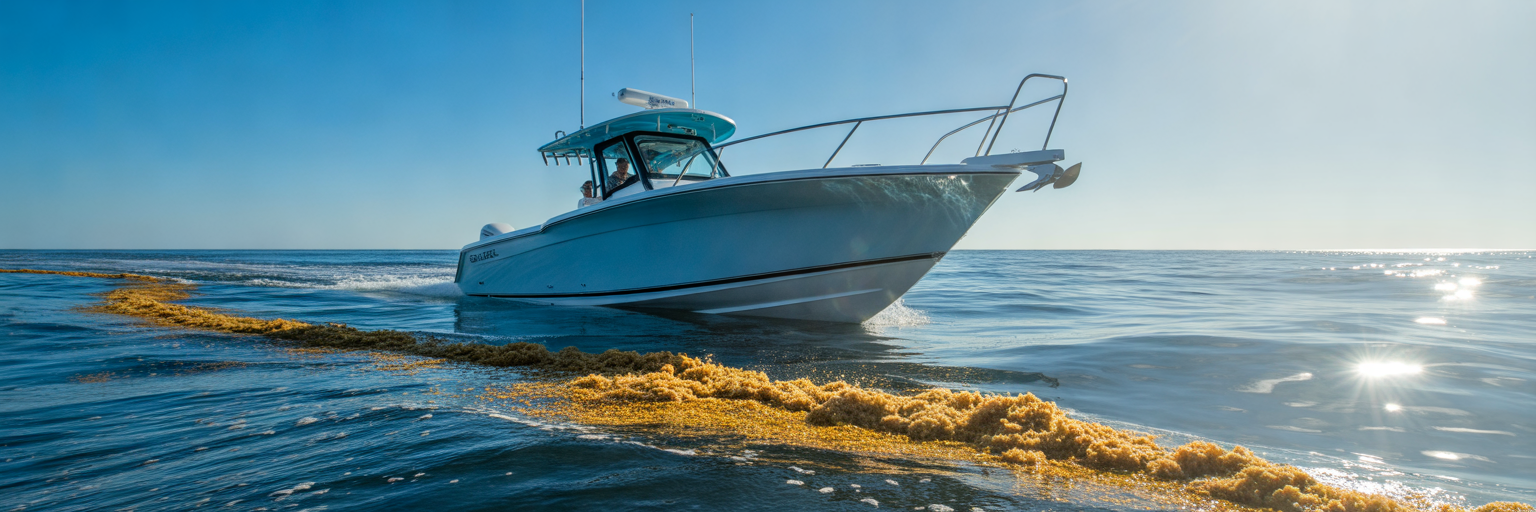
Burning fuel at forty knots while blindly hunting for grass is a quick way to blow your trip budget. Smart captains start their offshore recon on a tablet screen before the boat ever leaves the lift. Dialing in consistent Florida mahi fishing requires matching seasonal migration patterns with real-time oceanographic data so you know exactly which compass heading offers the highest probability of holding stacked sargassum.
The Florida Mahi Seasonal Calendar
While stragglers get caught year-round during warm winter eddies, the prime Florida dolphin window runs from April through October once offshore water temperatures stabilize between 74 and 85 degrees Fahrenheit. Late April through June brings the peak push of hyper-aggressive schoolies and solid gaffer packs moving north through the Straits of Florida. Southern boaters time this early push of grass down to the week, a pattern we break down in our Florida Keys spring calendar for crews running out of Islamorada, Marathon, and Key West. By July, August, and September, the overall numbers thin out slightly, but the average size jumps significantly as larger bulls and heavy cows patrol the deeper summer weed lines.
Leveraging SST, Chlorophyll, and Altimetry Data
Before buying bait, overlay three specific satellite datasets using subscription services like ROFFS, SiriusXM Fish Mapping, or RipCharts. First, pull the high-resolution Sea Surface Temperature (SST) chart to locate thermal breaks even before the summer water turns uniformly hot. Next, check chlorophyll imagery, which measures microscopic phytoplankton density and reveals the exact boundary between green nearshore water and clean blue pelagic water when midsummer surface temperatures blend together. Finally, examine altimetry data to measure sea surface height anomalies. Cyclonic (cold-core) eddies show up as dips in sea surface height raising nutrient-rich water, whereas anticyclonic (warm-core) eddies form slight hills where sargassum collects along the outer edges. For macro-level seasonal forecasting, check the University of South Florida Optical Oceanography Lab imagery and the NASA-supported Sargassum Early Advisory System (SEAS) to see when massive Caribbean and Atlantic blooms will push into the Keys, Palm Beach, or the Panhandle.
Night-Before Wind and Current Alignment
Satellite snapshots can be twelve hours old or blocked by cloud cover, which is why cross-referencing our HookCurrent real-time wind, tide, and local offshore reports bridges the gap between space imagery and what is actually happening at the inlet. Run through this five-step checklist the night before shoving off:
- Verify Sustained Wind Direction: Look for three consecutive days of east or southeast winds between 10 and 18 knots on the Atlantic coast, which pushes Gulf Stream weed lines closer to the ledge and within easy range of small center consoles.
- Check Wind-Against-Current Scenarios: Identify when a north or northeast wind blows directly against a 3-knot northbound Gulf Stream current, stacking sargassum into tight, towering walls rather than blown-out scatter.
- Plot Depth Contour Intersections: Mark waypoints where satellite-identified chlorophyll or altimetry edges cross major bottom contours like the 100-fathom curve, steep canyons, or offshore humps.
- Calculate Overnight Current Drift: Measure the speed of the current in knots and project where a reported afternoon weed line will drift over the next twelve hours so you intercept it at dawn rather than chasing yesterday’s numbers.
- Confirm Inlet Tides and Bar Conditions: Check the morning outgoing tide against oncoming swell height at your local pass to ensure you can clear the inlet safely at first light with a full livewell.
Separating Productive Sargassum from Dead Grass
Once the throttles come back and you settle in beside a line of grass, your eyes become your best piece of electronics. Knowing how to catch mahi in Florida consistently comes down to rapid visual scouting and refusing to waste prime morning hours working barren water. You can tell within five minutes whether a weed line is an active cafeteria or a biological desert.
The Baitfish Ecosystem Inside Healthy Mats
Pull alongside a mat and look directly into the root structure. A healthy, productive sargassum canopy is a living reef floating over thousands of feet of water. You should immediately spot tiny brown sargassum shrimp, juvenile planehead filefish, swimming crabs, and camouflaged frogfish clinging to the stalks. Those micro-critters form the base of the food chain, drawing in palm-sized blue runners, juvenile triggerfish, and compact balls of glass minnows. The ultimate indicators of a live, fish-holding line are flying fish and ballyhoo flushing out from the edge as your bow wake approaches. Look for dense, compacted, golden-brown mats with bright yellow growing tips that create a solid four-foot shadow canopy underneath. Avoid pale, bleached-out, or dark rotting grass, and steer clear of scattered popcorn weed that lacks the shade canopy required to hold mature predators.
Reading Frigatebirds and Terns
Even before you reach the edge, scan the horizon at thirty degrees above the water line for aerial scouts. A solitary magnificent frigatebird (man-o-war bird) changes everything. Learn to read the bird’s body language. A frigate soaring high on thermals at five hundred feet is simply searching, covering miles of ocean just like you. Drop everything when you see that same black scissor-tailed silhouette drop low to thirty feet, fold its wings back, and begin swooping, hovering, or pecking at the surface. Low-flying frigates and diving bridled terns are actively shadowing feeding bulls or packs of schoolies that are pushing flying fish and ballyhoo out of the grass.
Evaluating Flotsam When Weed Lines Scatter
Summer squalls and shifting winds frequently blow tight weed lines into unfishable scatter. When the grass disappears, shift your focus to isolated flotsam. Not all floating debris holds fish equally. A brand-new plastic bucket or clean styrofoam cooler that fell off a boat yesterday rarely holds more than a couple of micro-baits. You want aged, waterlogged flotsam: barnacle-crusted lumber, wooden shipping pallets, heavy poly rope tangles, bamboo poles, or lost crab trap buoys coated in green algae. If a piece of wood has been floating in the current long enough to grow gooseneck barnacles and hold a resident tripletail or a dark cloud of oceanic triggerfish in its shadow, a pair of gaffer mahi is almost always patrolling within fifty yards. Work a questionable stretch of grass for no more than fifteen minutes without seeing bait, birds, or a knockdown before picking up the throttles and running toward the next edge.
| Surface Feature | Visual & Biological Indicators | Expected Mahi Presence | Tactical Boat Response |
|---|---|---|---|
| Compacted Golden-Brown Mat on Current Edge | Flying fish flushing, crustaceans visible, water color change | High probability of schoolies and cruising gaffer pairs | Troll the clean side edge at 6 knots and ready pitch baits |
| Scattered Popcorn Sargassum | Broken clumps, no shade canopy, constant fouling on hooks | Very low; predators rarely hold under fragmented cover | Pull lines in and run toward denser lanes or bird activity |
| Barnacle-Crusted Lumber or Pallets | Triple-tail, baitfish clouds holding tight to shadow line | High potential for solitary bulls or large gaffer packs | Stop upwind, pitch live pilchards or jigs before trolling past |
| Vast Stagnant Mat in Slack Water | Bleached dying weed, zero current rip, no bird life | Barren; low dissolved oxygen under the mat repels forage | Do not waste fuel trolling; scan only the outermost points |
Setting the Trolling Spread for Heavy Grass Conditions
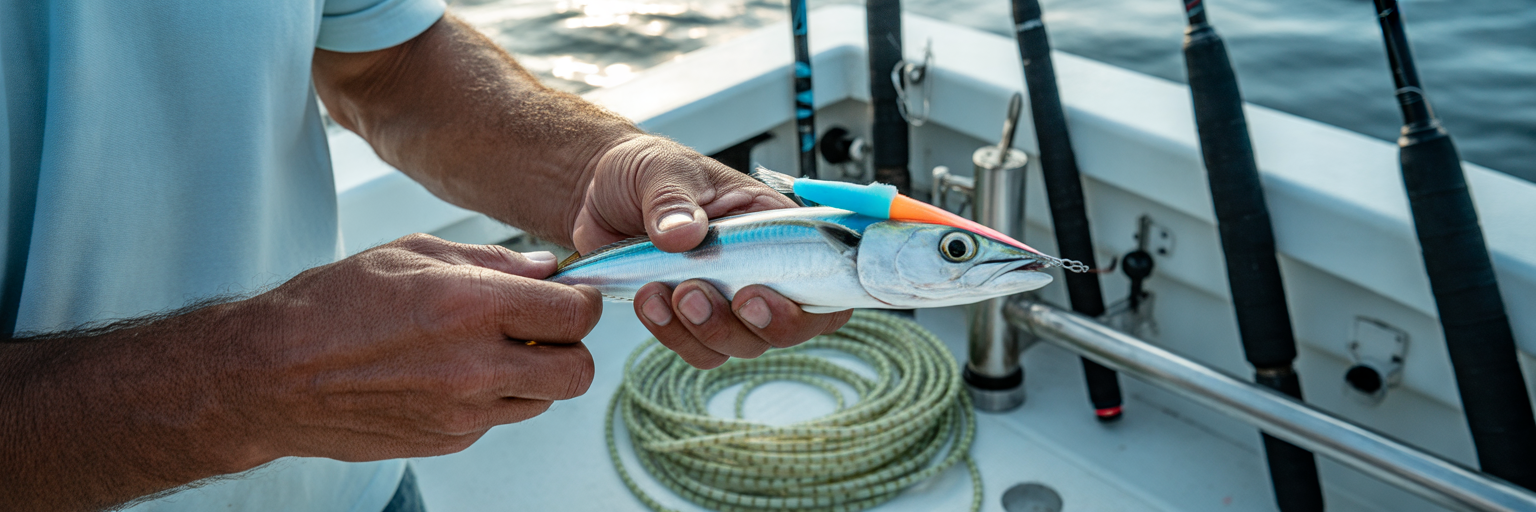
Nothing kills cockpit morale faster than spending forty minutes clearing soggy clumps of grass off six fouled rods while watching mahi free-jump fifty yards away. Effective trolling sargassum weed lines demands a disciplined spread geometry and lures specifically chosen to shed stray weeds rather than rake them in.
Staggered 2-to-5 Rod Spreads for Clean Lanes
Leave the eight-rod tournament spread at the dock when fishing ragged grass edges. A tight, high-efficiency 2-to-5 rod staggered spread pulled between 5.5 and 7 knots covers water rapidly and lets your crew clear lines in seconds when a pack erupts. Stagger your distances so baits can make tight turns around protruding points of grass without crossing lines. Run a heavy deep-diving lipped plug or weighted jet head tight on the short flat line right in the clean water of the prop wash, where the engines push surface weeds aside and the lure tracks four feet below floating scatter. Set your second flat line slightly further back with a weighted jig, and run two outrigger baits staggered wide on the clean blue-water side of the boat.
Choosing Weed-Resistant Lure Profiles and Rigged Ballyhoo
Lure head geometry dictates how much time you spend fishing versus cleaning hooks. Broad-faced cup chuggers and wide slant heads act like bulldozers in scattered grass, catching every floating frond. Swap them out for aerodynamic bullet heads, pointed sea witches, and conical nylon hair jigs that part stray strands of sargassum and allow weeds to slide off the leader. When rigging ballyhoo for mahi in grassy water, clip the beak short, tuck the copper rigging wire or waxing floss loops tightly flush against the jaws, and bury the point of a 7/0 or 8/0 J-hook cleanly into the belly slot so nothing protrudes to snag passing grass. Remember that dolphin have razor-sharp eyesight. A mahi will charge fifty feet to eat a skipping bait and turn away at the last inch if a single two-inch leaf of sargassum is spinning on the hook point. Assign one crew member to constantly watch the spread and snap-check rods to shake off tiny hangers. For a complete breakdown of head shapes, weights, and skirt colors that survive heavy grass, check out our guide to trolling lures for mahi.
Matching the Hatch in Pressured Waters
In heavily pressured corridors out of Miami, Islamorada, Palm Beach, or Stuart, weekend fleet traffic makes dolphin noticeably leader-shy. When big schools ignore standard ten-inch rigged mediums, scale down immediately to match the micro-forage hiding in the mats. Drop down to 40 or 50 pound fluorocarbon leaders and pull small 1/2-ounce blue-and-white, pink-and-white, or chartreuse feathers and mini strip baits that mimic three-inch juvenile flying fish and sargassum filefish. Keep the hull positioned twenty to thirty feet off the clean blue-water side of the weed line. Plowing the boat directly through the main mat fouls your props, ruins the shadow canopy, and spooks fish holding on the edge. Instead, swing the bow gently around pockets and points so your outer rigger bait kisses the fringe of the grass while your hull stays in clean water.
| Rod Position | Distance Behind Transom | Lure / Bait Selection | Primary Function in Grass |
|---|---|---|---|
| Short Flat Line (Port) | 30 to 45 feet (in clean prop wash) | Deep-diving lipped plug or heavy jet head | Tracks below floating surface scatter to trigger deeper bulls |
| Long Flat Line (Starboard) | 75 to 100 feet | 1 oz Nylon hair jig or bullet head with rigged ballyhoo | Slices through stray grass strands without fouling the hook |
| Short Outrigger (Port) | 120 to 150 feet (clean water side) | Small chugger head with fresh select ballyhoo | Pops and leaves a bubble trail parallel to the main mat |
| Long Outrigger / Way Back | 180 to 220 feet | Unweighted sea witch with strip bait or mini flying fish lure | Skips on the surface to draw strikes from boat-shy fish |
Boat Handling and the Bail-Out Strategy When Hooked Up
The moment a rigger clip snaps and a gold-and-green streak cartwheels across the wake, the real test of your crew begins. Executing sharp offshore dolphin fishing tactics during the first sixty seconds after a strike determines whether you put one fish in the box or hold a fifty-fish school behind the transom for an hour.
The Transition from Trolling to Bailing
Never slam the throttles into neutral the instant a single reel screams. Mahi travel in competitive packs, and the panic flash of the first hooked fish triggers an immediate feeding response from its schoolmates. Keep the boat in gear at five knots for ten to fifteen seconds while the angler picks up the bent rod, giving the rest of the pack time to crush your remaining flat lines and turn a single into a double or triple header. Once multiple rods load up, pull the throttles back smoothly in a gradual arc toward the clean-water side of the weed line, keeping tension on the lines while sliding the transom within casting range of the mat.
Keeping a Decoy Fish in the Water
The cardinal rule of bailing mahi is simple: always leave one hooked fish swimming in the water. Dolphin are fiercely schooling fish driven by visual curiosity and competitive aggression. As long as one lit-up, flashing mahi stays tethered on a short line right in the shade of the hull or engines, the entire school will stay parked right beneath your transom trying to steal food from its mouth. While one angler holds that decoy fish ten feet off the stern corner, the rest of the deck crew must wind in the remaining trolling outfits, stow them out of the way in the forward gunnels, and immediately toss a handful of cut squid, glass minnows, or chunked bonito into the prop wash. Once the school starts flashing and chewing the free-floating chunks recklessly, drop back hooked baits on spinning tackle and only gaff or swing the first decoy fish aboard after the next angler is solidly hooked up. We cover the exact deck roles that keep this rotation running smoothly in our breakdown of crew tactics for mahi.
Lone Slammer Bulls Versus Schoolie Packs
Know when to break the decoy rule. Big mature dolphin over twenty-five pounds rarely travel in large packs. They typically patrol weed lines as solitary bulls or mated male-and-female pairs. If your long rigger gets demolished by a 35-pound slammer bull and a big cow shows up behind the boat, pitch a live bait or heavy jig to the second fish immediately, but never leave a trophy fish hanging in the water as a decoy. Big bulls have the jaw strength to chaff through 60-pound leader, throw a hook on a violent headshake next to the lower unit, or attract a bull shark or silky shark waiting below the mat. Clear the deck and sink the gaff into a trophy fish the very first time it slides within reach. Run this six-point cockpit drill to keep every bail-out session under control:
- Hold Speed for Ten Seconds: Let the remaining trolling spread fish after the initial strike to draw multiple hookups before slowing down.
- Clear Unused Trolling Rods Forward: Wind in all unhooked trolling lines immediately and move those heavy rods to the bow holders to open up the stern cockpit.
- Chum with Micro-Chunks: Throw small half-inch pieces of cut bonito, ballyhoo, or live pilchards every thirty seconds to keep the school excited without filling their bellies.
- Park the Decoy Fish at the Corner: Keep the hooked attractor fish on a short leash right beside the trim tabs where it stays visible but away from the spinning props.
- Rotate Anglers Over and Under: Follow hooked fish around the transom corners, passing rods over and under the decoy line to prevent braided mainlines from crossing and cutting each other off.
- Open the Fishbox Lid Preemptively: Swing lifters or gaffed fish straight from the water into an open, iced fishbox in one fluid motion so green mahi never thrash loose on a bloody deck.
Run-and-Gun Casting, Pitch Baits, and Tackle Setups
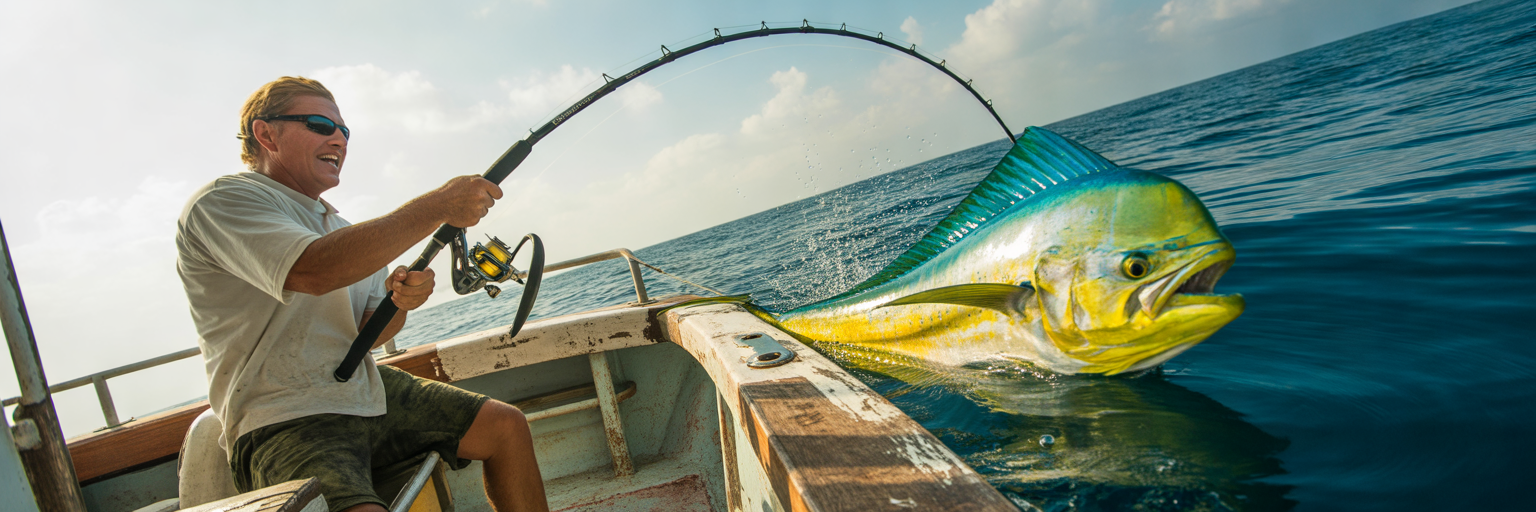
When midsummer wind drops out and the Atlantic or Gulf turns into a slick sheet of glass, blind trolling actually works against you. In crystal-clear, flat-calm conditions, boat hull noise and heavy outrigger wakes alert pressured fish long before your lures arrive. That is when you rack the trolling rods and switch to an active run-and-gun casting game.
Sight-Casting from the Tower or Bow
Put your sharpest pair of polarized amber or copper-lens sunglasses on the tower or elevated bow casting platform and cruise ten yards off the weed line at ten to twelve knots. From that high vantage point, glowing electric-blue pectoral fins and neon green backs pop right out against the dark brown sargassum shadows. You will regularly spot pairs of gaffer mahi sunning themselves near the surface or hovering under isolated clumps of grass that you would have blown right past at trolling speed. When you spot fish or a dense dinner-table mat, pull the throttles back to idle fifty yards uptide, let the boat glide silently into casting range, and fire pitch baits ten feet past the target so your presentation swims naturally out from the edge of the shade canopy.
Spinning Arsenal, Braided Line, and Terminal Tackle
Your pitch-bait arsenal must sit rigged, unhooked from the reel bail, and ready to fire in the gunnel holders before you ever leave the inlet. Match 7-foot medium-heavy fast-action spinning rods with high-speed 4000 to 6000 size spinning reels, such as a Shimano Stella SW 6000XG or Twin Power SW, capable of picking up over forty inches of line per crank when a hooked mahi charges straight at the boat. Spool those reels with 20 to 30 pound high-visibility eight-carrier braid so you can track line angles in the cockpit and make long, effortless casts with weightless baits. We detail the exact knots, line capacities, and top-shot configurations in our guide to dialing in braided line for mahi fishing. Connect your braid via an FG or Alberto knot to three feet of 30 to 40 pound fluorocarbon leader. Rig two rods with 4/0 or 5/0 inline light-wire circle hooks (crimping the barb down makes unhooking schoolies at the rail twice as fast) for pitching live pilchards or chunks, and rig two more rods with 3/4-ounce white bucktail jigs tipped with strip bait or 5-inch soft plastic jerkbaits rigged weedless on heavy belly-weighted swimbait hooks to rip directly through thick grass mats.
Fooling Boat-Shy Bulls with Light Fluorocarbon
Every Florida angler has lived the nightmare of watching a 25-pound bull swim right up to the transom, inspect five different chunk baits with its nose an inch from the hook, and lazily swim away without eating. Big pressured mahi get smart fast. When a picky bull or heavy gaffer pack locks its jaws behind the boat, drop down immediately to a stealth setup: a 20-pound fluorocarbon leader tied with a small loop knot to a #1 or 2/0 short-shank live bait hook. Hide that tiny hook inside a chunk of fresh bonito belly or nose-hook a lively threadfin herring, cigar minnow, or Spanish sardine. Free-spool the bait back into the chum slick with the bail open, holding the braided line lightly between two fingers so the bait sinks at the exact same speed as your unhooked freebies. Verify this five-point rod-rack readiness checklist before pulling the throttles back on a weed line:
- Set Spinning Drags with a Scale: Dial drags to exactly 6 to 8 pounds on 20-pound tackle and 10 pounds on 30-pound setups so frantic strikes do not pop light fluorocarbon leaders.
- Pre-Cut Chum and Pitch Chunks: Fill a cutting-board tray with twenty uniform cubes of bonito, squid, or ballyhoo before approaching the grass so no one is searching for a bait knife during a bite.
- Rig One Heavy Wire or Mono Pitch Rod: Keep one 6000-size spinner rigged with 80-pound hard mono or a short trace of #5 single-strand wire and a heavy jig for the inevitable wahoo That lurks fifty feet below major floating debris.
- Stage De-Hookers and Long-Nose Pliers: Hang two commercial-grade arc de-hookers right on the transom baitwell for rapid, hands-free releases of undersized fish.
- Clear the Deck of Loose Gear: Stow bucket handles, stray dock lines, and tackle trays so flying braided line cannot wrap around deck hardware during a double hookup.
Florida Mahi Regulations, Regional Nuances, and Stock Ethics
Fishing Florida waters means operating across two completely different oceans with distinct current systems and strict regulatory boundaries. What puts fish in the box three miles off Boynton Beach will leave you empty-handed out of Clearwater, and misreading state versus federal rules at the dock carries heavy fines.
Atlantic Ledge Runs Versus Gulf Loop Current Expeditions
On the Florida Atlantic coast from Key West through Miami, Palm Beach, and up to Stuart, the western wall of the Gulf Stream hugs the continental shelf closely, often pushing productive sargassum lines into 150 to 600 feet of water just three to twelve miles outside the inlet. Further north out of Ponce Inlet, St. Augustine, and Jacksonville, the stream bends east, requiring longer 30 to 50 mile runs toward the ledge. Over on the Gulf Coast, the game changes completely. While central west coast anglers out of Tampa Bay and St. Pete occasionally encounter coastal grass pushes in 100 feet of water during late summer west winds, consistent Gulf mahi action requires long expeditions toward the Loop Current and deepwater structure. Panhandle crews running out of Pensacola, Panama City, and Destin benefit from the DeSoto Canyon carving deep blue water much closer to shore, a tactical advantage we map out in our Destin offshore spot guide for private boaters targeting weed lines and FADs.
FWC Bag Limits, Fork Length Rules, and Release Ethics
Florida regulations split sharply between the Atlantic and the Gulf. In Atlantic state and federal waters, strict conservation measures protect the heavily pressured stock: anglers must adhere to a 20-inch minimum fork length, a 5-fish per person daily bag limit, and a strict maximum vessel limit (always verify current FWC and South Atlantic Fishery Management Council rules before shoving off, as federal and state vessel caps undergo periodic adjustments). In Gulf of Mexico waters, there is currently no minimum size limit in state or federal waters, with a 10-fish per person bag limit and a 60-fish vessel limit inside state waters. Regardless of the legal rules, ethical stock stewardship starts on your deck. Heavy recreational pressure along the Atlantic coast has made protecting juvenile “peanut” mahi below twenty inches vital for next season’s gaffer class. Never swing an undersized 14-inch mahi onto a scorching fiberglass deck or grab it with a dry towel, which strips its protective slime coat and causes fatal internal bleeding when it thrashes. Keep short fish in the water beside the gunnel and pop the hook out cleanly with a long-handled de-hooker so they swim back under the mat unharmed.
When to Book a Local Charter Captain
If you are trailering your boat to a new Florida region for vacation or transitioning from inshore flats fishing to offshore blue-water runs, jumping straight into a 35-mile ocean crossing in a hybrid bay boat is a high-stakes gamble. Booking a day with a vetted local charter professional lets you learn regional inlet hazards, seasonal run distances, and live-bait rigging nuances firsthand before burning your own fuel, a smart move we detail in our guide on when to book a mahi charter. When you do run your own hull and box legal fish, measure every borderline mahi flat on a certified board from the tip of the closed jaw to the center V of the tail fork. Bleed your keepers immediately and submerge them in a thick saltwater and crushed-ice slurry rather than dry bagged ice; rapid core cooling preserves the firm, sweet white fillets that make dolphin famous on the grill. Finally, take five minutes back at the dock to log the exact water temperature, wind history, depth, and current speed into your plotter so you are ready to intercept the very next edge that pushes down the coast.