
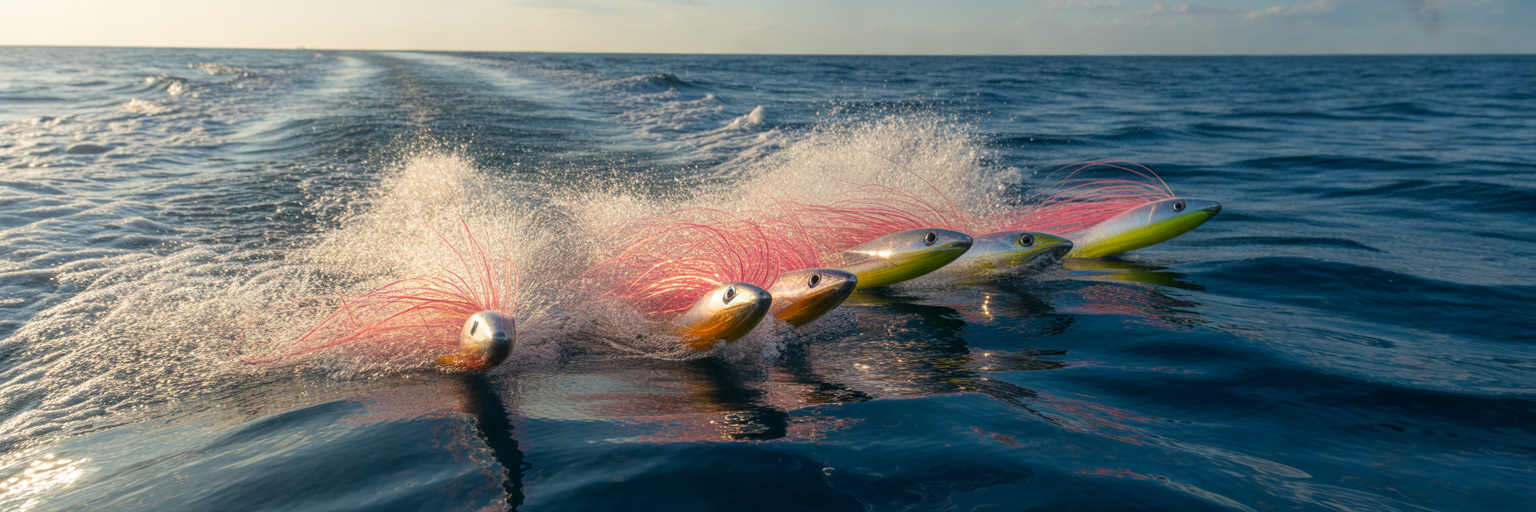
There is a specific moment on every Florida offshore run. It is that feeling when you clear the inlet, the sun climbs, and you spot the first promising weed line stretching across the blue water. This is when the real work begins. Success hinges on understanding your trolling lures for mahi not as individual baits, but as a coordinated system designed to imitate life and trigger strikes. Get this right, and you turn a long boat ride into a productive day on the water.
Essential Trolling Lures for Mahi Success
Before a single lure hits the water, you need a plan. A well-thought-out spread is the foundation of successful trolling. It is not about randomly clipping on your prettiest lures. It is about creating a presentation that tells a story to every mahi that swims by. This approach is fundamental to all effective mahi mahi fishing, separating anglers who get lucky from those who consistently fill the fish box.
The Spread as a System: Telling a Story
Think of your trolling spread as an illusion. You are creating the appearance of a small, panicked school of baitfish fleeing for their lives. Each lure, from the splashing teasers near the transom to the distant shotgun lure, plays a specific role in this drama. The commotion from the lures closest to the boat draws attention, while the lures running farther back in clean water appear as easy, isolated targets for an opportunistic predator. When every piece works together, the entire presentation becomes irresistible.
Key Positions in Your Trolling Spread
Every spot in your spread has a distinct job. Understanding these roles is key to building an effective pattern. The short corner, or flat line, is your close-in brawler. This lure runs in the turbulent prop wash, creating chaos and noise right behind the boat. Farther out, the long rigger position is the clean-water cruiser, presenting a lure in undisturbed water where it can be seen clearly from a distance. Finally, the shotgun is the stealthy sniper. This is a single lure run way back behind everything else, designed to pick off the larger, warier fish that might be hesitant to approach the boat.
The Core Lure Arsenal
Your lure bag should contain three primary categories of tools. Skirted lures, including chuggers, jets, and bullets, form the backbone of most mahi spreads. Diving plugs are your problem solvers, allowing you to get a presentation down into the water column when fish are not feeding on the surface. And of course, there is natural bait like ballyhoo, which adds the critical element of scent. A well-organized spread with a mix of these types is a tangle-free, effective spread. This organization allows you to make tight, confident turns on a weed line or debris without creating a mess.
Matching Lure Head Shape to Sea Conditions
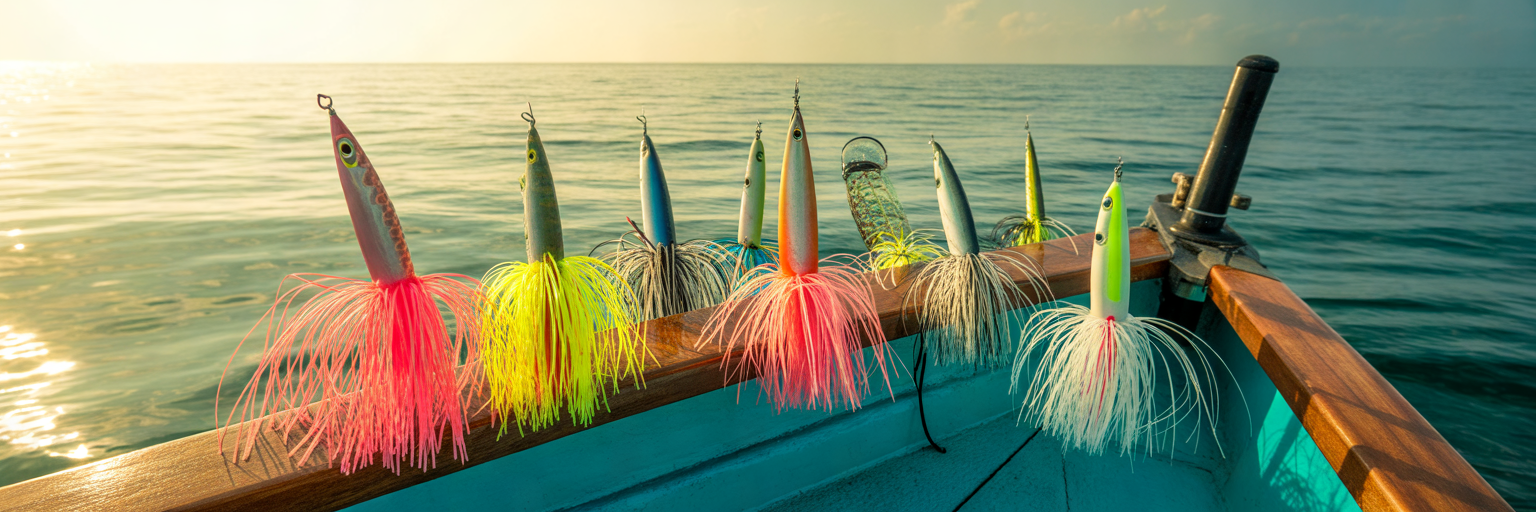
The shape of a lure’s head dictates its action in the water and, ultimately, its effectiveness on any given day. Choosing the right head shape for the sea conditions is not just a minor detail, it is a critical factor that determines whether your lure swims properly or tumbles uselessly. This is the technical side of trolling, where understanding lure physics translates directly to more hookups.
Bullet Heads: For Speed and Rough Water
When the wind is up and the seas are choppy, the bullet head is your workhorse. Its streamlined, hydrodynamic design allows it to stay in the water and swim straight, even when pulled at higher speeds of 8 to 10 knots. This stability makes it the go-to choice for covering ground in rough conditions. They do not create a lot of splash, but their ability to run true in messy water makes them an essential component for your long rigger and shotgun positions.
Jet Heads: The Bubble Trail Advantage
A jet head is all about visual attraction. Designed with holes or channels that force water through the head, these lures create a dense and highly visible bubble trail. This trail acts like a beacon, helping mahi locate your lure from a distance, especially in clear, calm water. They run best at speeds of 7 to 9 knots and are classic choices for the long rigger and shotgun positions where visibility is paramount.
Chugger and Slant Heads: Maximum Commotion
In calm to moderate seas, you want to make some noise. Chugger and slant heads, with their cupped or angled faces, are built for this job. As they move through the water, they dig in, pop, and throw a significant amount of spray. This commotion mimics a fleeing baitfish and acts as an aggressive dinner bell for any nearby mahi. They perform best at slower speeds, typically 6 to 8 knots, and are most effective when run in the short corner or short rigger positions where their splashing action can excite fish into the spread.
Diving Plugs: Getting Down to Business
Sometimes the bite is not on the surface. When you are marking fish deep or the surface action is slow, a deep-diving plug is your prospecting tool. These lipped hard baits are designed to wiggle and dive to a specific, predetermined depth, allowing you to present an offering where the fish are holding. Running one off a short corner or flat line is a proven way to locate the strike zone when mahi are not showing themselves on top.
Quick Guide: Matching Lure Head to Offshore Conditions
| Lure Head Shape | Ideal Sea Condition | Optimal Trolling Speed | Action in Water | Common Spread Position |
|---|---|---|---|---|
| Bullet Head | Rough / Choppy | 8-10 knots | Straight, stable swimming | Long Rigger, Shotgun |
| Jet Head | Calm to Moderate | 7-9 knots | Straight swimming with heavy bubble trail | Long Rigger, Shotgun |
| Chugger / Slant Head | Calm / Light Chop | 6-8 knots | Pops, splashes, and ‘chugs’ on surface | Short Corner, Short Rigger |
| Deep-Diving Plug | All Conditions | 5-7 knots | Wiggles and dives to a set depth | Short Corner / Flat Line |
This table provides a practical reference for selecting the right lure head based on the day’s sea conditions and your trolling speed. The choices reflect common tactics used by experienced Florida offshore anglers to maximize lure performance.
Decoding Mahi Lure Color and Size
Once you have matched your lure’s action to the sea conditions, the next decision is visual: color and size. While there are endless debates on the topic, a few proven principles will guide your mahi lure color selection and help you build a versatile and effective arsenal. Getting this right is what turns lookers into biters and makes for the best lures for dolphin fish on any given day.
Matching the Hatch: Natural Presentations
The foundational theory of lure color is to mimic what mahi are naturally eating. Offshore, this often means flying fish, ballyhoo, and squid. Lures with blue and white, silver, or black and silver combinations are staples for a reason. They effectively imitate the flash and profile of these primary food sources. On bright, sunny days with clear water, a natural presentation is often the most effective approach, as it presents a familiar and trustworthy target to feeding fish.
Triggering the Bite: High-Visibility Attractors
Sometimes, matching the hatch is not the answer. On overcast days, in murky water, or when fish are simply not aggressive, a high-visibility attractor color can provoke a reaction strike. This is where the classic mahi colors come into play: bright pink, chartreuse, and the green-and-yellow “rasta” pattern. These loud, obnoxious colors do not look like anything natural, but their visibility can trigger a predatory response out of pure aggression or curiosity. Having a few of these bright lures in your spread is a critical part of a complete trolling strategy.
Sizing for Schoolies vs. Slammers
Lure size directly influences the size of the fish you are likely to catch. For consistent action with school-sized mahi, lures in the 4 to 7-inch range are the bread and butter. This size perfectly matches the profile of the smaller baitfish that make up the bulk of their diet. However, if your goal is to target a big “slammer” bull, you need to upsize your offering. Stepping up to larger 7 to 10-inch lures is a strategic trade-off. You will likely get fewer bites, but the fish that do commit are more likely to be the trophy you are looking for. Just as you need a complete kit for success with our Florida inshore fishing gear, your offshore lure selection must be comprehensive enough to target fish of all sizes.
To build a practical lure bag, start with this core selection:
- The Naturals: At least two blue/white or silver/white lures to mimic flying fish.
- The Brights: A pink/white and a chartreuse/green lure. These are your high-visibility attractors.
- The Dark Horse: A purple/black or red/black lure for low-light conditions at dawn and dusk.
- Mixed Sizes: Ensure your color palette is spread across both schoolie (5-inch) and slammer (8-inch) sizes.
Setting Your Four-Line Mahi Trolling Spread
Now it is time to put theory into practice. A clean, organized, and effective mahi trolling spread setup is the mark of a seasoned angler. The most important rule is to set your lines from closest to farthest to prevent tangles. A standard four-line spread is a perfect starting point for most boats and provides excellent coverage. The precision required here is just as important as it is when mastering tide chart reading for kayakers; every detail matters.
- Position 1: The Port Short Corner. Start with your port side flat line. This is the place for a high-action lure like a chugger or a deep-diving plug. Position it in the second or third wave of your boat’s wake, typically about 30 to 50 feet back. Its job is to create noise and commotion right behind the boat, drawing attention to the rest of your spread.
- Position 2: The Starboard Short Corner. Next, set the starboard flat line. Use a similar style of lure here, but consider using a different color to give the fish a choice. Set this lure slightly farther back than the first, around 50 to 75 feet. This initial staggering is the first step in creating a tangle-free pattern.
- Position 3 & 4: The Long Riggers. With the flat lines set, it is time to deploy the outriggers. These positions are ideal for skirted lures like jets or bullets that run best in the clean, undisturbed water outside the prop wash. Set one rigger at 75 to 150 feet and the other at 100 to 200 feet. This significant difference in distance is crucial and allows the lures to swim freely without interfering with each other.
- Position 5: The Shotgun. This is your money line. The shotgun is a single lure run straight down the middle, far behind everything else. A small, simple lure like a bullet head or a classic cedar plug is perfect here. Set it way back, anywhere from 175 to over 250 feet. This lure often catches the largest, wariest fish that are spooked by the boat’s presence.
The key principle that makes this all work is staggering. No two lures should ever be running at the same distance from the boat. This separation is what allows you to make productive S-turns along a weed line or circle back on a school of fish without creating a catastrophic tangle. Mastering this setup is a fundamental skill for any serious offshore angler.
Integrating Teasers and Ballyhoo Rigs
While a well-run spread of artificial lures will catch plenty of mahi, integrating teasers and natural bait can turn a good day into an unforgettable one. These advanced tactics add another layer of attraction to your spread, creating more excitement and drawing in fish from a wider area. This is also where you learn how to rig ballyhoo for mahi, a skill that will pay dividends for years to come.
The Role of Teasers: Creating a Feeding Frenzy
Teasers are large, hookless attractors whose only job is to create the illusion of a major feeding event. They are your billboards, advertising an easy meal. Common types include spreader bars, which mimic a school of squid, and daisy chains, which look like a line of small baitfish or birds chasing each other. These are run from the transom corners, just outside the prop wash, where their splashing and commotion can be seen from a great distance, pulling curious mahi into your lure spread.
Why Natural Bait Still Reigns Supreme
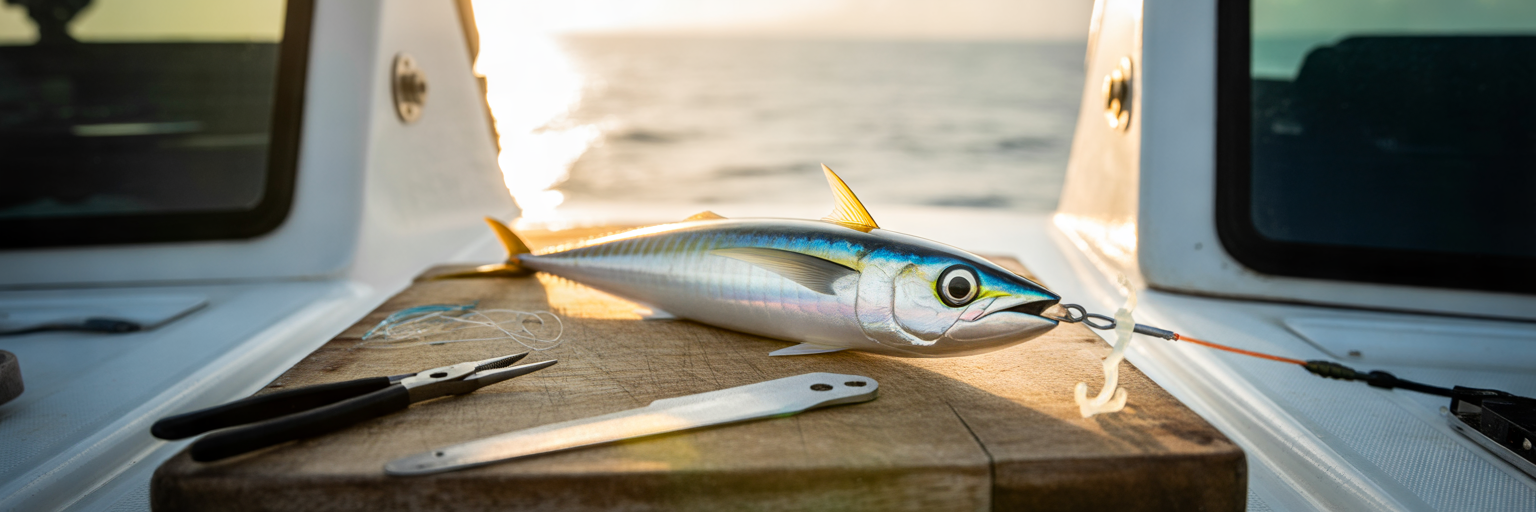
Artificial lures are convenient and effective, but there are days when finicky fish will follow a lure but refuse to commit. This is when natural bait makes all the difference. The scent and subtle, lifelike action of a properly rigged ballyhoo are often what it takes to trigger a strike from a hesitant fish. Experienced captains know that even in a spread full of artificials, having at least one or two lines with natural bait is a critical form of insurance.
How to Rig Ballyhoo for Mahi
Rigging ballyhoo is a skill, but the two primary methods are straightforward. The specific rigs needed are just as important as those used in our guide to Florida bottom fishing rigs. For the most natural look, a naked rig using a simple pin rig and monofilament leader is best. This allows the ballyhoo to swim with its own natural action. For a combination of flash and scent, a hybrid rig is the answer. This involves placing a small chugger head or a skirted lure like an Ilander over the ballyhoo’s nose. This gives you the color of an artificial with the undeniable appeal of real bait. Ballyhoo rigs are most effective on the short and long riggers, trolled at a slightly slower speed of 5 to 7 knots to keep them from washing out.
On-the-Water Adjustments for More Hookups
The best anglers are not passive. They are constantly observing, thinking, and adjusting their approach based on what the fish and the conditions are telling them. Mastering these on-the-water adjustments is the final piece of the puzzle and a core component of effective Florida offshore trolling tactics. This active approach is what separates the top 10% of fishermen from the rest.
Reading the Seas and Adapting Your Spread
Pay attention to how your lures are running. If the seas begin to build and your lures are tumbling, it is time to adapt. Speed up to 8 or 9 knots and switch to heavier bullet heads that can handle the chop. Conversely, if the seas lay down and become calm, slow down to 6 or 7 knots and deploy chuggers and slant heads to create more surface commotion. Constantly tuning your spread to the conditions ensures your lures are always working at peak effectiveness.
Working Structure: Weed Lines and Debris
When you find a promising weed line or a piece of floating debris, do not just troll past it in a straight line. Work the structure using a series of gentle S-turns. This tactic swings your lures in and out of the strike zone, keeping them in front of holding fish for a longer period. As you approach the structure, consider tightening your spread by bringing the lures closer to the boat. This concentrates your presentation right where the fish are most likely to be.
The All-Important Pitch Bait
This is a non-negotiable rule of mahi fishing: always have a pitch bait ready. Keep a medium-action spinning rod rigged with a live bait, a dead ballyhoo, or a bucktail jig in a rod holder, ready to be deployed at a moment’s notice. When you hook a mahi, it will often be followed to the boat by the rest of its school. Pitching a bait into this frenzy is the fastest way to turn a single hookup into a multiple-fish stop. This single tactic can be the difference between catching one fish and catching ten.
Finally, let the fish tell you what they want. When a lure gets hit, that is direct feedback. Immediately consider putting another lure of the same size and color out in the spread. As top captains featured in publications like Sport Fishing Magazine consistently emphasize, adapting to the day’s bite is the ultimate key to success.