
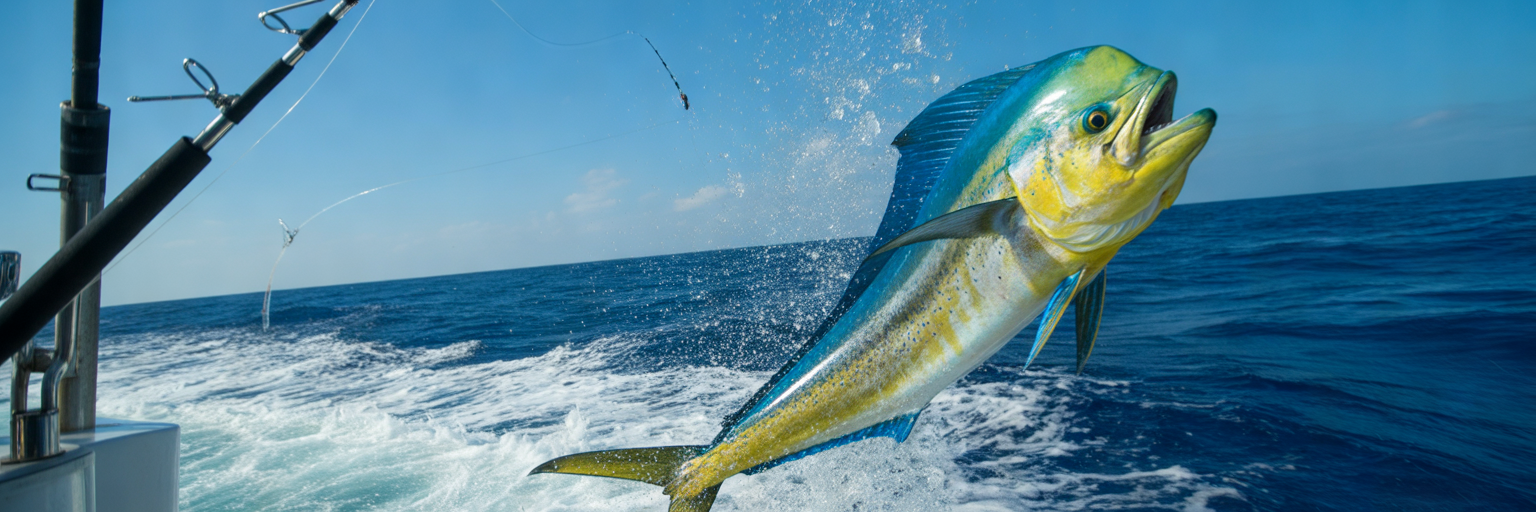
Dolphin grow faster than almost any other pelagic species in the Atlantic, burning massive calories daily and forcing them to ambush bait schools moving at precise velocities. Getting your boat speed and wake geometry dialed in is the difference between burning fuel across empty blue water and loading the fish box before noon. Mastering mahi trolling speeds and a clean mahi trolling spread setup turns your hull into a predator magnet.
Baseline Mahi Trolling Speeds and Spread Setup Fundamentals
Turning Your Wake Into a Baitfish Dinner Bell
When you clear the inlet and push out to the blue water, your hull and outboard props become your primary teaser. The fundamental goal of offshore trolling for dolphin is turning your prop wash and wake into an acoustic and visual dinner bell that mimics a panicked school of fleeing baitfish. You are not just dragging hooks through the ocean. You are building an illusion of chaos that forces a high-metabolism predator to react before it can think.
For most Florida offshore runs, the baseline window sits right between 6 and 8 knots. That range generates enough hull displacement to throw a crisp, aerated white water alley while leaving clean, glassy lanes along the wave faces where fish can track your offerings. Still, staring at your console electronics all morning is a fast way to fish dead water. What happens behind the transom matters far more than the digits on your helm screen.
Step back to the covering boards and look directly at how your baits swim in the clean water pockets. Your lures and natural baits should kick, pop, and breathe right on the forward-sloping faces of the wake waves without launching into the air or dragging limp beneath the foam. How you manage boat speed and wake control fits directly into the bigger picture of our mahi mahi fishing game plan for locating and converting packs offshore.
Reading Water Speed vs GPS Speed Over Ground in the Gulf Stream
One of the most common mistakes we see along the Atlantic edge is trusting GPS Speed Over Ground (SOG) instead of reading actual speed through the water. The Gulf Stream does not care what your chartplotter says. Take a typical morning running out of Palm Beach or Boynton Inlet where the northbound current is ripping at 3.5 knots. If you point the bow south into that current and set your throttles to hit 7 knots SOG on the screen, you are actually pushing 10.5 knots of water flow across your lures. At that velocity, natural baits spin like propellers and light chuggers blow completely out of the water.
Turn the boat around and troll north with that same 3.5 knot current at 7 knots SOG, and your actual water speed drops to a sluggish 3.5 knots. Your spread loses all surface action, baits sink, and lines foul before you cover half a mile. Ignore the GPS speed and calibrate your throttles by watching the wake foam, listening to the engine pitch, and checking the bend in your rod tips. Every rod on the gunwale must work as part of a unified system rather than isolated lines dropped randomly behind the transom.
Dialing In Boat Speed for Rigged Ballyhoo vs Artificial Lures
Natural Bait Mechanics from 5.5 to 7 Knots
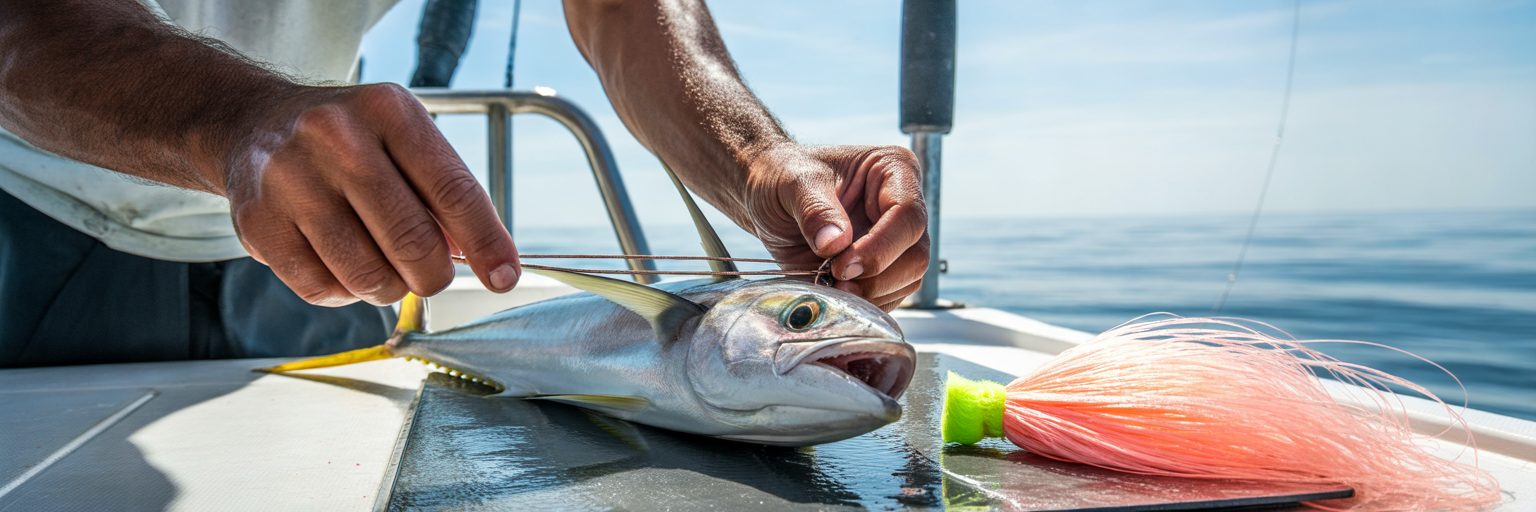
Matching your boat velocity to what is tied onto the end of your leaders dictates how many knockdowns you get. When trolling ballyhoo for mahi, speed discipline keeps your natural baits intact and swimming naturally. Naked rigged ballyhoo and Spanish sardines perform best between 5.5 and 6.5 knots of water speed. Inside that window, a properly brined bait swims with a tight, natural tail kick just below the surface film.
Push a naked ballyhoo past 6.5 knots and water pressure catches the lower jaw, blowing out the gills and turning the bait into a spinning helicopter that twists 80-pound monofilament in minutes. Watching a balanced bait swim cleanly at 6 knots without helicoptering starts at the rigging table, which we break down step by step in our offshore ballyhoo rigging guide. When you need to cover lifeless water between structure a bit faster, slide a small concave chugger head, nylon sea witch, or weighted mylar skirt over the nose of the ballyhoo. That nose cone shields the beak from direct water pressure, extends bait durability, and lets you bump boat speed up to a solid 7 knots while throwing a tight bubble trail.
High Speed Searching with Resin Heads and Jets
When summer scattered grass requires covering twenty miles of open water off Islamorada or Jupiter to locate a single fishy rip, dead bait slows you down. Shifting to an all-artificial spread lets you push the throttles up between 7.5 and 9.5 knots. Resin-head bullets, metal jet heads, and heavy slanted plungers thrive on velocity. The faster water flow forces air through the jet ports and around the beveled resin faces, creating a dense smoke trail of micro-bubbles that calls dolphin in from fifty yards away.
At 8.5 knots, a fish has fractions of a second to make a decision as a skirted bullet streaks overhead. That instinctual reaction triggers violent strikes and solid hooksets against heavy drag. When you transition from meat to resin bullets, jets, and chuggers for faster search speeds, check our guide to selecting and running mahi trolling lures so your head profiles match the sea state.
Finding the RPM Sweet Spot for Mixed Spreads
Most mornings, Florida crews run a mixed spread combining rigged meat and plastic on the same pass to see what the fish want. Pulling both effectively requires finding the exact tachometer sweet spot right around 6.5 to 7 knots of water speed. At this crossover velocity, your concave chuggers and small jets still pop the surface and throw smoke on the short lines, while your skirted ballyhoo on the riggers swim true without washing out their bellies.
Lock in that engine RPM and establish a strict 20-minute deck timer. Every twenty minutes on the watch, crank each natural bait to the surface at the side of the boat to inspect the eyes, belly, and swimming posture. Resetting a washed-out ballyhoo before it starts spinning keeps your leaders crisp and ensures every rod in the spread is actively fishing when you cross a pack of gaffers.
| Bait or Lure Profile | Optimal Water Speed | Wake Action and Smoke Trail | Wash-Out Inspection Interval |
|---|---|---|---|
| Naked Rigged Ballyhoo | 5.5 to 6.5 knots | Subtle subsurface swimming roll | Every 15 to 20 minutes |
| Sea Witch or Skirted Ballyhoo | 6.0 to 7.0 knots | Moderate surface pop with scent trail | Every 25 to 35 minutes |
| Concave Chugger and Popper Lures | 6.5 to 8.0 knots | Heavy bubble pulse and surface splash | Continuous run until strike |
| Resin Bullet and Jet Head Lures | 7.5 to 9.5 knots | Tight subsurface smoke stream | Continuous run until strike |
| Deep Diving Lipped Plugs | 5.5 to 7.5 knots | Aggressive subsurface wobble at 8 to 15 feet | Check every 30 minutes for grass |
Building the V-Pattern Spread from Flat Lines to the Shotgun
Short and Long Transom Flat Lines in the Prop Wash
Once your boat speed matches your baits, deck geometry takes over. Proven offshore dolphin trolling tactics rely on a staggered V-pattern spread of four to six rods that mimics a dense school of baitfish with a few vulnerable stragglers trailing behind. Maintaining at least 25 feet of longitudinal and lateral separation between every lure in the pattern is mandatory. That spacing prevents your port and starboard lines from crossing over each other when you bank the boat into tight perimeter turns around a floating pallet or weed patch.
Your foundation starts right at the stern corners with the two transom flat lines set 30 to 50 feet back. Position one flat line at 35 feet and the opposite corner at 50 feet right in the clean edges of the white prop turbulence. Run heavier concave chuggers, poppers, or deep-running plugs here so they stay anchored in the wash. Always pin both flat lines low to the water using roller troller flat-line clips or #64 rubber bands looped to your stern cleats. Lowering the line entry angle keeps your flat lines running well beneath your outrigger lines during turns and forces the lures to dig into the water rather than skipping across the chop.
Staggering Short and Long Outrigger Positions
Moving outward from the transom corners, your short and long outrigger lines create the wide wings of the V-pattern, staggered from 75 to 130 feet back. The goal here is wave placement rather than arbitrary line measurement. Watch the wake ribbons behind your hull and drop your short riggers onto the clean, forward-sloping faces of the third and fourth wake waves, roughly 75 and 90 feet off the transom.
Your long outrigger baits go back to the fourth and fifth wave faces at 110 and 130 feet. When a rigged ballyhoo or sea witch rides right on that forward wave slope, it swims in crystal-clear water where hunting dolphin have unobstructed upward visibility. The bait stays slightly downhill with the wave surge, giving it a lifelike glide while keeping the leader out of the aerated white water that hides hooks from wary fish.
Sending the Center Shotgun Way Back for Wary Bulls
To lock down the back of the spread, deploy a center shotgun line from your T-top center rigger or highest center rocket launcher. Send this bait 150 to 300 feet way back down the middle alley, well behind the main wake commotion. While schoolie dolphin charge right into the prop wash to fight over the flat lines, heavy bull mahi and stray wahoo often hang back behind the boat noise, watching for an easy meal to fall behind the pack.
A small resin jet head or a clean naked ballyhoo riding in the slick water way back on the shotgun looks like an injured straggler separated from the school. To deploy a six-rod spread cleanly without tangles, assign your crew specific rods and always set your lines from longest to shortest, or clear them from shortest to longest using this exact deck sequence:
- Short Transom Flat Line (Port): 35 feet back, pinned low in the corner clip right on the edge of the prop wash with a heavy chugger or deep plug.
- Long Transom Flat Line (Starboard): 50 feet back, pinned low in the opposite corner clip riding the second wake wave with a skirted ballyhoo.
- Short Outrigger (Port): 75 feet back in the lower rigger halyard clip, swimming on the clean face of the third wake wave.
- Short Outrigger (Starboard): 90 feet back in the lower rigger clip, staggered one wave behind the port short rigger.
- Long Outrigger (Port): 110 feet back in the outer rigger tip clip, riding the fourth wake wave in clean outside water.
- Center Shotgun (T-Top): 180 to 250 feet way back down the center chute from the highest overhead rod holder with a small jet or naked ballyhoo.
Pulling Spreads Without Outriggers on Center Consoles
Creating Vertical and Horizontal Separation with Rod Holders
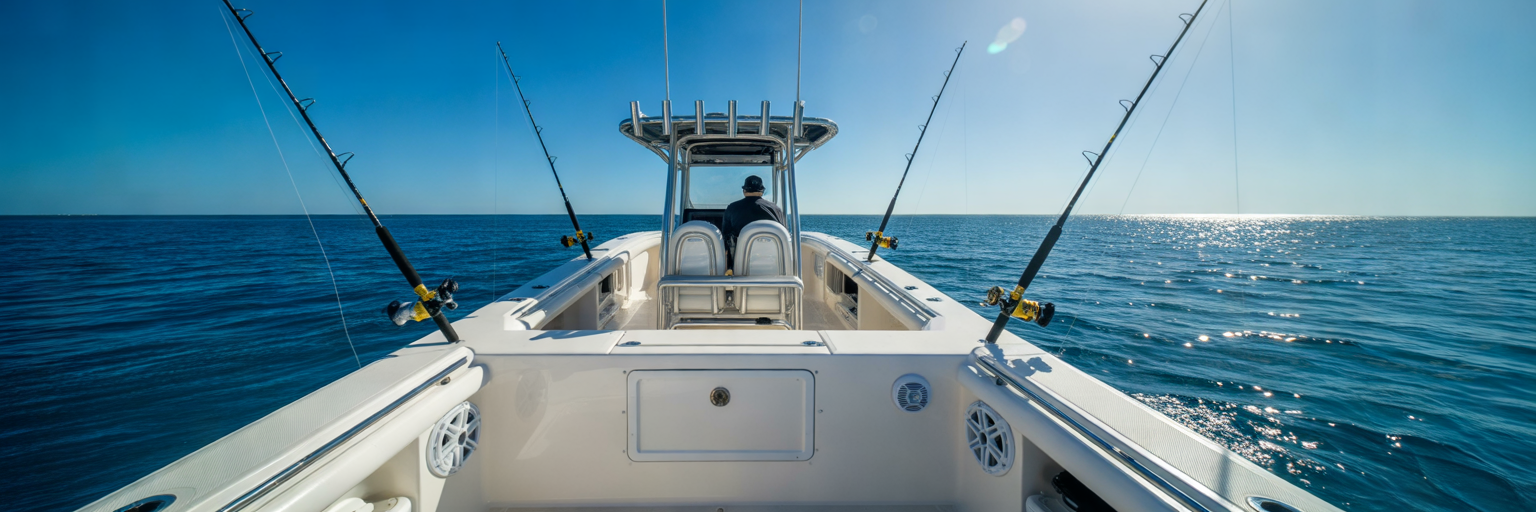
You do not need 15-foot carbon outrigger poles to pull a lethal five-rod spread out of Ponce Inlet, Haulover, or Destin Pass. Thousands of Florida weekend crews run 20 to 26 foot single or twin engine hulls and box limits of gaffer dolphin by using three-dimensional geometry. Building a tangle-free center console trolling spread comes down to combining vertical rod tip height, horizontal rod holder flare, and water column depth.
Look at your gunwales and T-top as an elevator system. Pin your two short corner flat lines down to the stern eyes with #64 rubber bands so the line leaves the boat just inches above the waterline. Next, place two rods in your 30-degree mid-gunwale rod holders angled outward toward the horizon, or drop kingfish-style horizontal out-rodders into your T-top corners to kick those rod tips six feet wide of the hull. Finally, stick your fifth rod straight up in the center T-top rocket launcher nine feet off the deck. Because the line from the high T-top travels over the top of the mid-gunwale rods, and the mid-gunwale rods pass well above the rubber-banded flat lines, your lines sit in separate vertical lanes and cannot snag each other when you turn.
Running Deep Diving Plugs Down the Center Alley
To squeeze even more separation out of an eight-foot-six-inch beam, use the water column beneath the boat. Instead of pulling five surface baits that compete for the same narrow wake lanes, clip a deep-diving lipped plug onto a short 35-foot flat line and run it straight down the center prop wash chute. A quality lipped plug digs down 10 to 15 feet beneath the prop turbulence and tracks true with a tight, vibrating wobble.
Because that plug is swimming ten feet underwater, your surface baits on the gunwale corners and T-top can sweep directly over the top of it during sharp maneuvers without ever touching the line. Managing line capacity, drag pressure, and water blowback on compact T-top and gunwale setups is much easier when you spool up with the right diameter line, which we detail in our small boat braided line setup guide.
Tangle Free Turning Protocols for Narrow Beams
Even with solid vertical separation, narrow-beamed center consoles demand smart helm discipline when turning around structure. Never chop the wheel hard over in a tight pivot with five lines in the water. A sharp rudder turn stalls the inside lines while accelerating the outside lines, dropping your inside lures down into the depths where they wrap the outside leaders on the straightaway.
Always execute wide, gradual arcs that keep steady water tension across every rod tip. Have a crew member watch the inside flat line during the turn. If the rod tip goes soft or the line bows, bump the throttle up half a knot to keep the lures swimming forward. When you are boxing a productive weed patch, make it a rule to turn toward the side of the boat pulling the longer stagger so your shortest lines stay safely tucked on the inside radius.
Adjusting Speed and Setbacks for Sea State and Sargassum Lines
Rough Chop vs Slick Calm Spread Modifications
No baseline spread survives first contact with changing offshore weather unless you adjust for sea state. When a 15-knot east wind stacks up steep four-foot chop against the northbound Gulf Stream, running 7.5 knots will launch your lures out of the back of every wave crest. In rough water, throttle back to 5.5 or 6 knots so your hull stays settled and your baits stay submerged. Lengthen your setbacks slightly so each lure rides the back slope of a swell where tension remains steady, and swap out light chuggers for heavier concave heads, metal jets, or weighted bullets that stay dug into choppy faces instead of tumbling down the troughs.
Flip the script on slick-calm, glassy summer mornings off the Keys or the Gulf Coast. When the ocean looks like a swimming pool, dolphin have all day to swim up behind your baits and inspect heavy hardware in gin-clear water. Bump your speed up to 7.5 to 8.5 knots to force reaction strikes before fish can scrutinize your terminal tackle. Drop your leader material down from 80-pound mono to 40 or 50 pound fluorocarbon, stretch your shotgun line past 250 feet, and put noisy, small-profile chuggers in the short riggers to manufacture your own surface commotion and bubble cover.
Shortening Setbacks Along Compacted Weed Lines
Your spread geometry also needs an immediate overhaul when you transition from open-water searching to fishing sargassum weed lines, floating pallets, or sharp current rips. Pulling a wide, 250-foot spread along a ragged weed edge is a guarantee that your long rigger and shotgun lines will sweep through scattered grass flyers every time you adjust the wheel, fouling your hooks and ruining the pass.
Before you slide up next to a compacted weed line, have the crew reel in and shorten all setback distances by 25 to 30 percent. Bringing the entire spread tighter to the transom turns your boat into a nimble surgical tool. You can execute tight S-turns right along the ragged pockets, points, and current edges of the mat while keeping every bait in the clean water lane just feet off the vegetation. Knowing how to read ragged pockets, current edges, and mat thickness along floating vegetation is half the battle, so review our Florida boat angler’s guide to mahi weed lines before your next run.
While schoolie dolphin pack the upper three feet of water directly under the sargassum canopy, larger lone bulls regularly hold 15 to 30 feet deeper in the cooler shadow line beneath the smaller fish. Dedicate one short flat line to a deep-diving lipped plug or a ballyhoo rigged with a one-ounce chin weight and run it right along the edge of the mat. That submerged bait slips directly underneath the hyperactive schoolies and puts a meal right in front of the biggest fish on the line.
| Offshore Condition | Speed Adjustment | Setback Modification | Head Style and Leader Change |
|---|---|---|---|
| Stacked Wind Against Current Chop | Drop to 5.5 to 6.0 knots | Lengthen slightly to ride wave backs | Heavy jets and bullets with 80 lb leader |
| Slick Calm Glassy Surface | Bump to 7.5 to 8.5 knots | Stretch shotgun 250+ feet back | Small noisy chuggers with 40 to 50 lb fluoro |
| Heavy Compacted Sargassum Line | Steady 6.0 to 6.5 knots | Shorten all lines by 25 to 30 percent | Weedless rigged ballyhoo and deep diving plug |
| Scattered Flyer Grass Flyers | Drop to 6.0 knots | Bring rigger baits inside clean wake lanes | Inline circle hooks or single hook skirts |
Adding Hookless Teasers, Daisy Chains, and Dredges
Positioning Squid Chains Relative to Short Flat Lines
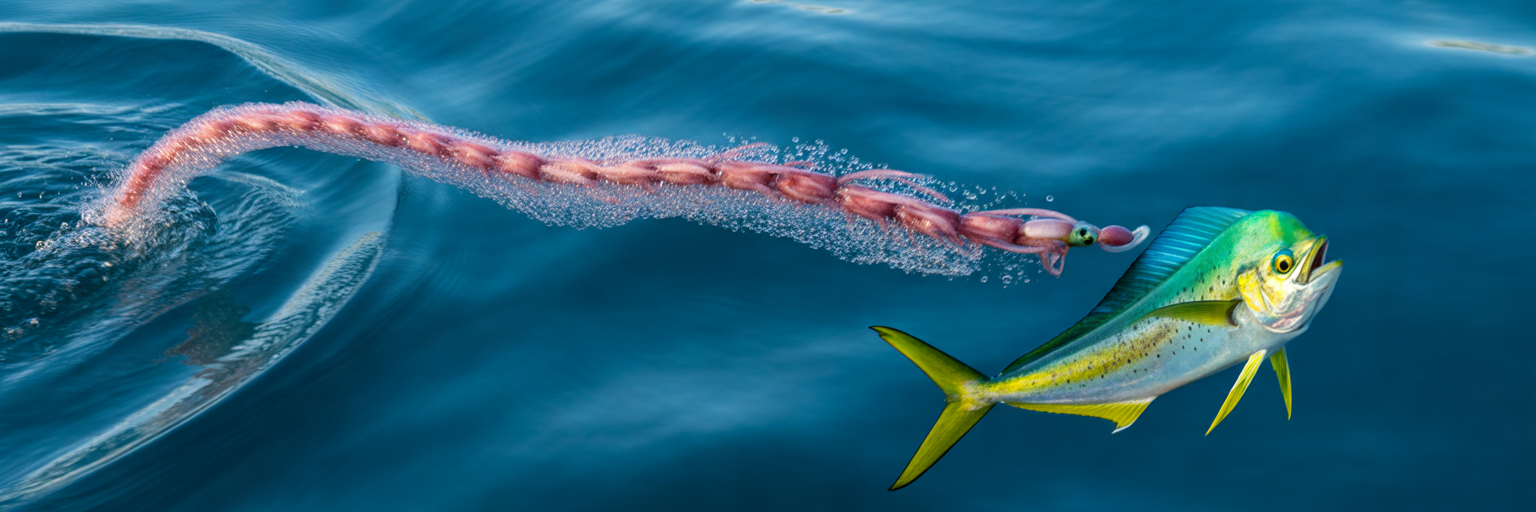
When dolphin are scattered or holding deep under structure, four single lures spaced across sixty feet of water can look sparse. Adding unhooked multi-lure attractors turns a standard trolling spread into a dense, flashing bait ball that pulls deep fish straight up into your prop wash. Bright pink, chartreuse, or holographic squid daisy chains, mylar strip teasers, and small six-arm ballyhoo dredges create a massive visual footprint that dolphin spot from deep down in the water column.
Exact placement geometry makes the teaser work for your hooked rods rather than competing against them. Run your squid daisy chain or strip teaser 20 to 25 feet off the transom corners, positioned 10 to 15 feet directly in front of and slightly inside your shortest armed flat line bait. When a lit-up dolphin charges into the wash and tries to crush the fast-moving teaser chain, a crew member immediately cranks or pulls the teaser forward away from the fish. Denied its target, the fired-up dolphin immediately pivots and inhales the trailing rigged ballyhoo or chugger sitting right behind the teaser.
Armed Stinger Chains vs Pure Hookless Teasers
Offshore crews debate whether to pull armed stinger daisy chains or pure hookless teasers, and both have a specific place on the deck. An armed stinger chain rigs five or six unhooked plastic squids in line ahead of a trailing hooked chugger or ballyhoo on the terminal end. When you are meat fishing for schoolie dolphin or running shorthanded with a two-person crew, armed stinger chains are deadly effective because they raise the pack and hook the fish automatically without requiring a mate to work the teaser line.
Pure hookless teasers shine when you are working blue-water edges where a sailfish, blue marlin, or 40-pound trophy bull mahi could slide into the spread at any moment. Because there is no hook on the chain, billfish and giant bulls will bill-whack and charge the teaser repeatedly without getting pricked and spooked. The mate simply cranks the hookless teaser clear of the water in three seconds, leaving the fish boiling right in front of your pitch baits and flat lines. You do not need custom sportfish hardware to run them; cleat your teasers off the stern corners using heavy 200-pound monofilament on simple hand spools, or run them through compact pancake teaser reels mounted under your T-top hardtop so anyone on deck can clear them fast.
Cockpit Management and Hookup Execution When the Pack Hits
Why You Never Chop the Throttles on the First Strike
The single biggest mistake beginners make on the offshore grounds happens the exact second a flat line reel starts screaming: the captain panics and chops the throttles into neutral. Stopping the boat on the first knockdown costs you fish and wrecks your spread. When you kill forward boat momentum, tension drops on the hooked fish, allowing a jumping mahi to throw the hook on slack line. Worse, your remaining four or five trolling lines immediately lose water pressure, sink straight down, and wrap together into a massive bird’s nest around your lower units.
When that first reel goes off, keep the boat in gear at trolling speed or half-speed (around 4 to 5 knots) for a full 10 to 15 seconds. Forward boat speed keeps the hook buried tight against the drag while the angler gets to the rod. More importantly, dolphin travel in competitive packs. A hooked mahi streaking sideways through the wake lights up neon blue, green, and gold, triggering a frantic feeding reflex from every other fish in the school following behind it. Keeping the remaining baits swimming for fifteen seconds turns a single knockdown into a double, triple, or quad header.
Transitioning from Trolling to Run and Gun Pitch Baiting
Once you have two or three fish tight on the trolling rods, it is time to transition from trolling mode into a run-and-gun bailout operation. Have the captain gradually pull the throttles back while keeping just enough forward bump in gear to maintain steerage and keep lines flowing behind the transom. As the first angler fights their fish to the boat, do not gaff or boat that first mahi. Leave that hooked fish swimming in the water right beside the motor.
A frantic, lit-up dolphin held on the line next to the transom acts as a live decoy that anchors the entire school right under your hull. While that decoy holds the pack, the rest of the crew cranks in the empty long rigger and shotgun lines so the cockpit is completely clear for casting. Grab your dedicated 15 to 20 pound spinning rod setups that you racked in the gunwales before leaving the dock, rigged with 40-pound fluorocarbon leaders and 1/2-ounce bucktail jigs, hookless topwater plugs, or 4/0 circle hooks pinned with fresh bonito chunks or live pilchards. Pitching baits directly to a lit-up school around the boat is how you turn a single trolling strike into a plugged fish box, and knowing when these heavy schooling migrations push past your local inlet starts with checking our Florida mahi seasonal guide by coast and region.
The Six Step Cockpit Drill for Multiple Hookups
When chaos erupts behind the transom, a disciplined crew executes the same cockpit drill every time to maximize hookups and keep the deck safe:
- Hold Speed for 15 Seconds: Keep the boat in gear at 4 to 5 knots after the initial strike to bury the hook and let the rest of the pack eat the remaining trolling baits.
- Mark the Waypoint Immediately: Punch the man-overboard or quick-mark button on the chartplotter the instant the first rod bends so you can return to the exact floating debris or current rip after the fight.
- Clear Outside Lines First: Assign free crew members to crank in any unhooked long outrigger and center shotgun lines completely to the rod tips and stow them in the T-top holders out of the way.
- Park the Decoy Fish Boatside: Fight the first hooked mahi to the transom and leave it swimming in the water on a short leader beside the engines to keep the rest of the school lit up and circling the hull.
- Deploy Pitch Rods and Chum: Toss a handful of cut bait chunks or glass minnows into the prop wash to hold the pack’s attention, then pitch bucktails or chunk baits on spinning tackle so you always hook a fresh fish before gaffing the previous decoy.
- Box and Bleed Immediately: Swing schoolies or gaff larger fish directly over the gunwale straight into a pre-slushed ice box rather than letting lively dolphin thrash across the deck with loose hooks and leaders.