
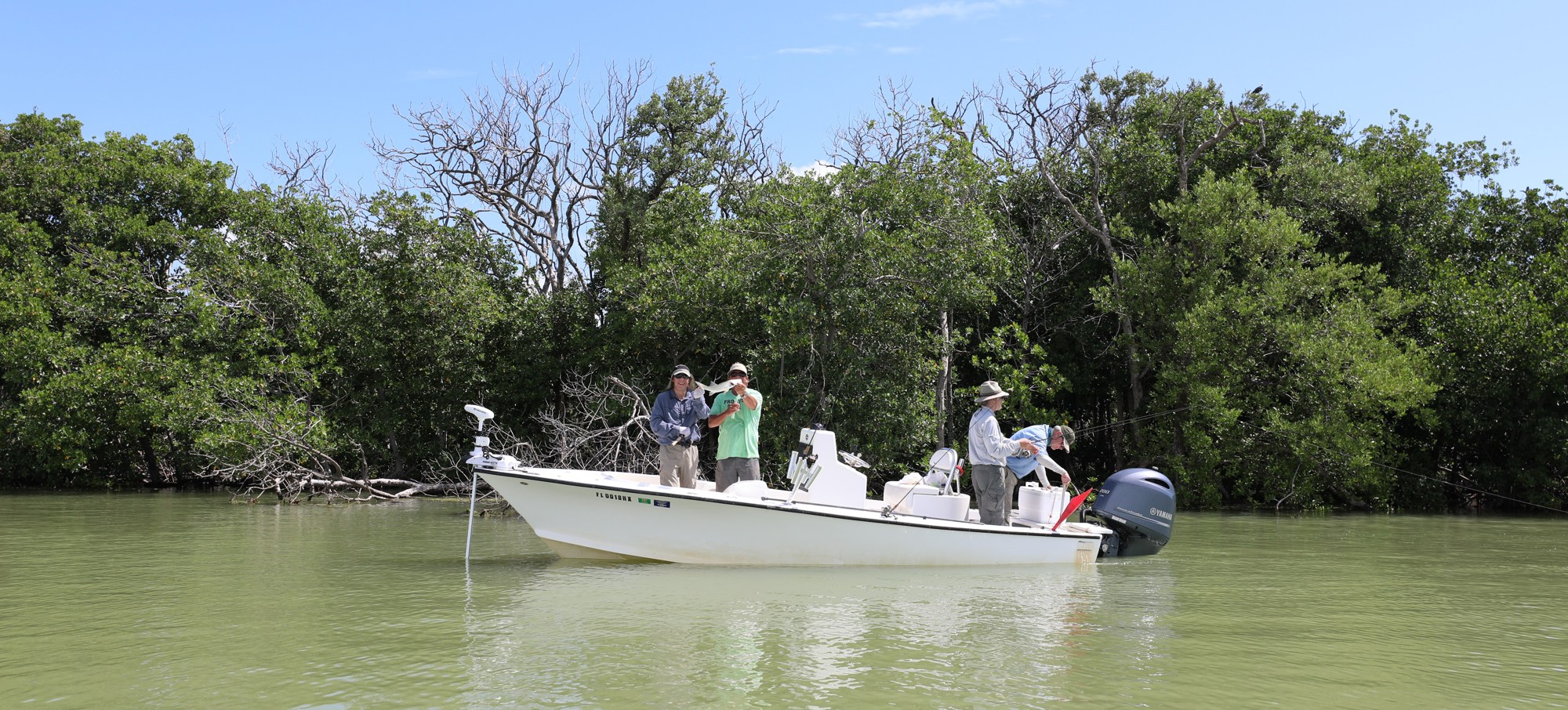
FLORIDA KEYS & EVERGLADES
Flamingo
fishing guide
Flamingo opens into Florida Bay and the Everglades backcountry. Its shallow banks, mangrove creeks and tidal routes hold very different fishing opportunities. Plan around park exclusions, boating education and a route that remains safe when wind or water level changes.
Explore the guide ↓Start with the national park boundaries
Flamingo is the southern developed hub of Everglades National Park. The road leads to a marina and ramps beside Florida Bay, with access to the inland backcountry through connected waterways. A park entrance payment does not replace a fishing license or boating requirements.
NPS prohibits fishing at the Flamingo Marina and ramps from sunrise to sunset. The visitor-center cement seawall has its own fishing closure. Eco Pond, Mrazek Pond and Coot Bay Pond are also closed to angling. These are not convenient fallback fishing spots.
The campground shoreline has a nighttime fishing restriction. Obtain the current park fishing directions before choosing a shore position. A place that looks accessible from the road may have a specific wildlife or visitor-use closure.
Choose Florida Bay or the backcountry
Florida Bay has broad shallow banks, sand and vegetation with deeper routes between them. Inland waters offer mangrove shorelines, creeks and larger bays. Choose one manageable route for the day's weather instead of trying to sample the entire area.
A bright patch may be a shallow bank, not a place a boat can cross. Use current charts and watch the actual depth. Seagrass damage can happen long before a hull becomes visibly stuck. Lift the motor before entering water too shallow for safe operation.
A backcountry route can involve narrow turns and similar-looking mangrove banks. Record the route and bring a reliable navigation backup. Learning the way home is more important than extending the fishing day by one more creek.
Place a bait near mangrove edges
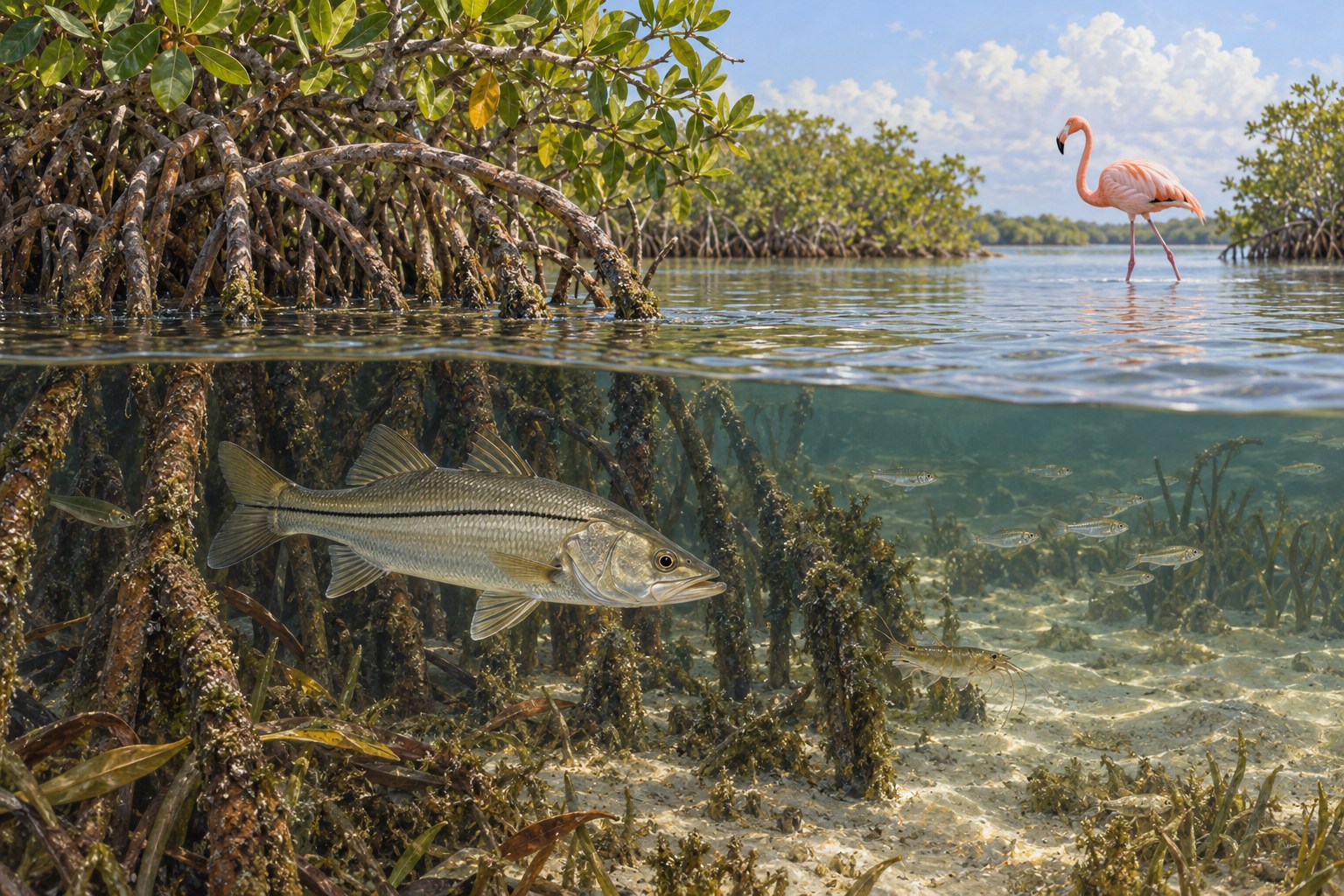
Snook use estuary cover and moving prey. In open legal water, search for points, creek mouths and edges with enough depth for a fish to approach. Look for baitfish escaping or a small concentration of feeding birds before committing to the spot.
A three- to four-inch paddle-tail can be retrieved just outside a mangrove edge. Keep casts recoverable rather than burying the lure in roots. A shrimp or appropriate small baitfish can also work when the current carries it naturally past cover.
Use tackle strong enough to keep a hooked snook from reaching roots immediately. Abrasion-resistant leader helps, but locked drag can break line or hooks. Plan the landing beside the boat before the first cast, with a net ready and spare tackle clear.
Work mixed bottom for redfish and seatrout
Redfish often feed on crustaceans and small fish along shallow edges. A shrimp imitation moved quietly over clean bottom is useful when you can see feeding signs. Cast ahead of the fish's route rather than landing tackle on its back.
Spotted seatrout can hunt above vegetation and beside sand openings. Suspending shrimp under a float keeps the offering out of thick grass. Set the depth carefully, then drift it along an open edge while retaining enough line control to detect a bite.
Do not assume a bay with one productive drift will be equally useful the next day. Water temperature, wind and salinity can change where fish gather. Compare a few distinct depths instead of repeating the same empty pass for hours.
Treat tarpon as a separate fishing plan
Tarpon may occur in the Flamingo region, but large fish need much more preparation than ordinary trout fishing. Match tackle to the intended size and bring a handling plan that follows the current tarpon rules. Accidental encounters should not turn into an exhausting fight.
For smaller fish in permitted water, a baitfish imitation worked near visible activity can be useful. Keep hooks and line clear of the kayak or boat's occupants. A jumping fish can throw a lure back toward the people who caught it.
Avoid pursuing tarpon where sharks are actively following hooked fish. Repeatedly hooking fish into obvious predation is a reason to leave. Successful fishing includes choosing a situation in which the fish can be released promptly.
Build the kit around the route
A medium inshore spinning outfit can cover shrimp drifts and modest soft plastics. Heavier tackle may be appropriate near roots or for larger intended targets. Carry different leader sizes so you can match cover without rebuilding the whole outfit on the water.
Take drinking water, insect protection, sun coverage and a communication plan. A phone is useful but does not guarantee reception deep in the backcountry. Keep essential navigation and safety equipment accessible after an unexpected splash or capsize.
The table compares presentations for permitted waters. It is not permission to enter a closed pond, wildlife area or shallow bank.
| Permitted habitat | Useful starting rig | Reason to adjust |
|---|---|---|
| Mangrove edge | Paddle-tail outside roots | Snags on every cast |
| Grass beside sand | Shrimp suspended under float | Bait dragging in vegetation |
| Shallow feeding route | Small shrimp imitation | Fish moving away from noisy casts |
| Large open bay | Controlled drift in suitable weather | Wind reducing the safe return margin |
Complete the boating checks before launching
Everglades National Park requires boaters using its marine waters to complete its boater education program and carry the appropriate proof. Review current permit and ramp procedures with the park. Vessel size and motor restrictions differ among launch locations.
Follow marked idle-speed, pole-and-troll and other restricted areas. A fishing target does not excuse crossing protected shallow habitat under power. Choose a route that your boat and crew can safely handle at the expected water level.
Kayaks are vulnerable to wind across broad bays. Begin with a short route and a conservative return margin. Do not rely on a tailwind outbound if it will become a difficult headwind on the way back.
Watch water level as closely as the tide time
Strong wind can push water off shallow banks or pile it against one shore. The resulting depth may differ from what a tide prediction suggests. Check actual water movement before leaving a known navigable channel.
Cool fronts can make a shallow Florida Bay trip rough and uncomfortable. Warmer months bring heat, mosquitoes and fast-growing storms. Select a shorter route when the forecast leaves little margin for a safe return.
In a mangrove creek, mosquitoes may remain active even when the bay has a useful breeze. Wear protective clothing and avoid rushing through navigation decisions because insects are bothersome. Good preparation makes it easier to fish patiently.
Respect special fishing and wildlife protections
Joe Bay and Snag Bay have catch-and-release rules for finfish and specific bait-possession exceptions. Read the current park instructions if that area is on your route. Do not treat those waters like an ordinary place to put legal fish in a cooler.
Use current Florida regulations together with park rules for harvest, bait and methods. Know whether the fish is a saltwater or freshwater species and which license applies. A familiar species name does not settle every boundary or possession restriction.
Give crocodiles, manatees and wading birds space. Never clean fish or leave bait at a launch where wildlife may become accustomed to people. Recover loose line and leave mangrove branches, shells and vegetation as you found them.
Common questions
Can I fish at the Flamingo Marina during the day?
NPS prohibits fishing in the marina and at the ramps from sunrise to sunset. Use an allowed fishing area instead.
Are Eco Pond and Mrazek Pond fishing options?
No. The park lists those ponds, along with Coot Bay Pond, as closed to fishing.
Do boaters need more than a Florida fishing license?
Yes. Review the park boater education requirement, ramp procedures and any permit rules for your outing.
Is a predicted tide enough to navigate Florida Bay?
No. Wind can alter shallow-water depth. Use current charts and check actual conditions before crossing a bank.
Prepare for your visit
Check local tides and weather. Read more about snook, permit, spotted seatrout. Check current FWC saltwater fishing rules.