

PANHANDLE
Panama City
fishing guide
Study the bay behind the beach. Work grass edges, public waterfront structure and sandy lanes without making an offshore run.
Explore the guide ↓FISH THE BAY BEHIND THE BEACH
Panama City’s fishing starts inside the bay
Panama City faces the St. Andrew Bay system. This is a place to study shoreline edges, grass, docks and changes in depth. The open Gulf beaches belong to a separate trip across the water toward Panama City Beach.
The bay branches into large arms, including West Bay, North Bay and East Bay. Each reacts differently to wind and runoff. You do not need to explore all of them in one outing. Choose a small section with a safe launch or lawful shore access, then learn what changes as the water moves.
From shore, your useful fishing area may be a narrow strip beside a seawall or a small patch of deeper water. From a boat, the temptation is to cover miles. Resist that urge when you find bait and suitable habitat close to your starting point.
Turn a waterfront visit into a workable fishing plan
Bob George Park
The city’s facilities list identifies Bob George Park at Church Avenue and 1st Plaza as a location with fishing and a boat launch. It is a concrete place to begin your access research. Check the condition and signs on arrival, keep the launch lane open and choose a casting position that does not interfere with boats.
Public bayfront areas
A waterfront walkway is useful for looking at wind, water clarity and bait. It is not automatic permission to fish every adjacent dock. Respect marina boundaries and posted rules. Look for clearly designated public fishing space instead of stepping onto a boat slip to reach deeper water.
Launching into the bay
Choose a ramp on the side of the bay you intend to fish. That can reduce a long, exposed crossing. Check parking and launching arrangements before loading the boat. Keep a chart available and remain in marked routes where shoals or obstructions make shortcuts uncertain.
Freshwater is a different outing
Deer Point Lake is not interchangeable with the saltwater bay below it. Different fish, access considerations and fishing rules apply. Do not take a bay species list as a guide to fishing the freshwater side.
Find the change, then place the cast
A broad grass bed can look uniform from a distance. Polarized glasses may reveal pale sand pockets, a dark outer edge or a narrow depression. Those changes offer feeding routes and places for fish to wait.
Begin outside the feature. Let the lure travel across the edge instead of landing directly on top of it. Keep the hook above the grass. A lure dragging a clump of vegetation no longer resembles the shrimp or small fish you intended.
A dock creates shade and cover, but it also creates places to lose tackle. Present a bait along the outside edge first. Do not cast against a boat or underneath an occupied private dock. The best-looking structure is not worth damaging someone else’s property.
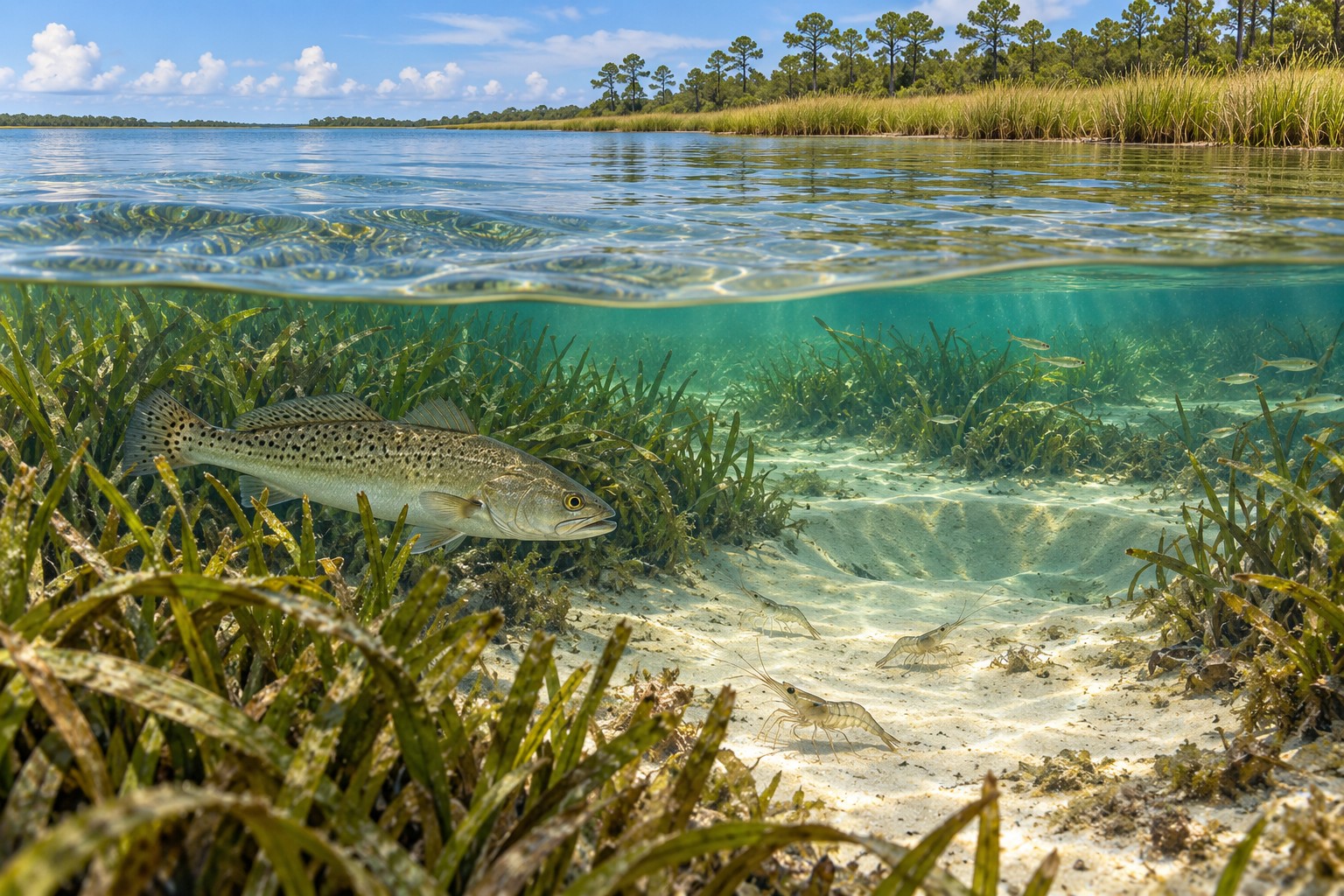
Bay fish and useful presentations
| Fish | Habitat to inspect | Try this first |
|---|---|---|
| Spotted seatrout | Grass edges and nearby holes | A small paddletail swimming just above the grass |
| Redfish | Shoreline turns, shallow feeding edges and creek mouths | A shrimp or weed-resistant soft plastic |
| Flounder | Sand meeting a channel edge | A slow, low retrieve with short pauses |
| Sheepshead | Hard, barnacled structure | A compact crab bait beside the hard edge |
| Black drum | Deeper shoreline structure and soft-bottom edges | A natural bait kept near the bottom |
| Spanish mackerel | Open bay water with active bait schools | A narrow spoon moving through the school’s outside edge |
These targets need different speeds. A fast spoon may appeal to a chasing mackerel and pass a bottom-hugging flounder too quickly. Change the presentation to suit the fish you are actually trying to catch.
Make a shrimp work in several ways
A live shrimp under a float is a useful search method over grass. Set the depth so the bait stays above the vegetation. Watch the float’s travel. If it repeatedly stops at the same place without a bite, the bait may be hanging in grass.
Beside a deeper edge, remove unnecessary flotation and use just enough weight to stay in touch. Let the current provide some movement. Pinning the bait under a large sinker can make it less natural and harder to move away from snags.
For a lure-only trip, carry a few light jigheads and soft plastics of a similar size. A natural-looking color is a sensible start in clear water. In stained water, choose a lure you can see and control, then adjust after observing fish response.
Wind and rain can change the best shoreline
A strong wind across an open bay can create a short, uncomfortable chop. Choose shelter that remains accessible if the wind shifts. Do not assume a flat ramp basin represents conditions a mile outside it.
Heavy runoff can discolor the heads of bay arms. Rather than treating all darker water as bad, look for a manageable edge between water types and signs of bait. If floating debris, poor visibility or strong flow make the route unsafe, choose another location.
The tides and weather forecast helps with planning, but local water movement matters most to the cast. Water may continue moving in a narrow area after a nearby station reaches its predicted high or low.
Let the season shape your search
Spring: work shorelines and flats as warming water brings more activity. Give a promising grass edge several presentations before moving. A chilly morning may fish differently from its sunny afternoon.
Summer: start at lower light and keep deeper water nearby in your plan. Carry extra drinking water. Return early enough to avoid getting caught on an exposed crossing when afternoon storms develop.
Fall: look for groups of bait near shore and at changes in depth. Moving a short distance along the same bank can be more productive than making a long run to a completely different bay.
Winter: slow down around protected depth changes. A small lure with a deliberate pause can be easier for a less active fish to take. Do not repeatedly run a boat across the area you are trying to fish.
A focused half-day on the water
Choose one shore or launch location the evening before. Pick two nearby habitat types, such as grass and a sandy channel edge. Begin with the shallower feature if conditions favor it. Shift to the second only when the first lacks bait, becomes uncomfortable or stops producing.
Record the wind direction, approximate water level and where bites occurred. Those observations are more useful on the next visit than a note that simply says the fishing was good. Do not record or share private access as a public spot.
Keep a landing net, pliers and a measuring board close at hand. Check current harvest requirements with the Florida Fish and Wildlife Conservation Commission. Return unwanted fish promptly with their body supported.
Choose between a dock edge and a grass flat
A structure session suits an angler who can reach a clearly permitted public position and keep a bait close to cover. You can fish a small area carefully without needing to cover much water. The challenge is avoiding snags and landing the fish from the available edge.
A grass-flat session suits a boat or kayak outing with a safe route and manageable drift. You are searching a wider area for feeding fish. The challenge is keeping the lure above vegetation and remembering where the useful depth changes lie.
Decide which problem you want to solve before launching. If you carry only a heavy bottom rig into shallow grass, you will spend more time cleaning hooks than fishing. If you bring only tiny unweighted lures to deep, fast water, you may never reach the intended holding area.
A useful middle-ground outfit is a medium spinning rod with roughly 10- to 15-pound line for ordinary light inshore work. Adjust leader strength to cover and target size. The exact outfit matters less than staying within its limits and having a net for landing.
Learn from a missed bite
A strike followed by a loose line can happen when a fish swims toward you. Reel smoothly until you know what the line is doing. A violent sweep at every tap may pull a small bait away before the fish has taken it.
If the lure returns with only its tail missing, small fish may be biting without reaching the hook. A shorter lure can help test that possibility. If the leader returns rough or cut near structure, address abrasion and angle instead of blaming the hook.
When you see fish follow but refuse, make the next cast quieter and change the retrieve slightly. A brief pause may look natural; a long pause may simply bury the lure in grass. Watch the habitat and choose accordingly.
If the whole area seems empty, inspect another nearby feature with a different depth or exposure. Moving from a uniform bank to a point can be a meaningful change. Moving hundreds of yards along identical empty water may teach less.
Keep one useful record
After the outing, note which side of the bay you used, the wind direction and whether the water was clear or stained. Add the habitat where bites occurred. These observations help you choose a starting place on a future day with similar conditions.
Do not turn one catch into a claim that a public park always produces a certain fish. The goal is to build a flexible local plan, not a guarantee.
Panama City fishing questions
Is this the same fishing as Panama City Beach?
No. This guide concentrates on the bay system beside Panama City. The beachfront piers and surf require a different destination and tackle plan.
Can a beginner catch fish without leaving the bay?
Yes. Shoreline and grass-edge fishing can provide a full outing. An offshore run is unnecessary for learning local inshore methods.
Why does my lure keep coming back green?
It is likely contacting vegetation. Use a lighter head, raise the retrieve or change to a presentation that passes above the grass.
Should I cross the bay to escape wind?
Only if the entire crossing is safe for your boat and experience. Launching closer to the intended shore is often a better plan.