
HookCurrent Florida fishing
Black Drum
Learn how black drum find food, where they gather, and how to fish shrimp or crab around oyster bars, bridges, channels and shallow flats.
Pogonias cromis

A bottom feeder with surprising strength
Black drum are built to search the bottom for food. Their chin barbels help them locate prey, and powerful teeth inside the throat crush shellfish. A fish moving slowly over an oyster edge may be feeding actively even when nothing splashes at the surface.
Small drum make approachable inshore targets. Large adults demand stronger tackle and patient control, especially near bridges or channel edges. The method should fit the fish and the setting rather than treating every black drum as a giant bridge fish.
Identification from young fish to adults
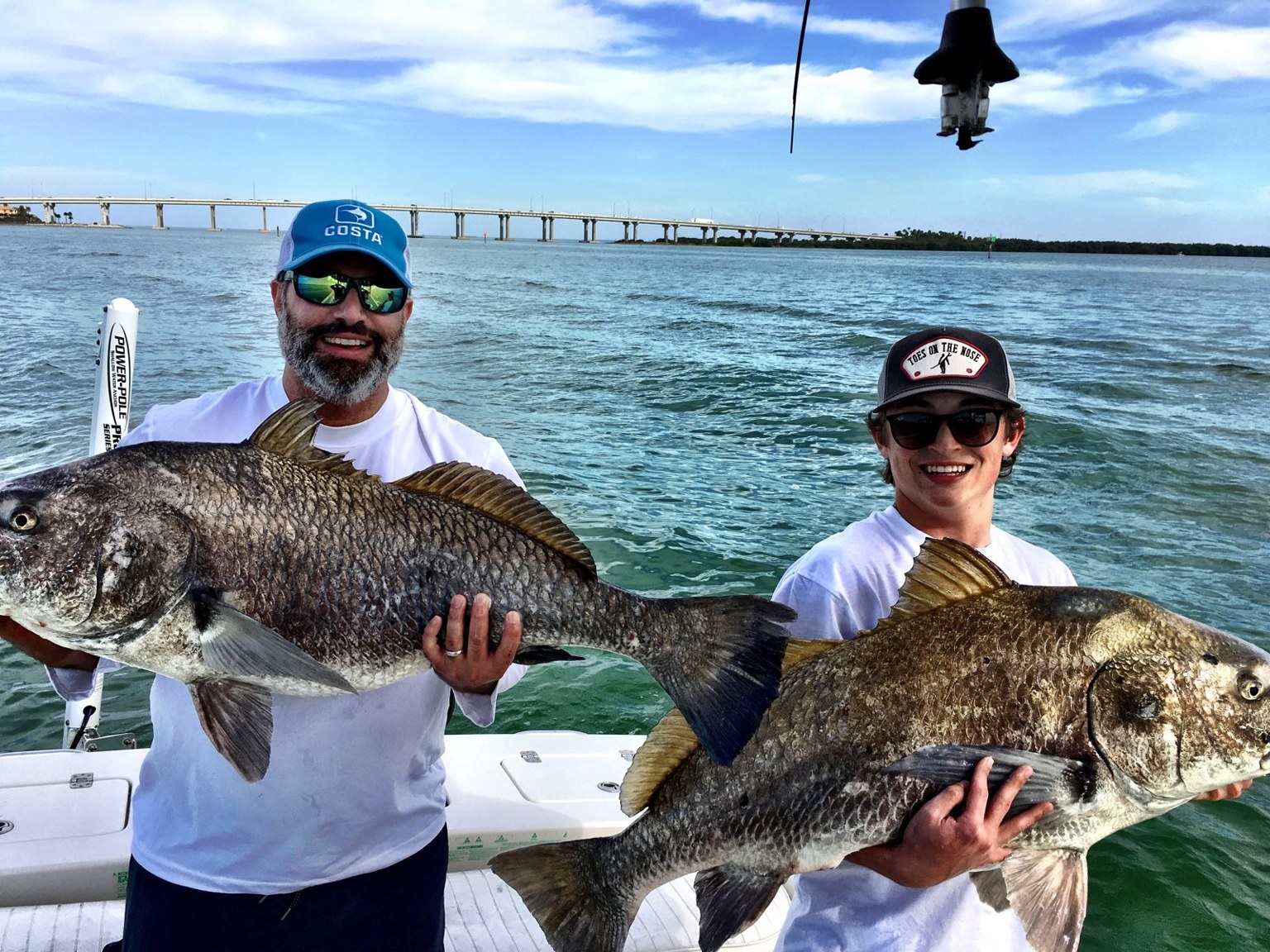
Young black drum have dark vertical bars on a lighter body. The bars fade as fish grow, and adults can appear gray, bronze or nearly black. A high arched back, large scales and barbels beneath the lower jaw are useful identifying features.
Sheepshead also have bars, but they lack the chin barbels and have obvious front crushing teeth. Redfish have a different body profile and usually a dark spot near the tail. Do not rely on the word drum to mean that both species follow the same rules.
A large dark fish in shallow water may be difficult to identify from above. Wait for a clearer view before deciding what to cast and how to handle the fish. A photograph should support an identification, not replace a close look at the actual features.
Oyster bars and other feeding ground
Black drum use bays, lagoons, river mouths, docks and bridge areas. Oyster beds are especially useful because they contain food and create small changes in depth. Fish can work along the edge without moving far between meals.
Soft bottom next to shell can be as valuable as the shell itself. Crabs and other prey move across these boundaries. A bait placed on the clean edge is often easier to fish than one dropped into the roughest part of the bar.
Large adults may also gather in deeper coastal water. The habitat used by a small creek fish and a heavy adult school can look very different. That range is part of the species' appeal and a reason to choose tackle thoughtfully.
Tides and bottom access
A rising tide can cover shallow shell and let fish reach new feeding ground. Falling water can concentrate fish along the outer edge or a drain. The productive stage depends on the height of the bar and the routes connecting it to deeper water.
Avoid assuming that maximum current means maximum feeding. A bait must remain in a useful position. If it tumbles continuously or disappears into snags, a slower current edge may be easier to fish effectively.
Watch the fish when visibility allows. Tails, wakes and small patches of disturbed sediment can reveal feeding drum. The fish may continue working an area slowly, giving a careful angler time to set up a quiet presentation.
Seasonal gatherings and spawning
Black drum spawn in coastal waters during the cooler part of the year into spring, with regional variation. Adults can form noticeable gatherings. Their sounds, produced with specialized muscles associated with the swim bladder, are part of the reason the drum family has its name.
Eggs and early life stages develop in the water, while estuaries support growing fish. Adults can live for decades. A very large drum may be much older than an angler expects from its slow, familiar movements.
Large spawning fish are worth handling with particular care. A quick photograph should not require a long fight, a dry deck and repeated lifts. Prepare for release before targeting a school of heavy adults.
Movement is not always a long migration
Some drum move between nearby feeding flats, channels and refuges as water level or temperature changes. Others participate in broader coastal movements and gatherings. A single migration calendar cannot explain every estuary or age group.
Cold weather may shift fish toward deeper or more stable water. Warm conditions can change their feeding windows and oxygen comfort. In either case, think about the route between a feeding place and a nearby holding area.
An empty oyster bar does not prove the fish have left the region. They may be waiting along the channel edge until the water level or current makes the bar useful again.
What black drum eat
Oysters, mussels, clams, crabs, shrimp and other bottom prey are important foods. Their feeding tools let them crush hard animals that would be awkward for many other fish. Small fish and other available items can also be eaten.
This diet explains the success of crab and shrimp baits. It also explains why a bait suspended far above the bottom may miss feeding fish. Put the offering where the fish are searching.
Freshness and size should fit the target. A small drum does not need a huge crab section. A large adult can take a more substantial bait, but the hook still needs an exposed point and enough gap to function.
Shrimp for smaller drum
Live or fresh shrimp can catch drum around creek mouths, docks and oyster edges. Use a hook that matches the bait without turning it into a heavy bundle. A small amount of weight may be enough in protected water.
Place the bait near the bottom and leave it long enough for a feeding fish to locate. Constantly dragging it away can reduce the chance. At the same time, retrieve periodically to check for missing bait or shell fouling the hook.
When small bait thieves dominate, try a tougher portion or move slightly away from the structure. A different depth can reach drum without presenting every bait to the same cluster of tiny fish.
Crab baits for larger fish
Blue crab is a familiar choice for large black drum. Whole small crabs or properly prepared portions can be used where legal. Secure the bait firmly, keep the point clear and avoid handling sharp shell carelessly.
Match the portion to the current and hook. A bulky piece that catches water and rolls may be harder to present than a smaller firm section. Fresh bait should be kept cool and protected from sun.
Collecting crabs has its own rules. A fishing license does not make every collection method or crab size legal. Obtain bait from a lawful source and avoid disturbing traps or gear that belongs to someone else.
Choosing the outfit by location
For smaller drum on open flats, a medium spinning outfit with roughly 10 to 20 pound line can be suitable. Around heavier structure or large adults, stronger line and a rod with more lifting power may be necessary. Bridge current can increase the demand further.
Leader strength should account for oysters, concrete and the fish's rough contact with the line. Inspect the last few feet after every fish. An apparently sound leader can carry small cuts that weaken it substantially.
Use enough tackle to finish the fight without exhaustion. The goal is not to prove how lightly a large fish can be caught. A balanced outfit gives better control and a better chance of a healthy release.
Bottom rigs that stay where you put them
A sliding sinker above a leader is a straightforward option. Choose a sinker shape that suits sand, mud or current, and use only enough weight to maintain the intended position. Too much weight can anchor the bait in a crack.
In shallow quiet water, a lighter presentation may be more convincing. A crab or shrimp placed ahead of a visible fish does not always need a large sinker. Watch how it settles and whether the fish can approach without crossing the line.
Circle hooks work well with a steady tightening line. Let the fish move into the bait and reel firmly rather than striking violently. Make sure the bait does not block the gap that allows the hook to rotate.
Sight fishing on shallow flats
Approach with as little disturbance as practical. A visible black drum may be focused downward, but that does not make it unaware of boat noise or a lure landing on its back. Cast beyond its path and bring the offering into the feeding area.
Small crab or shrimp imitations can work when placed accurately. Move them sparingly. A fast fleeing retrieve may be less convincing to a fish steadily rooting along the bottom than a short movement followed by a pause.
If the fish turns toward the bait, stop making unnecessary corrections. Let it close the distance. An angler who keeps pulling the offering away can turn interest into refusal.
Fishing a bridge or deep edge
Study current and boat traffic before anchoring or drifting. Large drum can hold near the base of structure, but a safe fishing position must leave navigation clear. Never attach the boat to a navigation aid.
Set the bait where it can remain near the bottom without continually wrapping around a piling. A different angle often solves more problems than another ounce of lead. Watch the line for changes as the tide strengthens or reverses.
After the hookup, guide the fish toward open water while maintaining controlled pressure. If it reaches structure repeatedly, change the setup or location rather than losing several fish with hooks and line attached.
When the rod bends slowly
Black drum may take a bait with a gradual pull. A heavy fish can feel almost stationary before beginning a determined run. Maintain attention even when the rod has been quiet for several minutes.
Do not leave rods unattended in precarious holders. A slow-looking take can become a strong pull quickly. Keep the drag appropriate and the line clear of railings, cleats and neighboring tackle.
If using a circle hook, wind down smoothly as the load builds. Repeatedly lifting and dropping the rod before the fish moves can prevent a secure hookup.
Florida places to explore
Northeast Florida estuaries, including the St. Augustine region, provide tidal-creek and inlet habitat. Mosquito Lagoon is known for shallow-water drum opportunities. Tampa Bay and Charlotte Harbor offer oyster, channel and bridge settings.
Choose a location guide based on the style of fishing you want. A shore trip for smaller fish has different access needs from a boat trip aimed at large adults. Check current pier status, private boundaries and launch conditions before setting out.
Handling a heavy drum
Support the belly and body during any brief lift. Do not suspend a large fish vertically by a lip grip or jaw. Its weight can strain tissues that are not meant to carry the entire body in air.
Keep release fish in the water while arranging a photograph or removing the hook whenever practical. Use wet hands and avoid the gills. Give the fish time to regain balance in suitable water before letting it swim away.
If retaining a legal fish, plan the cooler space in advance. Large size alone is not a reason to keep a fish, and a catch should never be wasted because storage was an afterthought.
Rules and identification checks
Florida's black drum rules include size and possession conditions that need to be read together. Check the current guidance before choosing a harvest target, especially when fishing for very large adults.
Remember that black drum and red drum are separate species. Their similar names do not create a shared limit. A mixed catch of drum, sheepshead and snapper requires correct identification and separate rule checks.
Black drum questions answered
Are the chin whiskers useful to the fish?
Yes. The barbels help the fish locate food while searching near the bottom.
Why do small drum have stripes but large ones do not?
The strong juvenile bars become less distinct as the fish grows. Adults often appear much more uniform in color.
Can they take artificial lures?
Yes, especially when a shrimp or crab imitation is placed accurately near a feeding fish. A slow, controlled presentation often suits the situation.
Is blue crab always better than shrimp?
No. Crab is popular for larger fish, while shrimp is versatile for smaller drum and mixed inshore fishing. Availability and presentation matter.
Why should I avoid lifting a big drum by the jaw?
Its body weight needs support. A horizontal supported hold reduces strain compared with suspending the whole fish vertically.
Do black drum use the same rules as redfish?
No. They are different species with different requirements. Check each fish separately.
Match your approach to the water
| What you find | An option to try | The detail that matters |
|---|---|---|
| Small drum beside shell | Shrimp or a small crab bait | Use a size the fish can take cleanly. |
| Large fish along a channel | Appropriate crab or cut bait | Use tackle that finishes the fight without needless exhaustion. |
| Heavy structure beside the bait | Abrasion-resistant leader | Keep a clear route to land or release the fish. |
Plan a black drum trip
Local access guides for black drum trip planning: St. Augustine, Tampa, Crystal River.
Tides and weather · Florida fishing charters
Read the current FWC rules for black drum.
Rules review: October 4, 2026.
Research and photograph credits · All fish species · Return to the beginning