
HookCurrent Florida fishing
Bonefish
Learn where Florida bonefish feed, how tides move them across the flats, which shrimp and flies work, and how to approach, hook and release them.
Albula vulpes
Find the fish before making the cast
Bonefish turn a shallow flat into a hunting ground for both fish and angler. A faint shadow, a small push of water or the tip of a tail may be the only warning that a school is approaching. Careful observation matters more than making cast after cast into empty water.
Florida's best-known bonefish waters lie around Biscayne Bay and the Keys. These are places to learn patience, accurate casting and quiet boat handling. The reward is a fast fish that can take line across a flat long after its size suggests it should be tired.
What a bonefish looks like
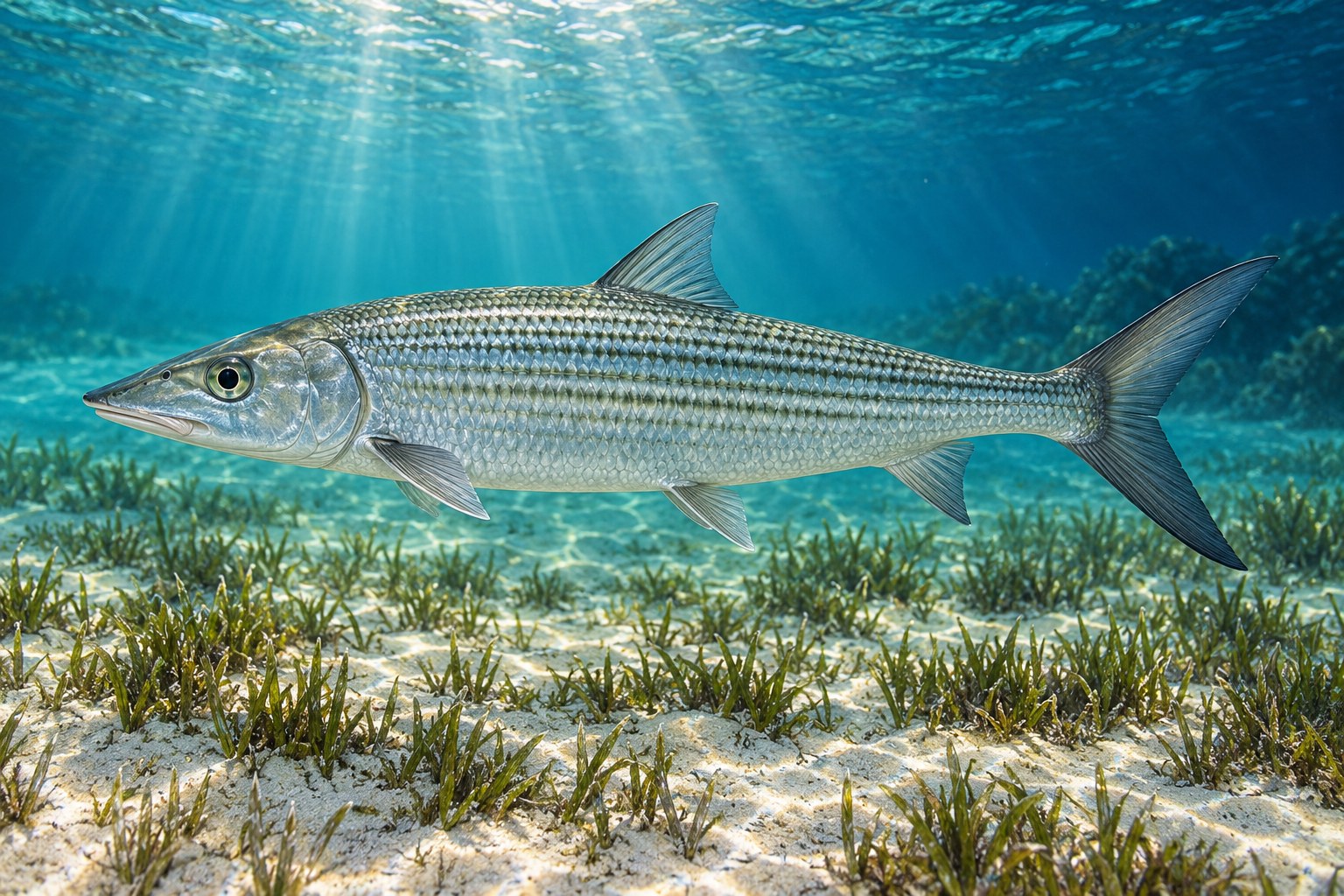
The common bonefish, Albula vulpes, has a narrow silver body, a pointed nose and a mouth set underneath the snout. Fine dark lines follow the rows of scales. Its back can look green, gray or blue against different bottoms. The tail has a deep fork.
Do not confuse a silver flash with a positive identification. Mullet often share the same shallows. Ladyfish have a mouth at the front of the head rather than tucked beneath a long nose. Florida also has other closely related bonefish species, so this guide focuses on the common bonefish targeted by flats anglers.
Fish of a few pounds are typical catches. A much larger individual deserves particular care. Length, weight and age do not have a fixed relationship, and a large bonefish is not simply an oversized version of a young fish in terms of its value to the population.
Flats, channels and a daily travel route
Bonefish forage over sand, seagrass and mixed shallow bottom. They may enter water barely deep enough to cover their backs. Nearby channels provide space to retreat when a flat drains, heats up or becomes uncomfortable.
A useful fishing area has more than a pretty patch of clear water. Look for a connection between a feeding flat and deeper water. Small channels, mangrove edges and changes in bottom color can help explain how fish enter and leave.
On a rising tide, fish may spread over newly flooded ground. During a falling tide, an outside edge or drain can concentrate their exit. Local wind can change the actual depth enough to make a predicted tide misleading. Watch the water reaching the grass and shore, not just the time on a chart.
Where to begin in South Florida
Biscayne Bay offers broad flats and shorelines close to a major city, but that does not make the fish easy. Boat traffic, changing visibility and access restrictions require planning. Public access to water does not mean every nearby shoreline allows wading or landing.
Key Largo and Islamorada provide different combinations of oceanside flats, backcountry water and channel edges. Farther down the Keys, the surroundings change again. Treat a location guide as a starting point for understanding access and habitat, not as a promise that fish will be standing at a marked spot.
Choose a first trip around manageable wind and a tide that covers useful feeding ground. A local guide can explain how a flat fishes without encouraging damage to the seagrass that makes it productive.
Seasons and spawning movements
Bonefish can be caught through the year in the Keys. Warmer months often provide good flats opportunities, while winter cold fronts can push fish away from exposed shallow water. In very hot conditions, a cooler morning or deeper edge may be more useful than a baking afternoon flat.
Spawning takes adults away from ordinary feeding flats toward deeper water. Florida research places much reproductive activity in the cooler part of the year and into spring. These movements are different from the short daily trip on and off a flat with the tide.
Eggs and early larvae drift in the water. Bonefish pass through a transparent, ribbonlike larval stage before becoming recognizable juveniles. Healthy shallow feeding grounds and access to deeper spawning habitat both matter to the fishery.
What they find in the bottom
Shrimp and small crabs are important bonefish foods. Worms, mollusks and small fish also contribute. The downward-facing mouth helps the fish pick food from the bottom, while structures farther back in the mouth crush harder prey.
Tailing happens when a bonefish tips forward to feed. Sometimes the tail breaks the surface. On a deeper flat, a small cloud of disturbed sediment may reveal the same behavior without any visible tail.
This explains why a good presentation often needs to reach the bottom. A bait suspended well above a feeding fish can pass unnoticed. A lure that plows deeply into grass can be just as ineffective.
A practical spinning outfit
A light or medium spinning outfit with a smooth drag is a useful beginning. Line around 10 to 15 pounds gives many anglers a workable balance between casting and control. A clear leader can help around wary fish, with its strength chosen for bottom abrasion and fish size.
Use a small, strong single hook that fits the shrimp or crab. Large hardware can make a small bait sink unnaturally. Florida prohibits multiple hooks used with natural bait when attempting to catch bonefish, so do not bring a treble-hook bait rig onto a bonefish flat.
Set the drag before sighting a fish. A tight drag combined with a sudden first run can break light line. A reel that releases line smoothly is more useful than a claim of extreme maximum drag.
Presenting a live shrimp
Keep shrimp lively and choose one that casts on the available tackle. Place the hook where it holds securely without passing through the dark organs near the head. A damaged bait may survive long enough to cast but lose the movement that makes it convincing.
Lead the fish so the shrimp reaches its path before the fish arrives. The correct distance depends on current, depth and travel speed. Casting directly onto its back usually ends the opportunity.
Let the bait settle. A small movement can draw attention, but repeated sharp twitches may make the offering look unnatural. When the fish takes and moves away, bring the line tight in a controlled way. Match the hook-setting motion to the hook design.
Flies and small jigs
Shrimp and crab patterns should land quietly and sink at a suitable speed. Shallow water over grass often calls for a lighter fly than a deeper channel edge. A heavy fly that reaches bottom quickly can be useful in one situation and disastrous in another.
Cast ahead, allow the fly to settle, then use short strips that keep it within reach. Watch the fish rather than staring only at the fly. A turn, tilt or sudden stop can show that it has noticed the offering.
With a fly, keep the rod low and use a strip strike when the fish eats. Raising the rod too early can pull a fly away before the hook connects. Small jigs follow the same presentation principles, with enough weight to reach the feeding level and little enough to avoid a heavy splash.
Seeing fish in difficult light
Polarized glasses reduce glare but cannot replace a favorable viewing angle. Keep the sun behind or to the side when possible. Cloud cover, ripples and dark bottom can hide fish even in clear water.
Look for movement against the bottom rather than a perfect fish outline. A school may show as several shadows moving at the same speed. A solitary large fish may be visible only when it turns.
Quiet feet matter while wading. On a boat, avoid dropping pliers or slamming a hatch. Never drive through a shallow grass bed simply to shorten the route to the next flat.
The first run and the release
Keep loose line clear of your feet, reel handle and boat fittings. Let the fish run against the drag. Trying to stop the first burst with a hand on the spool can end the fight immediately.
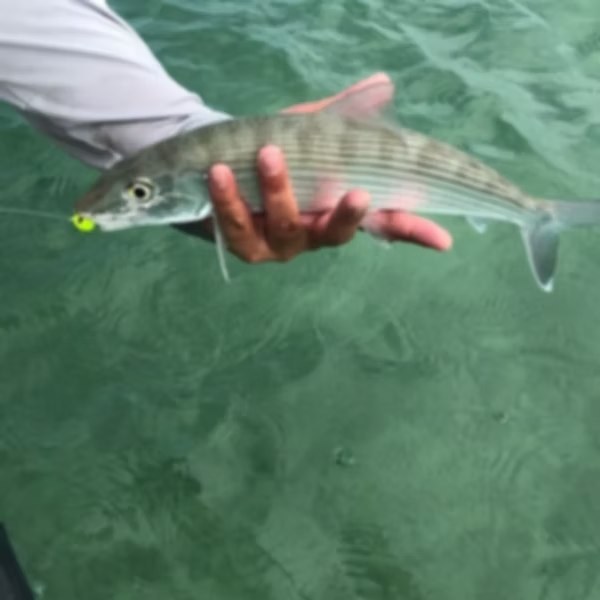
Use steady pressure to finish the fight without unnecessary delay. Keep the fish in the water while removing the hook. Wet your hands first and support its body if brief handling is unavoidable. Florida bonefish are a catch-and-release fishery, not a food target.
Look for sharks and barracuda before releasing. If predators begin following hooked fish, stop fishing that area and move. Repeatedly feeding released bonefish to predators defeats the purpose of releasing them.
Common reasons a good flat produces no bites
A flat can have the right bottom but the wrong water depth. It may be too shallow for fish to enter or so flooded that they spread over a much larger area. Change the part of the flat you search before changing every bait in the box.
Repeated refusals can come from a noisy cast, an oversized fly, a bait dragging in grass or a leader crossing the fish's path. Correct one thing at a time. A quiet, simple presentation provides better information than a frantic series of changes.
Bonefish questions
Are bonefish good fish for a first flats trip?
They are rewarding but demanding. Start with casting practice and realistic expectations. Seeing fish and placing a bait well are useful successes even before the first hookup.
Can I keep a bonefish in Florida?
No. Florida manages bonefish as catch and release. Check the current official rules before the trip, including the restriction on multiple hooks with natural bait.
Does every bonefish show its tail?
No. Cruising fish and fish feeding in deeper water may never break the surface. Search for shadows, wakes and small mud clouds too.
Is a falling tide always bad?
No. It can draw fish toward edges and drains. The important question is whether enough water remains over useful feeding ground.
Can bonefish be caught without a boat?
Suitable legal wading access can provide opportunities. Check bottom firmness, tide, protected areas and the route back before entering unfamiliar water.
Why do anglers use small baits?
Much of a bonefish's food is small. A compact shrimp or crab can land quietly and look natural without requiring bulky tackle.
Match your approach to the water
| What you find | An option to try | The detail that matters |
|---|---|---|
| Tailing fish in very shallow water | Light shrimp or crab fly | Choose enough sink to reach food level without a heavy splash. |
| Cruising school on sand | Live shrimp on a single hook | Lead the school and allow the bait to settle. |
| Water draining off the flat | Small jig near an exit edge | Intercept the route without standing directly in it. |
Plan a bonefish trip
Local access guides for bonefish trip planning: Key Largo, Islamorada, Key West.
Tides and weather · Florida fishing charters
Read the current FWC rules for bonefish.
Rules review: October 4, 2026.
Research and photograph credits · All fish species · Return to the beginning