
HookCurrent Florida fishing
Jack Crevalle
Learn where jack crevalle hunt, how to identify them, when to follow bait schools, and which lures, live baits and tackle handle their strength.
Caranx hippos
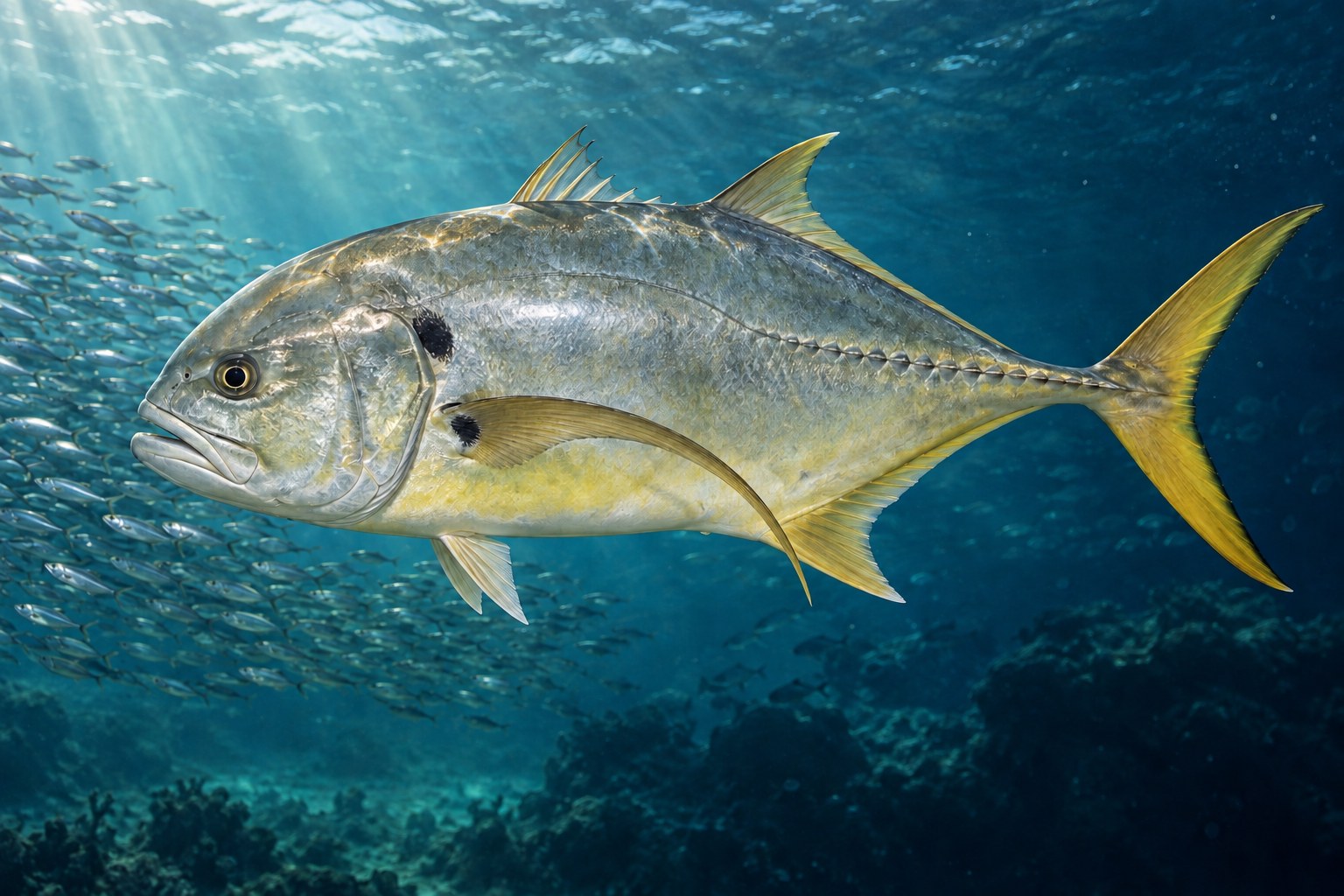
The fish behind the sudden surface explosion
A quiet seawall can become a feeding scene in seconds when jack crevalle pin bait against it. Fish slash through the school, gulls arrive and the opportunity moves down the shoreline. A rod rigged and ready is more useful than a tackle box full of unopened lures.
Jacks are strong, accessible and often overlooked. They can provide serious sport in canals, bays, passes and coastal water. A fish that looks manageable beside the dock can take a surprisingly long run once hooked.
Identifying a crevalle jack
Caranx hippos has a deep body, a steep forehead and a strongly forked tail. A dark mark appears on the gill cover, with another near the base of the long pectoral fin. The back can look blue-green or gold, and yellow often shows around the belly and fins.
Blue runners and other jacks share some features. Compare the full body and dark markings instead of identifying a fish only by its yellow tail. The hard scutes near the tail are also worth noticing when handling it.
Large adults can be much heavier than the small jacks common in an inshore school. Choose tackle for the fish that may appear, not only for the smallest one seen at the surface.
From brackish creeks to open coast
Jack crevalle tolerate a broad range of salinity. They use estuaries, channels, canals, beaches and open coastal water. Young fish often occur in protected inshore settings, while larger fish can roam much wider areas.
Food gives these places their importance. A seawall corner, channel bend or inlet edge can trap bait long enough for a school to attack. The structure may change how the prey moves even when the jacks themselves are not sheltering inside it.
Florida locations such as Tampa Bay, Charlotte Harbor, the Indian River Lagoon and Atlantic inlets all offer suitable settings. Access and safety differ, so choose a place where a hooked fish can be fought without crossing boat traffic or other anglers.
Spawning and seasonal movement
Jacks spawn offshore, with strong reproductive activity across spring and summer and into early fall. Eggs develop in the water rather than on a guarded bed. Young fish later use coastal nursery habitat.
Seasonal bait movements can bring visible schools along beaches and through passes. Cold weather can change where fish concentrate, particularly in northern parts of Florida. Local bait and water conditions explain a day's opportunity better than a promise that jacks always arrive on a certain date.
A school may use the same feeding route repeatedly, but it does not stay permanently at one seawall. Note the tide stage and bait location when activity occurs, then compare those conditions on the next visit.

What they eat and how they hunt
Small fish are the main attraction for many feeding jacks. Mullet, sardines and other locally abundant prey can draw a school. Jacks often hunt cooperatively, crowding bait into a tighter area before charging through it.
Watch the direction the bait is fleeing. Casting where the explosion just ended may put a lure behind the moving fish. An intercept cast ahead of the school can keep the lure in the path of the next attack.
Not every jack is feeding at the surface. Fish can patrol channel edges below visible activity. A sinking lure or live bait may reach them when a surface plug goes unnoticed.
Surface plugs for active fish
Poppers and walking plugs can produce dramatic strikes. Choose a lure large enough to cast effectively but still close to the size of the prey. A lure with suitable single hooks can simplify unhooking where appropriate.
Work the plug away from the school rather than repeatedly dropping it onto fish. A fleeing presentation often attracts a chase. Keep retrieving after a missed strike if the lure remains safely in the water.
Avoid striking at the first splash before the line loads. Jacks can miss a surface lure or hit it from an awkward angle. Wait until there is solid weight, then set according to the hook arrangement.
Jigs, spoons and soft plastics
Metal spoons and compact jigs cast well toward distant activity. Soft-plastic paddletails provide another useful option along channels and seawalls. Weight should suit the depth and current without forcing the lure into constant snags.
Try a quick retrieve for fish chasing bait, then vary speed if follows do not become strikes. A brief pause can let a following fish close the gap, though it can also allow the lure to sink into structure.
Inspect soft plastics after each fish. A torn lure may spin or slip down the hook. Replace damaged leader too, especially after a fight near concrete, oysters or bridge pilings.
Live bait in a travel lane
A lively baitfish can work when a school is cruising rather than attacking. Use a hook that allows the bait to swim naturally and a leader suited to the surrounding structure. Match the bait to what the fish are already hunting when possible.
Place it beside the travel route, not inside a tangle of dock lines. A jack can take a bait and cover the distance to a piling almost immediately. Think about the fight before making the cast.
Near bridges and inlets, obey access restrictions and give vessels room. Fishing from a high structure also requires a safe landing plan. Lifting a heavy jack by a light leader is not that plan.
An outfit that finishes the fight
Medium to medium-heavy spinning tackle suits many inshore jacks. Line around 20 to 30 pounds is a useful starting point for larger fish, with adjustments for open water, lure weight and structure. Small school fish can be handled on lighter equipment.
Use a smooth drag and check the knots before a feeding school arrives. Keep enough line on the reel for a sustained run. An underfilled small reel makes a powerful fish unnecessarily difficult to control.
Apply steady pressure from useful angles. When safe, move along a bank or around the boat to keep the line clear. Do not keep pulling from one position if the fish has wrapped a piling or crossed an obstruction.
Landing without unnecessary damage
Have a net or suitable landing tool ready. Support a jack's body rather than suspending a large fish for a long photograph. Wet hands reduce damage to its surface, and the hard tail area should be handled carefully.
If release is the plan, use tackle strong enough to avoid a needlessly prolonged fight. Keep the fish in water while removing the hook where practical. Give it time to recover facing into clean moving water without dragging it backward.
Check current rules if retaining fish. A reputation as an abundant sport fish does not mean there are no applicable harvest or gear rules.
Build a local pattern
Record where bait gathers during each tide stage. A corner that funnels bait on a falling tide may spread it out on the rise. The jacks follow the feeding advantage rather than the angler's favorite casting position.
Carry one ready lure that casts quickly and reliably. When a school appears briefly, familiar equipment usually works better than stopping to tie an elaborate rig. After the action ends, check tackle before searching for the next school.
Jack crevalle questions
Are jacks only caught in saltwater?
They tolerate brackish conditions and can enter low-salinity areas. Their presence often follows accessible prey and connected coastal water.
Why do small jacks pull so hard?
Their body and tail are built for sustained pursuit. A fish's weight alone does not predict how demanding the fight will feel.
Should I cast into the middle of the bait?
An edge or intercept cast often works better. Place the lure where hunting fish are moving rather than where the last splash occurred.
Can I use a freshwater bass lure?
Some lure styles work, but hooks, split rings and other hardware must withstand saltwater and the strength of the fish. Rinse and inspect equipment afterward.
Is a topwater strike an instant hook-set signal?
Wait for the fish to load the line. Striking at a splash alone can pull the lure away or send it flying back.
What if a large jack follows but will not bite?
Try a change in speed, a smaller profile or a deeper presentation. A visible follower may be curious rather than actively feeding.
Match your approach to the water
| What you find | An option to try | The detail that matters |
|---|---|---|
| Jacks pushing bait at the surface | Walking plug or popper | Cast ahead of the chase and wait for weight before striking. |
| Fish patrolling below a seawall | Paddletail or live bait | Keep the presentation in the travel lane. |
| Large jacks near pilings | Stronger line and a planned angle | Choose a position that lets you follow the fish safely. |
Plan a jack crevalle trip
Local access guides for jack crevalle trip planning: Tampa, Fort Myers, St. Augustine.
Tides and weather · Florida fishing charters
Read the current FWC rules for jack crevalle.
Rules review: October 4, 2026.
Research and photograph credits · All fish species · Return to the beginning