
HookCurrent Florida fishing
Sheepshead
Understand sheepshead teeth, feeding habits and spawning movements. Learn how to fish crabs and shrimp beside docks, bridges, rocks and oyster bars.
Archosargus probatocephalus
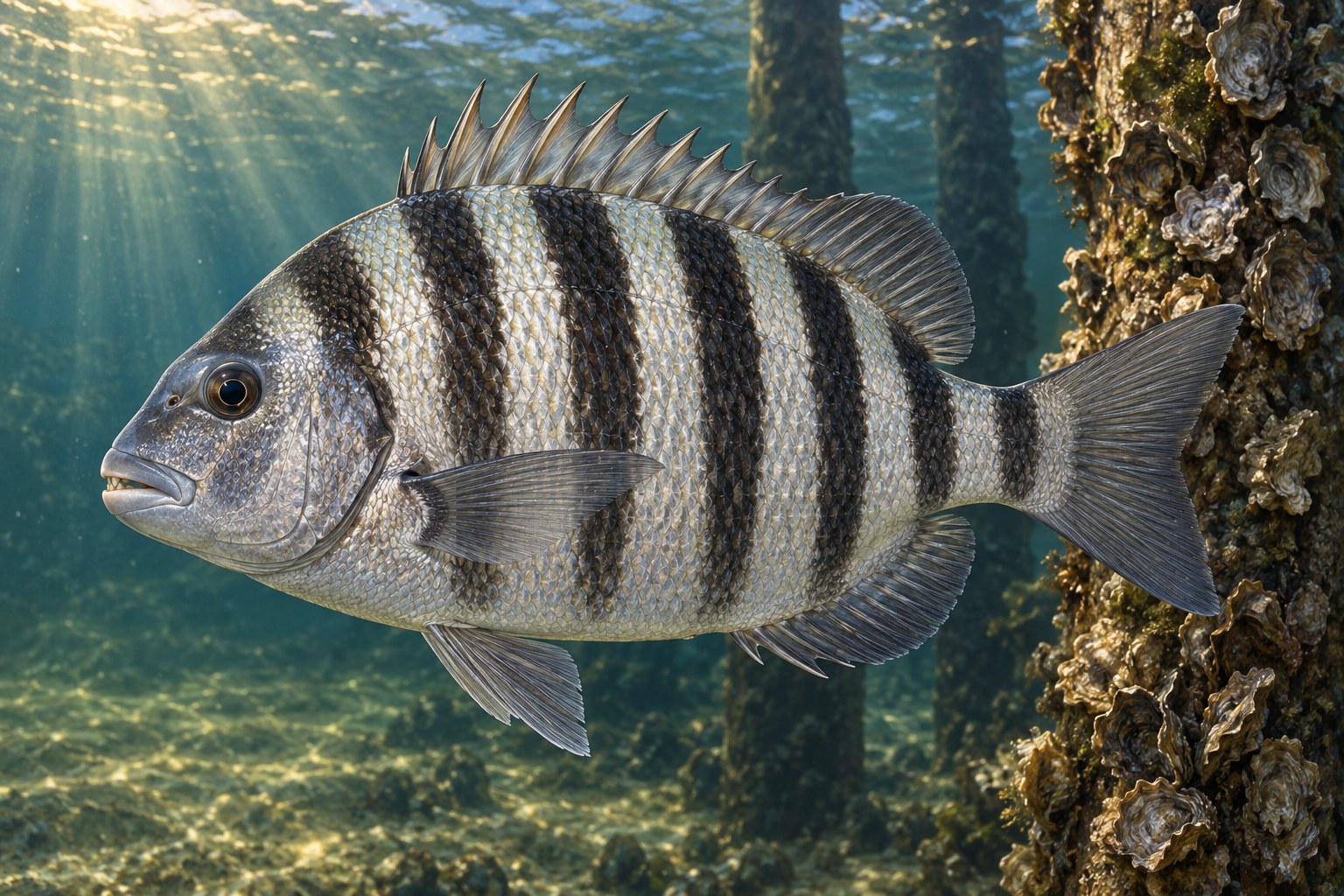
The striped fish beside the piling
Sheepshead turn hard structure into a feeding station. They pick small animals from oysters, rocks, seawalls and pilings, often close enough for an angler to see them. Watching a fish refuse a bait or remove it without moving the rod is part of the challenge. A little attention to hook size, line angle and timing makes that challenge much more manageable.
The species belongs to the porgy family. Its familiar black bars explain the nickname convict fish. Its unusual teeth explain how it earns a living. This is a fish built to crush and scrape, rather than spend the day chasing fast bait schools across open water.
Identification starts with the mouth and chin
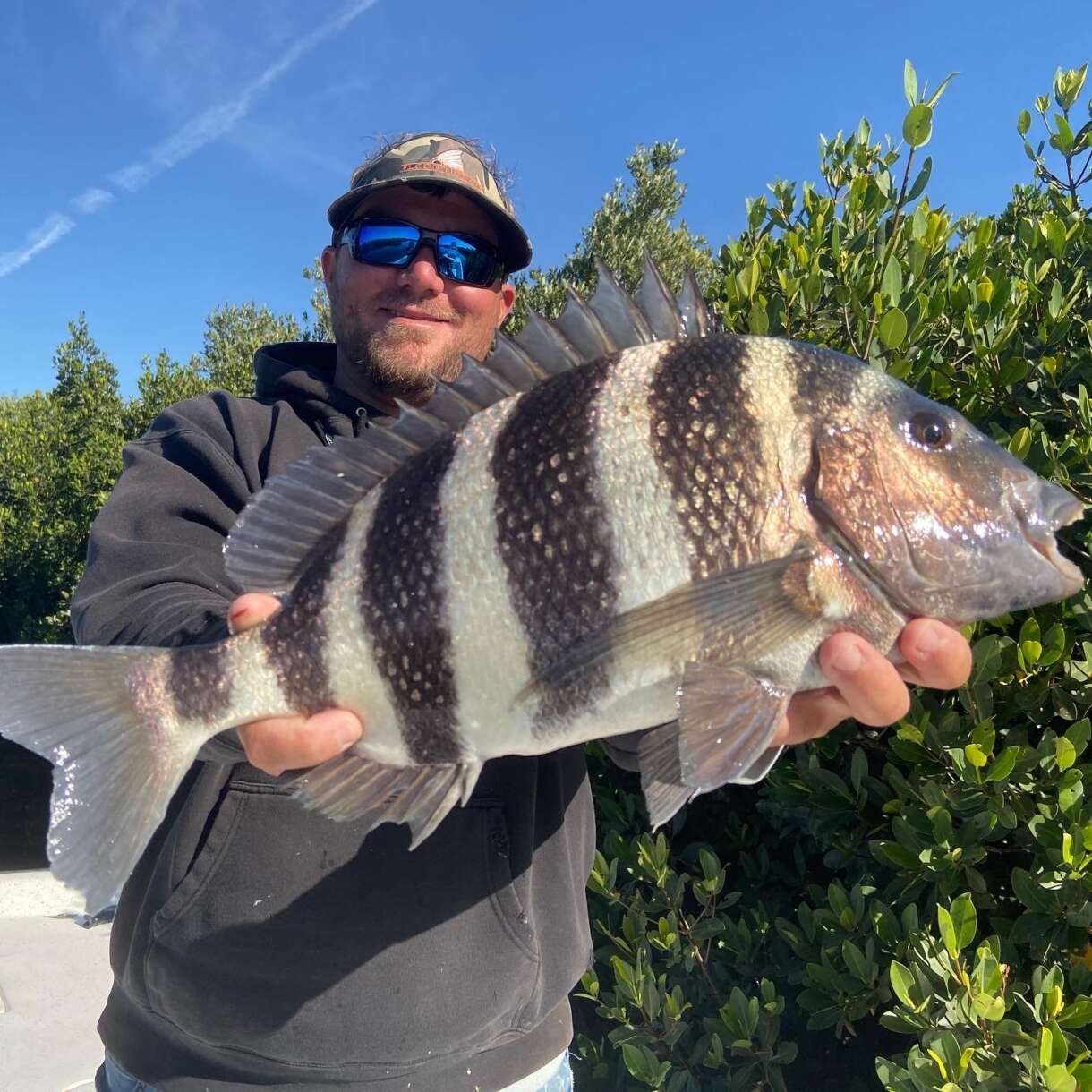
Adult sheepshead have a deep, compressed body with dark vertical bars over a lighter background. Their front teeth resemble small incisors, while heavier teeth farther inside crush hard food. The dorsal and anal fins carry stout spines.
Young black drum also have vertical bars. Look beneath the chin: black drum have barbels, while sheepshead do not. Atlantic spadefish have a different body and fin shape and lack the conspicuous crushing teeth. Do not identify a fish from stripes alone.
The bars may look stronger in one photograph than another. Use several features together. Keep fingers away from the mouth while checking a fish, and avoid sliding a bare hand forward against the dorsal spines.
Habitat is about food-covered surfaces
A plain concrete wall can become useful fish habitat once small organisms grow on it. Sheepshead visit those surfaces to feed. Oyster bars, barnacle-covered pilings and rocky edges offer similar opportunities, especially when current brings additional food.
The best-looking structure is not automatically the easiest place to fish. A piling in extreme current may make it impossible to keep a small bait close to the feeding zone. A nearby eddy or the sheltered side of the same bridge can give the bait a more natural path.
Depth varies widely. Some fish graze high on a piling; others stay near its base. Search the full useful water column instead of assuming that every bait must rest on the bottom. Where oysters are exposed on a low tide, feeding access can change as the water rises.
Winter, spring and spawning movements
Sheepshead can be caught during much of the year, but late winter and early spring are especially important periods in many Florida fisheries. Adults gather around nearshore structure as spawning approaches. Local weather and coast affect the timing.
Spawning takes place in batches, meaning a female can release eggs more than once. Early life stages drift in the water before young fish settle into suitable nursery habitat. As they grow, they increasingly use the hard structure familiar to anglers.
A seasonal gathering should not be treated as an unlimited supply. The fish concentrated around one reef or inlet may be important breeders. Keep only a sensible legal catch, and move away when repeated releases are becoming difficult or fish are being injured.
What their teeth are designed to eat
Crabs, shrimp, barnacles, oysters and other small hard-bodied animals feature in the diet. Sheepshead can also eat plant material and small fish, so calling them strict crab eaters would be misleading. Their feeding tools let them use prey that many other inshore fish cannot handle as easily.
This diet explains why an exposed hook and a compact bait matter. A sheepshead can nip at loose pieces without taking the point into its mouth. Large dangling shrimp portions may feed the fish while leaving the angler with an empty hook.
Notice what the fish are working on. If they are facing a shell-covered piling and repeatedly pecking at it, place a bait beside that feeding surface. Dropping a large bait several feet away may never enter the fish's immediate search area.
Fiddler crabs and other natural baits
Fiddler crabs are a classic choice because they offer a firm, compact meal. Match the hook to the crab and leave its point unobstructed. Check local collection rules before gathering bait, and avoid damaging marsh banks while doing so.
Live shrimp are convenient and versatile. A small whole shrimp or a carefully trimmed portion can work. Tougher pieces may last longer around bait thieves, but a stale bait is not improved simply by staying on the hook.
Sand fleas can produce around beaches and rocky shorelines. Small pieces of appropriate shellfish may also work where their collection and use are legal. Do not scrape living material from public infrastructure or remove oysters without knowing the applicable rules and permissions.
Tackle that shows a light bite
A sensitive medium spinning rod is comfortable for many dock and bridge situations. Around 10 to 20 pound braid and a 20 to 30 pound leader are practical starting points in moderate structure. Heavier current, larger fish or abrasive rocks may call for a stronger outfit.
Sensitivity does not mean using fragile gear everywhere. The first few seconds often decide whether the fish reaches a piling. Choose a rod with enough lower-section strength to guide a hooked fish away while keeping the tip responsive.
A small, strong hook should fit the bait and the fish's mouth. Oversized hardware reduces the advantage of a carefully chosen crab. Inspect the point often because repeated contact with shell or rock can dull it without an obvious snag.
Three ways to present the bait
A light jig head gives direct contact when fishing nearly vertically. Lower it beside the structure and feel for bottom or the level where fish are feeding. Too much weight can make the bait wedge into cracks.
A sliding sinker above a short leader lets the bait move separately from the main weight. It suits some bottom presentations, especially when a small amount of movement looks natural. Keep the leader manageable around tight structure.
A dropper arrangement can hold the hook above a sinker. This helps when fish feed just off the bottom. Whatever the rig, use the least weight that provides useful control in the current rather than choosing weight by habit.
Learning the bite
A sheepshead bite may feel like a tap, a faint scrape or unexpected weight. It can also look like the line moving sideways. The angler's job is to keep enough contact to notice these changes without pulling the bait away continually.
With an appropriate conventional hook, a short controlled lift can set the point. A wide overhead swing often creates slack before the line tightens. If using a circle hook, reel into steady pressure instead of striking sharply.
Repeated missing bait is information. Reduce loose bait, inspect hook exposure and shorten the distance between the bait and the structure. Do not respond automatically by using a much larger hook. The problem may be presentation rather than fish size.
Fishing a bridge without losing every rig
Begin on the side where current allows a controlled drop. Lower the bait so it travels close to the piling without wrapping around it. Keep the boat or your standing position far enough away to avoid disturbing fish and other users.
After a hookup, guide the fish toward open water promptly. A straight downward pull beside rough concrete can cut a leader quickly. Side pressure, used with a sensible drag setting, often gives better control than simply lifting harder.
Never tie to a navigation marker or obstruct a boat channel to reach fish. Check whether fishing is allowed from the bridge itself. A bridge visible on a map may have no safe or legal pedestrian fishing access.
Oyster bars, jetties and rocky shorelines
On an oyster bar, fish the submerged edge or a small drain rather than casting directly into the densest shell. A rising tide may allow fish to feed farther onto the bar. On the falling tide, the outer edge can become the practical target again.
Around jetties, choose footing and wave conditions before choosing a casting angle. Algae-covered rock is slippery even on a calm-looking day. A long-handled landing net can help from suitable platforms, but it should never require climbing onto exposed rocks during a swell.
Fish several small positions carefully. Sheepshead can gather around one face of a rock or a particular piling while nearby structure stays quiet. A short move is often more useful than a long cast across unsuitable bottom.
Boats, kayaks and shore anglers
A boat makes it easier to adjust line angle, but repeated engine corrections can disturb shallow fish. Set up outside the structure and approach with a plan for wind, current and landing. Keep enough room to leave without squeezing between pilings.
A kayak can reach quiet shoreline structure, yet fast bridge current presents a different level of risk. Avoid positioning where a hooked fish could pull the craft into traffic or fixed objects. Wear a suitable personal flotation device and keep the fishing plan within the craft's limits.
Shore anglers should carry only what they can manage safely. A compact bait container, measuring tool, pliers and net are more useful beside a seawall than a large pile of loose gear that blocks the walkway.
Where to plan a Florida sheepshead trip
The Tampa Bay region, Homosassa, Cedar Key and Charlotte Harbor all offer combinations of estuary structure and nearby coastal water. Atlantic inlets and bridges can also provide productive habitat. The key is legal access to food-covered structure, not a particular county name.
HookCurrent's location guides can help compare these areas. Check current pier openings and parking arrangements because storms and repairs can change access. Do not assume a photographed private dock is available for public fishing.
Landing, measuring and keeping fish
Support a sheepshead beneath the body and control its spiny fins. Use pliers rather than fingers near the teeth. A rubber-coated net can reduce the need to grip a struggling fish tightly.
Take the required measurement on a firm board. Fish intended for release should spend as little time as practical on dry surfaces. For legal fish kept to eat, prompt icing helps preserve quality.
The heavy scales and strong skeleton make cleaning more demanding than cleaning a soft-scaled fish. Work on a stable surface with suitable tools. Never hold a fish against your body while forcing a knife through hard material.
Rules before the first drop
Check Florida's current sheepshead size and bag limits, along with any seasonal vessel limit. Rules for a group on a boat can differ from simply multiplying a remembered personal allowance. Special areas may have additional restrictions.
The same trip may produce black drum, snapper or undersized reef fish. Carry enough identification knowledge to apply the correct rule to each species. A mixed catch needs several correct decisions, not one rule for every striped fish.
Sheepshead questions answered
Why do I feel nothing when my bait disappears?
The fish may be nibbling loose bait beyond the hook point. Use a smaller, tidier piece and maintain closer contact with the rig.
Are their teeth really like human teeth?
The front incisors look familiar, but the mouth also contains crushing teeth adapted to hard prey. Keep your fingers outside it.
Is winter the only time to catch them?
No. Seasonal gatherings can make winter and spring productive, but suitable structure may hold fish at other times too.
Do I need to scrape barnacles to attract fish?
No. A well-presented crab or shrimp can catch feeding fish without damaging the structure or collecting material unlawfully.
Can I use the same rig from every bridge?
Current and depth differ. Adjust the weight and line angle so the bait stays controlled near the feeding surface.
What is the fastest way to tell one from a young black drum?
Check the chin as well as the stripes. Black drum have barbels; sheepshead lack them and have distinctive front teeth.
Match your approach to the water
| What you find | An option to try | The detail that matters |
|---|---|---|
| Dock piling with growth | Fiddler crab | Lower close to the piling while keeping a clear fighting angle. |
| Rocky bottom with gentle flow | Small shrimp portion | Leave the hook point exposed and watch for steady weight. |
| Snags on every drop | A shorter controlled presentation | Move the bait to the edge of cover instead of its deepest crack. |
Plan a sheepshead trip
Local access guides for sheepshead trip planning: Crystal River, St. Petersburg, Cedar Key.
Tides and weather · Florida fishing charters
Read the current FWC rules for sheepshead.
Rules review: October 4, 2026.
Research and photograph credits · All fish species · Return to the beginning