

NORTHEAST ATLANTIC
Ponte Vedra Beach
fishing guide
Ponte Vedra Beach fishing guide with public entrances, sandy troughs, pompano and whiting methods, conditions and careful beach access.
Explore the guide ↓Start with a public entrance and a readable beach
Ponte Vedra Beach is a long coastal area, so the name alone is not a fishing location. The useful plan identifies a public entrance, a legal parking space and an open stretch of surf. Once those are settled, the sandbars and troughs decide where to cast.
South Ponte Vedra Beach Recreation Area is one established county beach access to investigate. North Beach Park and the Guana coastal accesses provide other managed options along the broader coast, each with its own facilities and rules.
For a relaxed first visit, focus on small bottom-feeding fish. Fresh shrimp, a simple rig and a manageable surf forecast are more useful than a large collection of specialized lures. Learn one entrance well before trying to cover the entire area in a morning.
Match the entrance to the group
St. Johns County lists South Ponte Vedra Beach Recreation Area among its beach pavilion locations. Its beach route uses stairs. If someone needs a step-free route, confirm the current access details before choosing it.
North Beach Park has a pedestrian overpass across A1A. Use the designated crossing rather than carrying rods across traffic at an unmarked point. Keep hooks secured while walking past other visitors.
Guana’s beach lots are a separate managed choice. They do not automatically provide access to every nearby lake, dam or trail area. The Guana fishing guide explains that split more fully.
Do not assume that a resort frontage or residential walkway is public access. A visible path to the ocean may serve private property. Use the county or park entrance you have confirmed and obey the signs at the lot.
Recent weather can alter the final step onto the sand. Check the crossing before carrying a heavy cart. A modest tackle load gives more flexibility if the beach surface is soft or uneven.
What to fish for from the sand
| Target | Water feature | Useful bait or lure |
|---|---|---|
| Whiting | Nearshore trough with gentle wash | Small fresh shrimp portion |
| Florida pompano | Clean sandy lane with crustacean food | Sand flea or compact shrimp bait |
| Bluefish | Bait pushed through the breakers | Metal spoon with a suitable leader |
| Black drum | Sand and scattered shell | Shrimp held close to bottom |
| Redfish | Deeper cut carrying bait | Fresh bait on tackle matched to the possible fish |
Whiting make a useful beginner target because they can feed close to shore. Pompano require the right combination of water and food, so bring expectations that allow for other catches. Passing predators may appear suddenly and then leave just as quickly.
Do not mistake an empty-looking surface for empty water. Bottom feeders may never show themselves before taking a bait. Careful bait checks tell you more than waiting for splashes.
Read the broken line of a sandbar
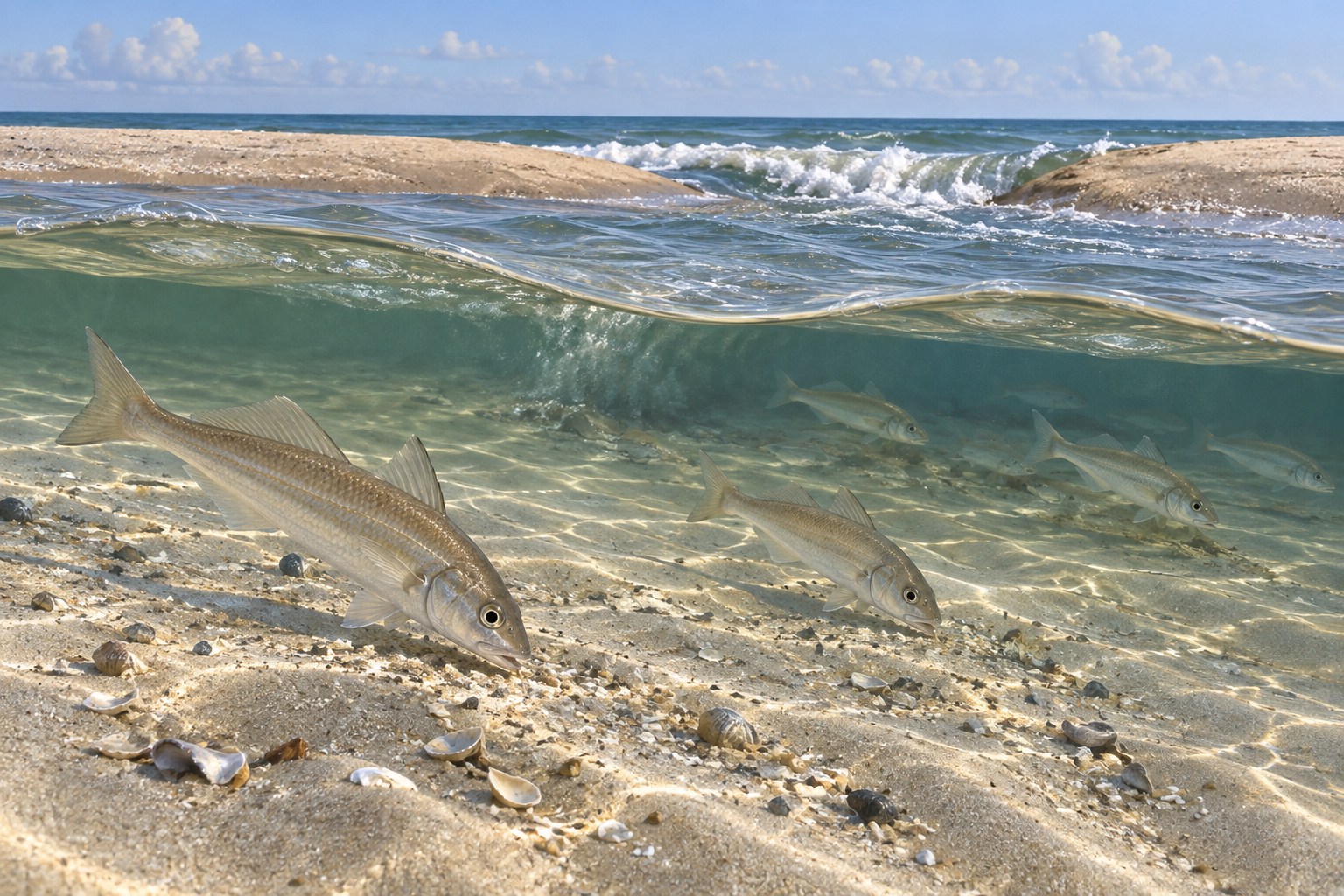
Watch where waves break consistently and where the line becomes uneven. A deeper opening can change the direction of the wash. Fish may use the nearby edge because food arrives there, but outward flow also makes such places unsafe for casual wading.
Stay on the beach and cast to a reachable lane. The target does not need to be the deepest point. A modest depression inside the first bar can be enough for whiting and other small fish.
Make the first few casts to a similar distance. If bait is being touched, refine the presentation there. If nothing happens, test a second lane so the results can be compared.
A changing tide can move the useful water closer or farther. Recheck the wave pattern during the visit instead of keeping the rod in exactly the same place because it produced earlier.
Use fresh bait in manageable pieces
Divide shrimp into short portions that fit the hook. A long loose piece may be stolen from the end while the point remains untouched. Keep enough bait on the bend to stay secure without hiding the point.
Sand fleas are another option when obtained legally. If collecting them is unfamiliar, do not spend the whole fishing window searching for bait. Purchased bait allows more time to learn the beach itself.
Store the main supply in a cool container and use a small working amount. Sun and wind quickly dry exposed bait. A fresh piece can make a bigger difference than adding decorative parts to the rig.
When bites are frequent but hookups are rare, shorten the bait and check hook size. When bait returns untouched, change position or depth before assuming the fish dislike shrimp.
Let the surf set the tackle limit
A surf rod should be matched to the weight it will cast. Read its rating and leave a margin for the bait as well as the sinker. An outfit that handles calm water comfortably may not be suitable after the wind rises.
Use a secure rod holder above the active wash and remain close. Sand can soften around the spike as water advances. A rod pointed at the sea is still unattended if nobody can reach it when a fish pulls.
Keep a spare leader and a few hooks ready. Retie when the line feels rough or a knot has been pulled hard against a snag. A quick inspection is less frustrating than losing the next fish to known damage.
Carry pliers and a ruler where they can be reached easily. A small release fish should not wait in the sand while the tackle bag is emptied.
Choose a window with room to cast
Morning often provides more space before swimming activity grows. That is a convenience, not permission to ignore opening or parking rules. Check the selected access before planning a dawn arrival.
Spring and autumn can offer good beach conditions between fronts. Summer brings heat and afternoon storm risk. Winter fishing may require more patience and a slower bottom approach after cold weather.
Use the tide and weather outlook to compare wind, surf and daylight. Strong onshore wind may make a previously easy trough difficult to hold. Heavy weed can make even moderate waves frustrating.
A calm sky does not guarantee calm water after a weather system. Watch several sets before unpacking, and keep a willingness to leave if the surf is beyond the group’s ability.
A focused first session
Begin with a single bottom bait in the nearest trough. Spend the first few minutes learning how the rig moves. If it stays in place and comes back clean, give the lane a fair trial.
Next, compare a farther cast or a short walk along the authorized beach. Keep the bait similar so the location change is meaningful. Record which distance produced taps or fish.
Finish while there is enough energy for the walk back. Rinse equipment later with fresh water and inspect hooks before storing them. A clean, ready outfit makes the next short visit much easier.
Check before keeping a catch
Consult the FWC saltwater fishing rules for licenses, seasons and limits. Coastal fish can have different requirements even when they take the same bait.
Release fish you cannot identify or measure confidently. Use wet hands and support the body. Keep rays, catfish spines and toothy fish away from bare fingers while removing hooks.
Give the hook point a quick check
A hook dragged through sand or shell can lose its sharp point. Inspect it when replacing bait, especially after a snag. A clean point and a compact bait help a small fish make contact without needing a violent strike. Keep used hooks in a container rather than dropping them into an open tackle pocket, where they can catch a hand during the next change.
Ponte Vedra Beach fishing questions
Is every walkway to the beach public?
No. Use an established county or park entrance. Private residential and resort routes should not be assumed open to visitors.
What should a beginner target?
Whiting in a manageable inner trough are a practical choice. A short shrimp bait can test that water without complicated equipment.
Does a gap in the breakers mean I should wade there?
No. It can mark outward flow and deeper water. Observe and fish from shore without entering the gap.
Why check the crossing before unloading?
Stairs, storm-altered sand and soft surfaces can change how easily the group reaches the beach. Confirm the route before carrying a large load.