
The gear is rigged, the tide is turning, and you can practically feel the thump of a snook hitting your lure. Then the question hits you: do I need a fishing license in Florida for this spot? It’s a moment every angler has faced. The last thing you want is for confusion over regulations to ruin a good day on the water or, worse, lead to a fine. This guide cuts through the noise to give you a straight answer on Florida’s shoreline license exemptions. We’ll break down exactly what they are, who qualifies, and how to fish from land with confidence.
These exemptions are not loopholes. They are specific provisions created by the Florida Fish and Wildlife Conservation Commission (FWC). Understanding them is your responsibility as an angler. It’s also worth remembering that license fees are what fund the science, habitat restoration, and stock assessments that keep our fisheries healthy for generations to come. Compliance is part of being a good steward of the resource.
This guide will give you the bottom line on the questions that matter most:
- What does the FWC officially consider “shoreline” fishing?
- Who qualifies for an exemption and under what specific conditions?
- How do the rules change when you step onto a pier, jetty, or beach?
- What special permits for species like snook or sharks might you still need?
By the time you finish reading, you will know exactly what you need before you make your next cast from shore.
Your Guide to Shoreline License Exemptions
Let’s get right to it. A shoreline license exemption is not a single, simple rule. It’s a set of conditions defined by the Florida Fish and Wildlife Conservation Commission (FWC) that allows an angler to fish from land without purchasing a standard saltwater fishing license. These are intentional provisions, not loopholes. Knowing them is the key to avoiding a conversation with an FWC officer that ends with a ticket. It’s also important to remember that the money from license sales directly funds the conservation work that keeps Florida’s fisheries world-class. Healthy habitats and strong fish stocks don’t happen by accident.
This guide is built to answer the questions every shoreline angler has. We will cover what the FWC officially defines as “shoreline” fishing, so there is no gray area. We will detail who qualifies for an exemption, whether it is due to age, residency, or other specific factors. You will also learn how the rules can change the moment you step onto a pier or jetty, as some have special licenses that cover you. Finally, we will cover the critical permits, like those for snook or sharks, that you might still need even if you are otherwise exempt.
Our goal is simple. We want you to walk away from this article with the confidence to know whether you need to buy a license before your next trip. No more guessing, no more uncertainty. Just clear, actionable information so you can focus on what matters: catching fish.
What FWC Considers Shoreline Fishing
To use any shoreline exemption, you first have to know what the FWC counts as the “shoreline.” This definition is the foundation for everything else, and getting it wrong is the fastest way to get a fine. Let’s break it down so there is no confusion.
The Official Definition of Shoreline
The FWC defines shoreline fishing as fishing from land or from any structure fixed to land. It is that straightforward. This includes casting from a beach, a seawall, a bridge, or a jetty. It also covers wading. You can walk from the shore out into the water to fish as long as you can stand on the bottom and you did not use a boat to get there. For example, parking at Fort De Soto Park, walking to the beach, and wading 50 feet out to cast into a trough is absolutely considered shoreline fishing. You are connected to the land.
The Critical Disqualifier: Arriving by Boat
This is the point that trips up more anglers than any other. If you use any type of vessel to get to your fishing spot, you are no longer a shoreline angler in the eyes of the FWC. This includes a boat, kayak, canoe, or even a paddleboard. The moment a vessel is involved in transporting you to the spot where you will fish, the shoreline exemption becomes void. Anchoring your skiff on a grass flat and hopping out to wade for redfish is not shoreline fishing. At that point, you are a vessel-based angler. Once a boat is involved, the rules change completely, and you will need to understand the standard florida fishing license requirements for anglers on a vessel.
Common Gray Areas and Mistakes
Let’s clear up a few common scenarios. Launching a kayak from the beach to paddle out and fish is not shoreline fishing. You are fishing from a vessel. Fishing from a private residential dock attached to a home is considered shoreline fishing because the dock is fixed to land. The key is your connection to the shore without the use of a vessel. Understanding this distinction is vital for anyone planning to use a saltwater shoreline fishing license exemption. Always ask yourself: “Did I use a boat to get here?” If the answer is yes, you need a standard license.
The Florida Resident No-Cost Shoreline License
For many Florida residents, the most direct path to free fishing in Florida from land is the no-cost shoreline license. However, this is not an automatic right. It is a specific license that you must actively obtain, and it comes with important rules and limitations. Think of it as your official pass to fish from shore without having to buy the annual license.
Who is Eligible for the No-Cost License?
This exemption is strictly for Florida residents. The FWC has a clear definition of what constitutes a resident. Generally, it means you have a Florida driver’s license or ID card issued for at least six months, you are registered to vote in a Florida county, or you have declared Florida as your home state for tax purposes. This license is not available for tourists, snowbirds, or part-time visitors, even if they own property in the state. You must prove your primary residence is in Florida to qualify.
How to Obtain Your No-Cost Shoreline License
Getting your no-cost license is simple, but you have to take the step to get it. You cannot just show up and fish. Here is how to do it:
- Go to the FWC’s official licensing portal, GoOutdoorsFlorida.com.
- You can also visit a county tax collector’s office or a licensed agent, such as a local tackle shop that sells licenses.
- Follow the prompts to “purchase” the shoreline license. After verifying your residency, it will be added to your account or printed for you at zero cost.
Even though it is free, you must have proof of this license with you while you are fishing. This can be a printout, the physical card, or a digital copy saved on your phone. An FWC officer will ask to see it, and saying you have one is not enough.
Critical Limitations You Must Know
This is where anglers need to pay close attention. The no-cost shoreline license is not a free pass for everything. It is valid only for shoreline fishing as we defined it earlier. The moment you step onto a boat, it is invalid. More importantly, it does not cover the harvest of certain regulated species. If you plan to keep a snook or a spiny lobster, you must purchase the separate, paid permits for them. Your free license does not include these privileges. As the FWC clarifies in its official guidance, this license has specific limitations designed for general shoreline fishing only. For more details, you can always check the FWC’s shoreline FAQ page directly.
Who Fishes Free: Age and Other Exemptions
Beyond the no-cost shoreline license for residents, the FWC provides several other exemptions based on age, military service, and disability status. These apply automatically as long as you meet the criteria and carry the right documentation. It is important to distinguish these from the shoreline-specific license, as they often have fewer restrictions.
Florida Residents 65 or Older
If you are a Florida resident aged 65 or older, you are not required to have a saltwater fishing license. However, you must carry proof of your age and residency with you at all times while fishing. A valid Florida driver’s license or state-issued ID card is the perfect document for this. This exemption covers you for both shoreline and vessel-based fishing.
Anglers Under 16 Years of Age
This is one of the simplest rules. Anyone under the age of 16, whether they are a Florida resident or a visitor, does not need a saltwater fishing license. This is a great way to get kids into the sport without any administrative hurdles. It is critical to remember, though, that while they do not need a license, they are still required to follow all other Florida fishing license rules. This includes bag limits, size limits, and seasonal closures. The exemption is for the license, not the regulations.
Special Exemptions for Residents
The FWC also provides exemptions for specific Florida residents. Those who are members of the U.S. Armed Forces and are home on leave for 30 days or less can fish without a license. They must carry a copy of their orders with them as proof. Additionally, Florida residents who have been certified as having a total and permanent disability by a state or federal agency are exempt. They must have their disability certification from an authorized agency on hand while fishing.
The “Cane Pole” Exemption
This is a very specific and somewhat dated rule, but it is still on the books. A Florida resident can fish in their home county using a pole or line that has no reel or other line retrieval mechanism. This is the classic cane pole setup. Given that most modern saltwater fishing involves a rod and reel, this exemption is rarely practical for most anglers. However, it technically exists for those fishing with minimalist gear in their local waters.
| Exemption Category | Who Qualifies | Required Documentation / Action | Geographic Limitation |
|---|---|---|---|
| Age (Under 16) | Any person under 16 | None required | None |
| Age (Resident 65+) | Florida residents age 65 or older | Proof of age and residency (e.g., FL Driver’s License) | None |
| No-Cost Shoreline License | Florida residents | Must obtain the free license online or from an agent | Shoreline access only (no boats) |
| Military on Leave | Florida residents in U.S. Armed Forces, home on leave for 30 days or less | Copy of orders | None |
| Disability | Florida residents with certified total and permanent disability | Disability certification from an authorized agency | None |
| Cane Pole | Florida residents | None, but gear is restricted (no reel) | Home county only |
How Licensed Piers Change the Rules
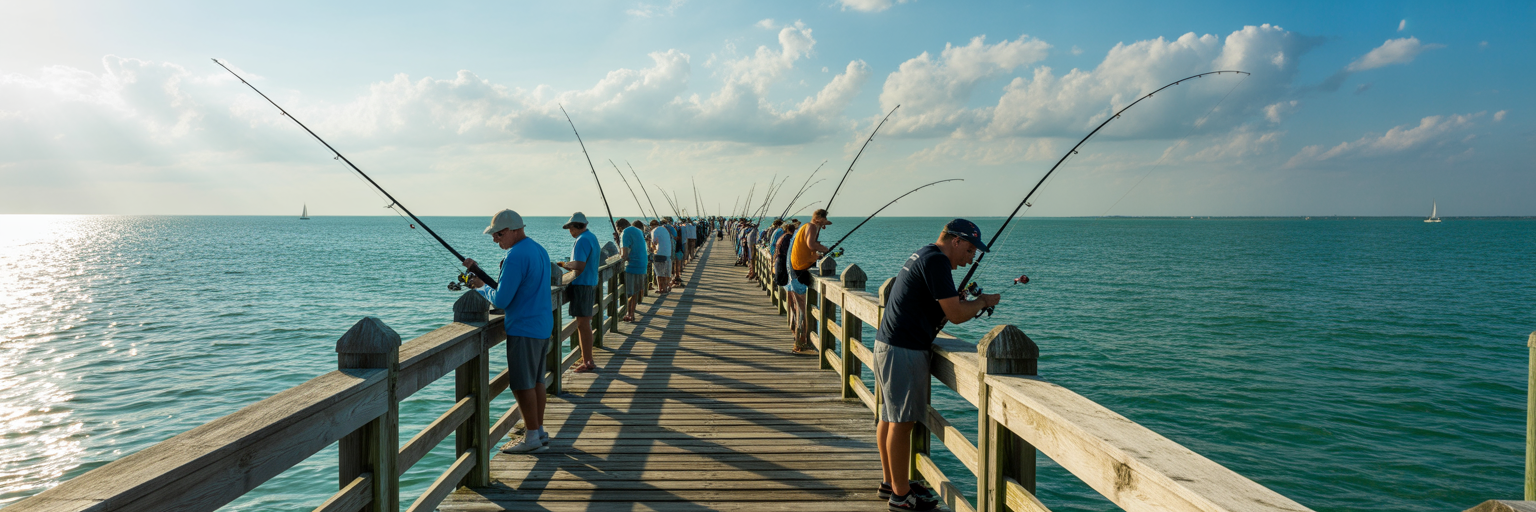
Fishing from a pier seems like a clear-cut case of shoreline fishing, but it introduces a unique set of rules that can work in your favor. Certain public piers operate under a special license that covers every angler on them, but making assumptions can be a costly mistake. Here is what you need to know before you pay your entry fee and start fishing.
Understanding the Pier License
Some public fishing piers in Florida purchase a special bulk license from the FWC. The best way to think about it is that the pier pays a single, large fee that covers every single angler fishing on its deck. If a pier holds this license, you do not need an individual saltwater fishing license or the no-cost shoreline license to fish from it. This is a huge benefit because the exemption applies to both Florida residents and non-resident visitors alike. It simplifies the process for everyone, making these piers popular destinations for tourists and locals.
The Angler’s Responsibility: You Must Verify
This is the most important part of this section. You cannot assume a pier is licensed. Not all public piers have this license, and licenses can expire. It is your responsibility to verify the pier’s status before you make a cast. An FWC officer will not accept “I thought it was licensed” as an excuse. Here is how to check:
- Look for a sign. Licensed piers are required to post their license status prominently, usually at the entrance or where you pay to get on.
- Check the FWC’s official list. Before you even leave the house, you can look up the pier on the FWC website to see if it is on their list of licensed saltwater piers.
- When in doubt, ask. The staff at the pier’s gate or in the bait shop will know the current license status. A quick question can save you a big headache.
For a definitive source of information, the FWC’s general licensing page is the portal to finding this list. As they state on their “Do I need a license?” page, checking official sources is always the best practice.
Common Pitfalls and Edge Cases
The pier license exemption has very clear boundaries. If you are fishing on the beach just 10 feet away from the entrance to a licensed pier, you are not covered by the pier’s license. You are back to being a regular shoreline angler and need your own license or exemption. If the pier’s license expired last week and they have not renewed it yet, you are not covered. This is why verifying every time is so important. Also, do not confuse large, licensed public piers with smaller, unlicensed municipal piers or private docks. For those, you are on your own and must have the proper license.
Beyond the Basics: Shark and Species Permits
Understanding the general shoreline license exemptions is only part of the picture. A common and costly mistake is assuming an exemption covers you for every species you might catch. It does not. The FWC requires special permits for certain high-interest species, and these permits are mandatory regardless of your license status. Think of it this way: an exemption might cover your general admission to fish, but it does not cover the special tags required for specific targets.
The most important one for land-based anglers is the Shore-based Shark Fishing Permit. Let’s be perfectly clear: anyone 16 or older who is targeting sharks from shore must have this permit. This includes fishing from beaches, jetties, and piers. No other exemption, whether it is age, residency, or being on a licensed pier, waives this requirement. To get the permit, you must complete a free online educational course that teaches proper shark identification, handling, and release techniques. This is a conservation tool designed to improve shark survival rates, and the FWC is very serious about its enforcement.
Beyond sharks, there are other key permits that are never covered by a general exemption. You must purchase these separately if you plan to harvest these species:
- Snook Permit: This paid permit is required if you intend to harvest, or keep, a legal snook. If you are just catching and releasing, you do not need it, but the moment you decide to put one in the cooler, you must have the permit.
- Spiny Lobster Permit: This paid permit is mandatory if you plan to harvest spiny lobster. No general license exemption covers this.
- Tarpon Tag: This is required only if you possess or kill a tarpon. Since the tarpon fishery is almost entirely catch-and-release and killing one is extremely rare and highly regulated, most anglers will never need this.
The takeaway is simple. Always check the specific regulations for your target species before you go. A general exemption gets you on the water, but it is your responsibility to know if you need an additional permit for what you are trying to catch.
Your Pre-Trip Exemption Checklist
Let’s boil it all down to a simple mental checklist you can run through before every trip. This is your go or no-go framework for understanding Florida’s shoreline license exemptions. Answering these four questions will tell you exactly what you need.
- Access: How am I getting to my spot? If a boat, kayak, paddleboard, or any other vessel is involved in getting you there, STOP. You need a paid license. If you are walking, wading from shore, or driving to a land-based structure, you can proceed to the next question.
- Location: Where am I casting from? If it is a licensed public pier, and you have verified it is currently licensed, you are covered for the base license. If it is any other shoreline spot like a beach, jetty, seawall, or bridge, proceed to the next step.
- Your Status: Do I qualify for a personal exemption? If you are under 16 or a Florida resident 65 or older with proof of age and residency, you are covered for the base license. If you are a Florida resident who has already obtained the free no-cost shoreline license, you are covered. If none of these apply to you, you need to buy a license.
- Your Target: What am I fishing for? If you are targeting sharks from shore, STOP. You need the mandatory Shore-based Shark Fishing Permit. If you plan to keep a snook or spiny lobster, STOP. You need to buy the specific paid permits for those species. Always double-check the rules for your target.
Using this checklist will ensure you are always compliant with Florida fishing license rules, letting you focus on fishing instead of worrying about fines.