
HookCurrent Florida fishing
King Mackerel
Find Florida kingfish around bait schools and nearshore structure. Learn live-bait spreads, trolling basics, bite leaders and how to identify juvenile kings.
Scomberomorus cavalla
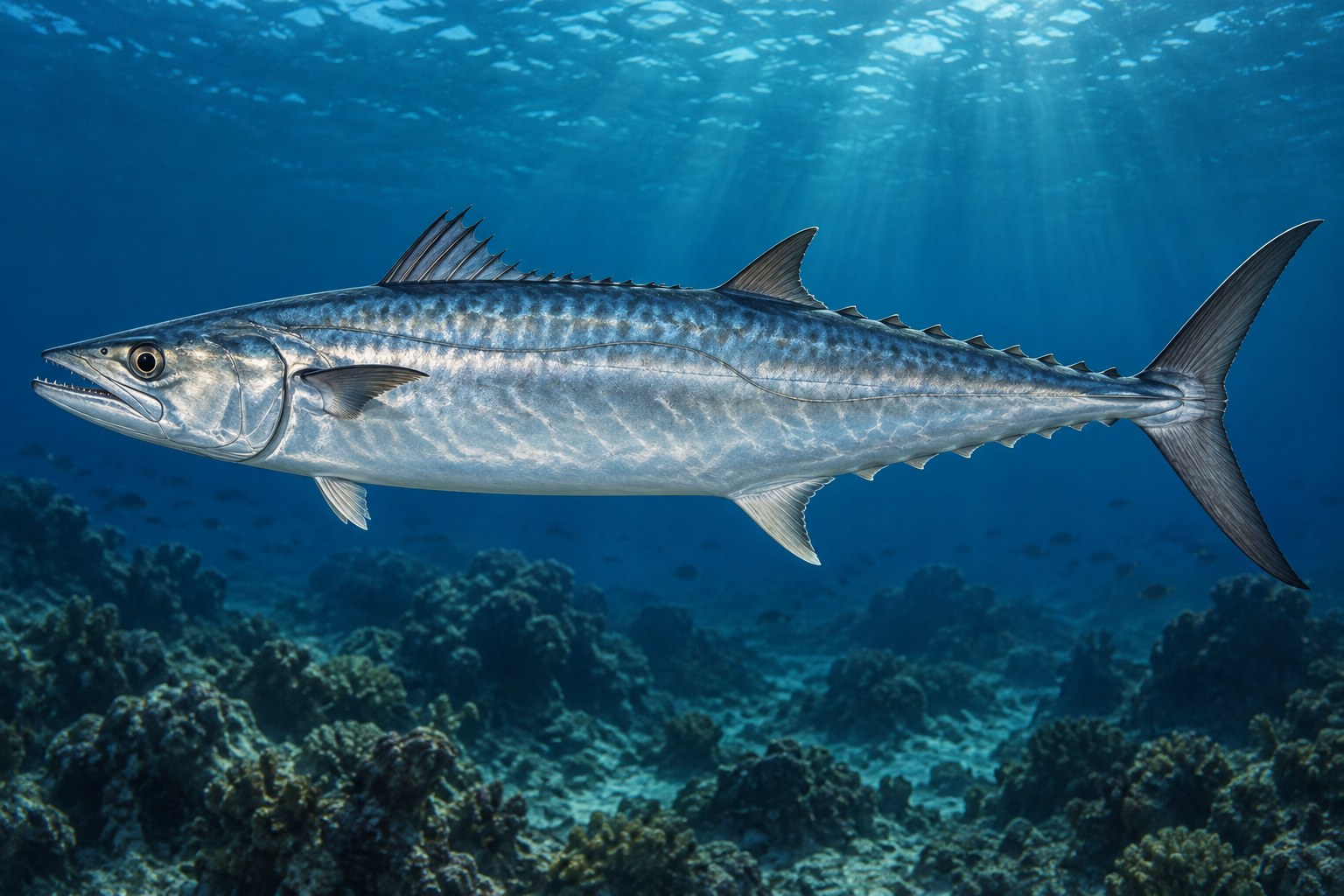
Built for a fast first run
King mackerel are open-water hunters with long bodies, sharp teeth and powerful tails. Florida anglers commonly call them kingfish. That name can be confusing because small surf fish called whiting are also known as kingfish in identification guides. This page covers Scomberomorus cavalla, the large mackerel.
A king bite can happen beside a reef, along a beach bait school or beyond a deep-water pier. The first run is often sudden. Tackle needs to be ready before the strike, and the crew needs a clear plan for the other lines once a fish is hooked.
Adult and juvenile identification
Adult kings usually have plain silver sides beneath a blue-green back. Their lateral line drops sharply below the second dorsal fin. The first dorsal fin lacks the prominent dark front patch found on Spanish mackerel.
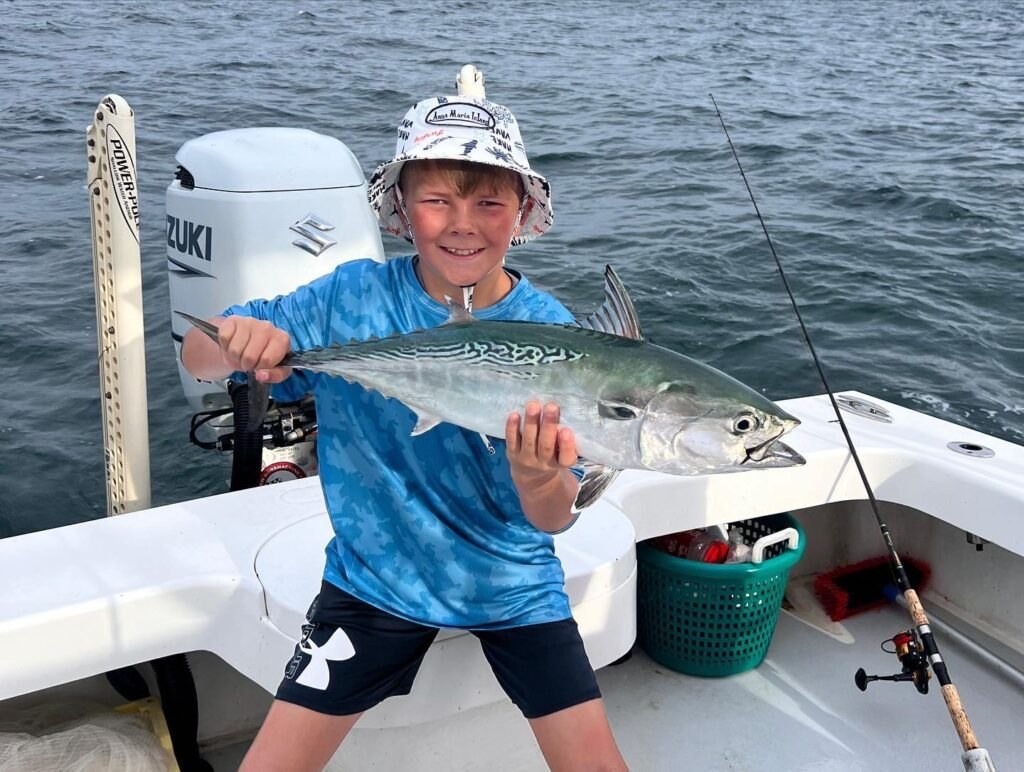
Young kings may carry yellowish spots. This is the most important identification trap for an angler catching mixed mackerel. A spotted fish is not automatically a Spanish mackerel. Examine the lateral line and dorsal fin before deciding which limit applies.
Wahoo are longer and narrower, with a long first dorsal and often clear vertical bars. Cero have a different side pattern. Learn these shapes while looking at reliable reference images, not while a fish is thrashing around several loose hooks.
Where kings hunt
King mackerel range from coastal water to offshore grounds. Reefs, wrecks, hard-bottom areas and channel edges can concentrate bait, which in turn attracts kings. The fish may patrol above the structure rather than remain close to the bottom.
Beachfront bait schools are another important setting. Menhaden, sardines and similar schooling fish can bring predators into relatively shallow water. A clean current edge or a change in water color may gather food even when the bottom itself looks unremarkable.
Look for a combination of signs. Bait on the sounder, birds working nearby and occasional surface activity together are more useful than a single old waypoint. A famous reef without food may be less productive than a temporary bait concentration elsewhere.
Seasonal movement around Florida
Kings generally move toward northern waters as conditions warm and toward southern waters as they cool. The Gulf and Atlantic fisheries have their own movement patterns, and not every fish follows the same route or timetable.
Spring and fall often draw attention because bait and migrating fish can become accessible along the coast. South Florida and the Keys provide additional opportunities in seasons when northern water is less favorable. Local temperature and food remain the immediate clues.
A cold front can change the bite by moving bait, muddying water or making a crossing unsafe. Treat a seasonal pattern as a starting point for planning, then check the conditions that will exist on the actual fishing day.
Spawning, growth and size
King mackerel spawn offshore during the warmer months. They release eggs into the water rather than guard a nest. Larvae and young fish develop in a changing open-water environment, where food and predation affect survival.
Females tend to reach larger sizes than males. The very large kings prized by tournament anglers are often called smokers. The nickname describes an impressive fish and its fast run, not a separate type of mackerel.
Large size also affects practical decisions. A bigger king needs stronger landing control, more room on deck and a cooler that can hold it properly if retained. Plan for the fish you might hook, not only the average fish from the last trip.
Food and the value of healthy bait
Kings primarily pursue fish, with squid and other prey also taken. Locally available menhaden, herring, sardines, mullet and similar baitfish can all be useful. The best choice is often the healthy bait the fish are already encountering.
A crowded livewell can turn good bait into weak bait quickly. Maintain suitable water flow and avoid mixing delicate bait with rough handling. Use an appropriate bait net instead of repeatedly chasing individual fish around the well by hand.
Watch a bait after it is deployed. If it rolls, spins or hangs unnaturally, retrieve and correct it. Leaving a poor swimmer in the spread does not improve the odds simply because it is technically alive.
Tackle for live-bait fishing
A rod with a forgiving tip helps protect hooks during a king's sudden run and head shakes. Reels need a smooth drag and enough line capacity for the chosen water and fish size. Common live-bait outfits use moderate line strengths rather than the heaviest possible tackle.
Drag should allow a fast fish to run without tearing out the hook or breaking a light connection. Set it deliberately before fishing. Tightening it sharply during the first surge can turn a strong bite into an immediate loss.
Leader design is important because of the teeth. A short wire bite section is commonly used for king fishing. Keep connections neat and check wire for kinks or fatigue. Replace damaged sections rather than straightening the same weak spot repeatedly.
Bait rigs and hook placement
A simple bait rig should let the fish swim naturally while placing a hook where a king is likely to strike. Some anglers use a trailing hook for short strikes on longer baits. Extra hooks add handling risk and must comply with the rules for the area and bait.
Do not stretch a rig so tightly along a bait that it bends the fish into an unnatural shape. Give the bait room to move. Check the presentation beside the boat before letting it far back.
Use pliers and keep unused rigs secured. A king can twist violently at the surface, leaving a free hook swinging near hands and faces. The safest landing begins with a tidy deck and a crew that knows where those hooks are.
Building a manageable spread
Start with fewer lines than the crew can theoretically deploy. A clean three-line spread that stays untangled can fish better than six poorly controlled lines. Separate distances and, where appropriate, depths.
Place one bait where it can swim freely behind the boat and another closer to likely feeding depth. If using a downrigger, understand the release and keep its line clear of other gear. Do not assume that every visible fish is feeding at the surface.
Watch turns. The inside bait slows and may sink, while the outside bait speeds up. Tight turns can cross lines or damage delicate bait. Make gradual adjustments and retrieve a line when the situation becomes crowded.
Slow trolling and drifting
Live-bait trolling should preserve the bait's ability to swim. Boat speed depends on bait type, wind and current. A speed that works with one bait may exhaust another. Check behavior instead of relying only on a number on the display.
Drifting can provide a natural presentation over bait-rich water. Set the drift to pass beside structure or along the bait school, with room to leave safely. Watch whether wind pushes the boat faster than the baits can follow.
Keep the engine and navigation plan ready. A fish can run toward another vessel or a restricted area. The crew may need to move the boat, but that movement should never create a collision risk just to save a fish.
Trolling dead bait and lures
Rigged ballyhoo, spoons and suitable plugs can cover water when live bait is scarce. Each needs to track cleanly. Test for spinning, fouling and the correct swimming action before deploying the full spread.
Diving plugs reach a depth influenced by design, speed, line and distance behind the boat. Treat the package's depth claim as a guide rather than a promise under every condition. Keep plugs clear of shallow reef or wreck hazards.
If fish strike only one position, compare that lure's depth and distance with the others. The answer may be where it swims rather than its color. Make a deliberate adjustment and see whether the pattern repeats.
Casting to feeding kings
When kings feed near the surface, a suitable casting lure can reach fish outside a trolling spread. Use tackle capable of handling the lure and likely fish. Bite protection remains important even if the visible school looks small.
Cast around the edge of the activity and retrieve through open water. Do not place a lure directly over another angler's hooked fish or into a dense concentration of birds. A large lure traveling at speed requires a clear casting area behind you.
Be ready for a strike close to the boat. Keep control through the final part of the retrieve rather than lifting the lure carelessly while watching distant splashes.
Fighting and landing a king
Let the first run happen against the preset drag. Keep the rod loaded and avoid pumping so far that the line goes slack. Gain line steadily when the fish allows it.
Clear nearby lines early if they threaten to cross the fish. One person should communicate boat movement and another should manage landing equipment. Too many conflicting instructions can make a simple landing dangerous.
Do not bring a lively, toothy fish into an unprepared cockpit. Use an appropriate method for whether the fish will be kept or released. A release fish should not be gaffed, and hands should stay away from both the mouth and trailing hooks.
Florida ports and shore opportunities
The Panhandle, Tampa Bay approaches, southwest Florida, Atlantic ports and the Keys all have king mackerel fisheries when suitable bait and conditions are present. Destin, Panama City Beach, the Canaveral area, Jupiter and Key West are useful departure regions to investigate.
Some deep-water piers offer king fishing, but special local practices and tackle rules may apply. Check current access and speak with pier staff before bringing specialized rigs. A public beach nearby does not necessarily provide the same depth or bait access.
Rules, identification and food advice
Check the current king mackerel size and bag limits for your coast and waters. Rules can vary across management boundaries. Keep a reliable measurement method aboard and distinguish spotted juvenile kings from Spanish mackerel before retaining fish.
King mackerel are an important species to check against current fish-consumption advisories, particularly for children and people who are pregnant or may become pregnant. Cooking does not remove mercury. Use current health guidance rather than assuming that a legal fish is suitable for every diner.
Questions about Florida kingfish
Why did a king bite my bait in half?
Kings can strike across a bait rather than swallow it immediately. Review bait size, rig placement and permitted hook choices without adding unnecessary exposed hooks.
Do I need to troll quickly?
Not with delicate live bait. Use a speed that keeps the bait swimming naturally. Lures and rigged dead baits have different requirements.
Is wire always required by law?
Do not confuse common tackle practice with a legal requirement. Wire is widely used for tooth protection; check actual gear rules separately.
Can a spotted fish still be a king?
Yes. Juveniles may show spots. The lateral-line drop and first dorsal fin help separate them from Spanish mackerel.
Should I tighten the drag when the reel screams?
Avoid a sudden increase during the first run. A smooth preset drag protects the connection while the fish uses its initial burst of speed.
Is kingfish the same as whiting?
The nickname is used differently. This guide covers large king mackerel; beach whiting belong to a different group of much smaller fish.
Match your approach to the water
| What you find | An option to try | The detail that matters |
|---|---|---|
| Healthy live bait available | Slow-trolled baitfish | Move only fast enough to maintain the intended swimming presentation. |
| Fish spread over a broad area | A manageable trolling spread | Cover useful water while keeping each lure clean. |
| A fish makes its first long run | Smooth pre-set drag | Avoid an abrupt increase in pressure on a lightly hooked fish. |
Plan a king mackerel trip
Local access guides for king mackerel trip planning: Destin, Panama City Beach, Key West.
Tides and weather · Florida fishing charters
Read the current FWC rules for king mackerel.
Rules review: October 4, 2026.
Research and photograph credits · All fish species · Return to the beginning