
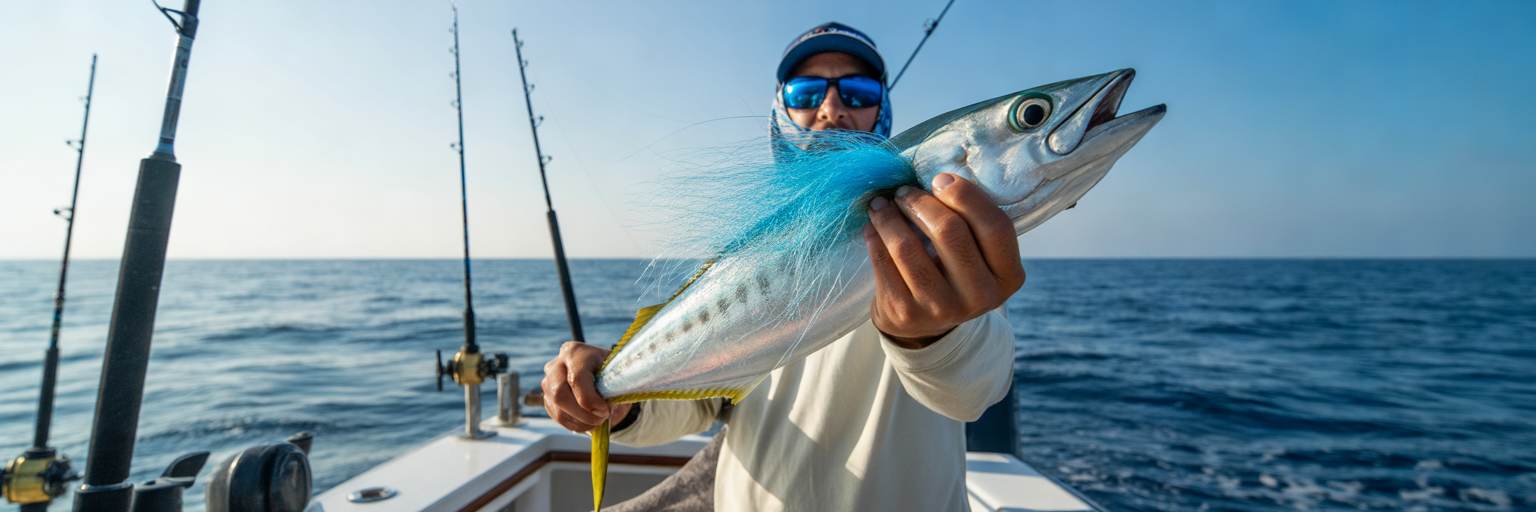
Decades before modern resin lures existed, Florida charter crews discovered that a hemiramphid baitfish skipping across a Gulf Stream rip was the ultimate trigger for pelagic predators. Learning to rig ballyhoo for mahi remains the dividing line between crews that merely spot fish and crews that fill the fishbox.
Why Learning to Rig Ballyhoo for Mahi Beats Pulling Plastic Alone
Every offshore captain has lived through that frustrating mid-morning scenario twenty miles off Islamorada or Palm Beach. You find a textbook current edge, watch a neon-lit bull dolphin streak into the spread, and hold your breath as he inspects a plain vinyl skirt. Then he peels off and vanishes. High-pressured pelagics along the Florida reef tract see hundreds of synthetic heads every weekend, and they quickly learn to spot a fake.
The Scent and Texture Advantage on Pressured Weed Lines
When you rig ballyhoo for mahi with precision, you change the entire strike equation from a visual reaction to a feeding response. A rigged natural dead bait leaves a continuous microscopic trail of menhaden-like oil, blood, and amino acids down the prop wash. Even more important is what happens the microsecond a fish closes its jaws. When a bull clamps down on hard acrylic or stiff vinyl, he knows immediately that something is wrong and spits it before the hook point finds the corner of the jaw. When that same fish crunches down on the soft ribcage and natural scales of a fresh ballyhoo, he feels real flesh, turns his head to swallow, and drives the hook home himself.
Earning a spot on the outrigger clip requires three non-negotiable traits from your bait. It needs a tight, natural tail kick that mimics a fleeing halfbeak, firm belly wall integrity that resists blowing out, and enough nose-cone security to handle a bumpy Gulf Stream cross-current or a steep Gulf Coast chop without washing out in twenty minutes. Connecting those bait qualities to the right water temperature breaks and current edges is the foundation of successful mahi mahi fishing across every Florida inlet.
When to Pull High-Speed Plastic vs. Natural Dead Bait
Smart crews never treat artificials and dead bait as an either-or religion. Pulling high-speed resin jets and bullet heads at 9 to 10 knots is an unbeatable way to cover dead water when you are hunting scattered birds or scanning for a five-mile rip line, as we break down in our guide on selecting and pulling synthetic lures. Once you find life, floating timber, or a stacked sargassum lane, throttling back to 6.5 knots and dropping back natural dead baits is what turns a tough scouting run into heavy coolers.
Terminal Tackle Specs and Hardware for Florida Offshore Spreads
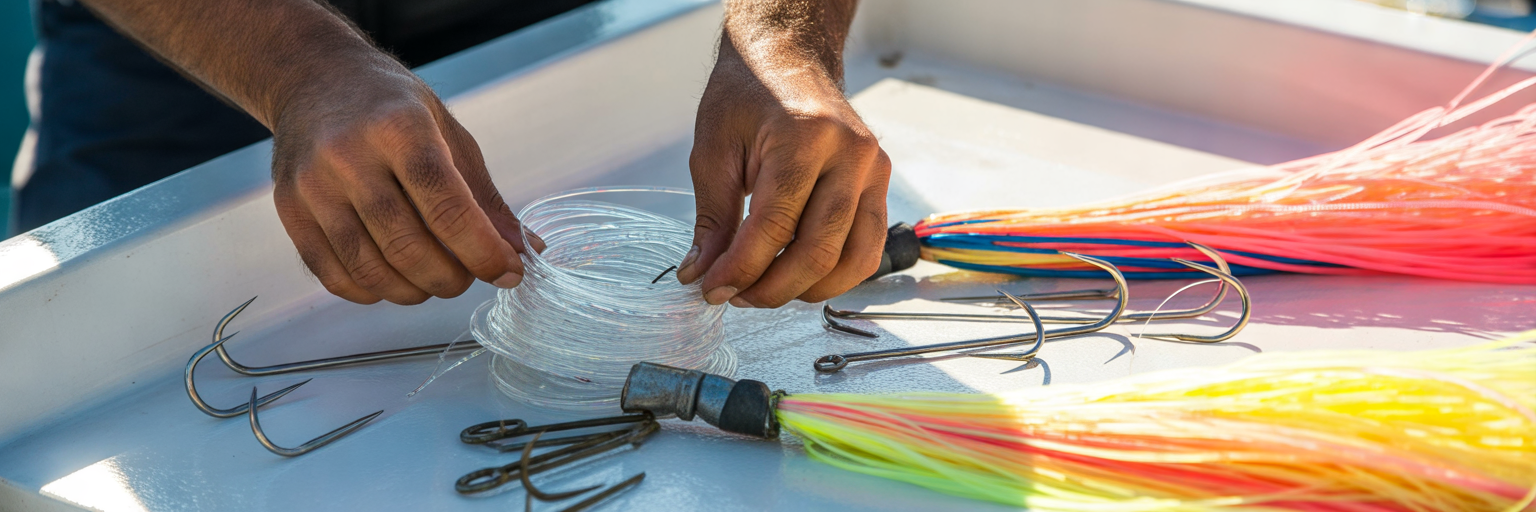
Building dependable offshore mahi trolling rigs starts at the rigging table long before you clear the sea buoy. If your terminal hardware is mismatched to your bait grade, even the freshest ballyhoo will spin like a ceiling fan or tear free on the first jump. Every crimp, hook bend, and lead sinker must balance stealth against the brutal shock of a high-speed strike.
Leader Material and Hook Geometry
For standard Florida dolphin spreads, your leader spool should stay between 80 lb and 130 lb test. When you are working gin-clear Atlantic water off the Keys or Miami on a slick summer morning, stepping down to 80 lb fluorocarbon gets bites from line-shy bulls that shy away from heavy cable or thick mono. When the wind kicks up to fifteen knots and you are ripping baits past barnacle-encrusted pallets and thick sargassum mats, step up to 100 lb or 130 lb monofilament for maximum abrasion resistance and stretch. Matching those leaders to a properly packed spool is critical, so review our breakdown on setting up braided mainlines for dolphin before loading your offshore reels.
Hook selection comes down to throat clearance and shank length. A 7/0 or 8/0 long-shank O’Shaughnessy J-hook, such as the classic Mustad 3407SSD, is the workhorse for medium and select ballyhoo. The extended shank lets you seat the hook eye tight inside the throat cavity while placing the point right at the anal vent, where short-striking schoolies love to nip. When early-summer packs of smaller schoolie mahi show up and you drop down to small rigging-grade baits, switch to a 6/0 hook so the iron does not overpower the tail action.
Chin Weights, Pins, and Rigging Wire
Keeping a dead bait upright at seven knots requires a low center of gravity. Segmented lead chin weights or split egg sinkers ranging from 1/4 oz to 1 oz tuck right beneath the hook eye and lock between the gill plates like a sailboat keel. Calm days call for 1/4 oz to 3/8 oz lead so the bait skips lightly on the surface, while a 1 oz weight keeps select baits planted in a three-foot chop.
To lock the jaws shut around the rigging pin, most mates prefer #8 or #9 soft copper wire because it molds cleanly around delicate beaks without slicing through the skin. Monel wire offers stiffer durability if you expect wahoo or kingfish bycatch, while heavy-duty rubber O-rings and screw-on bait springs let you swap washed-out baits in ten seconds during a chaotic pack attack. Up front, sizing your chuggers, slant heads, and hair sea witches with a wide nose cavity ensures the lure collar slips cleanly over the pin and wire wrap without binding the leader.
| Ballyhoo Size Grade | J-Hook Size (Long Shank) | Leader Rating (Mono/Fluoro) | Chin Weight Size | Target Trolling Application |
|---|---|---|---|---|
| Small (Rigging Grade) | 6/0 | 60 lb to 80 lb | 1/4 oz to 3/8 oz | Calm seas, naked flat-line baits for schoolie mahi |
| Medium (Standard Offshore) | 7/0 to 8/0 | 80 lb to 100 lb | 1/2 oz | All-purpose 6 to 8 knot spread with sea witches or chuggers |
| Select / Large | 8/0 to 9/0 | 100 lb to 130 lb | 3/4 oz to 1 oz | Rough Gulf Stream chop, long rigger baits for bull dolphin |
| Horse Ballyhoo | 9/0 to 10/0 | 130 lb to 150 lb | 1 oz to 1.5 oz | Heavy tackle trophy mahi, wahoo, and billfish mixed spreads |
Pre-Trip Rigging Tray Checklist
- Aluminum and double-barrel copper crimps: Match 1.0 mm to 1.3 mm sleeves precisely to your 80 lb to 130 lb leader diameter so connections never slip under heavy drag.
- Ratcheting bench crimpers: Calibrated jaws prevent over-crushing the monofilament inside the sleeve while leaving a flared edge that will not chafe the main line.
- 8-inch to 10-inch pre-cut copper rigging wire: Keep bundles twisted onto your tray handle for instant access when re-rigging in a rolling sea.
- Stainless steel rigging needles and waxed floss: Essential for stitching vents shut or building tournament-grade bridle rigs when big fish show up.
- Bait springs and stainless rigging pins: Pre-crimp pins into your hook loops at the dock so you never waste time threading tiny hardware offshore.
- Serrated bait shears: Sharp kitchen or rigging scissors clip fragile beaks cleanly and trim tag ends flush so weeds cannot catch on protruding mono.
Selecting, Thawing, and Brining Bait Before Leaving the Dock
Ask any veteran charter mate in Stuart or Key West and they will tell you the exact same truth: no amount of fancy wire wrapping can save a rotten, mushy ballyhoo. If your bait goes into the spread with ruptured belly walls and missing scales, it will blow out within ten minutes and spin like a propeller.
Grading Frozen Packs and the Saltwater Slurry Thaw
Quality control starts right at the tackle shop freezer. Pass over any vacuum-sealed flat that shows yellow freezer burn, milky eyes, or pink blood pooling around the tails. You want packs with jet-black, clear pupils, unbroken beaks, bright mirror-silver flanks, and tight scales. Knowing how many flats to thaw the night before depends heavily on whether you are targeting solitary spring bulls or massive summer schools, which you can track in our regional mahi season guide.
When you get to the dock, never dump frozen ballyhoo into a bucket of fresh tap water to speed up the thaw. Fresh water creates an osmotic imbalance that ruptures cell walls, softens the abdominal cavity, and strips the protective slime coat right off the skin. Instead, build a cold saltwater and ice slurry inside an insulated bait cooler. Let the vacuum-sealed packs float in that sub-freezing brine until the baits are just pliable enough to separate, keeping the meat icy cold and firm before you open the plastic.
How to Brine Ballyhoo for Maximum Washout Resistance
Once your baits are thawed and unbagged, learning how to brine ballyhoo properly will double their lifespan in the prop wash. In a clean five-gallon bucket or bait tray, mix one gallon of ice-cold seawater with two cups of coarse kosher salt and one-half cup of baking soda. The heavy salt draws excess moisture out of the flesh to toughen the belly skin into leather, while the sodium bicarbonate brightens the silver scales and locks the green-blue iridescence onto the back. Submerge the baits in this icy mixture for forty-five minutes to an hour before rigging, then transfer them onto dry, perforated cooler trays.
Bait Board Prep: Eyes, Backbone, and Gut Cavity
Before a single hook point touches a bait, lay each ballyhoo flat on the cutting board and run through a four-step physical prep routine. Start by pushing the blunt stem of your rigging needle straight through both eyeballs to pop them out completely. Leaving intact eyes inside the skull creates water-catching pockets that force the head to plane sideways at seven knots. Next, hold the head firmly with one hand and use the thumb and forefinger of your other hand to pinch firmly down the entire length of the spine from behind the gill plates to the tail wrist. You will feel the vertebrae pop and loosen, breaking rigor mortis so the tail swims with a fluid whip action.
After loosening the spine, lay the bait belly-up and press your thumb firmly from the pectoral fins straight back toward the anal vent. This milks out any undigested stomach contents and feces so the belly stays flat, streamlined, and slow to spoil in the tropical sun. Finish the board prep by snapping or clipping the fragile tip of the lower beak right where it meets the upper jaw so water pressure cannot catch the bill and rip the mouth open.
Step-by-Step Chin-Weighted Pin Rig for Straight-Swimming Baits
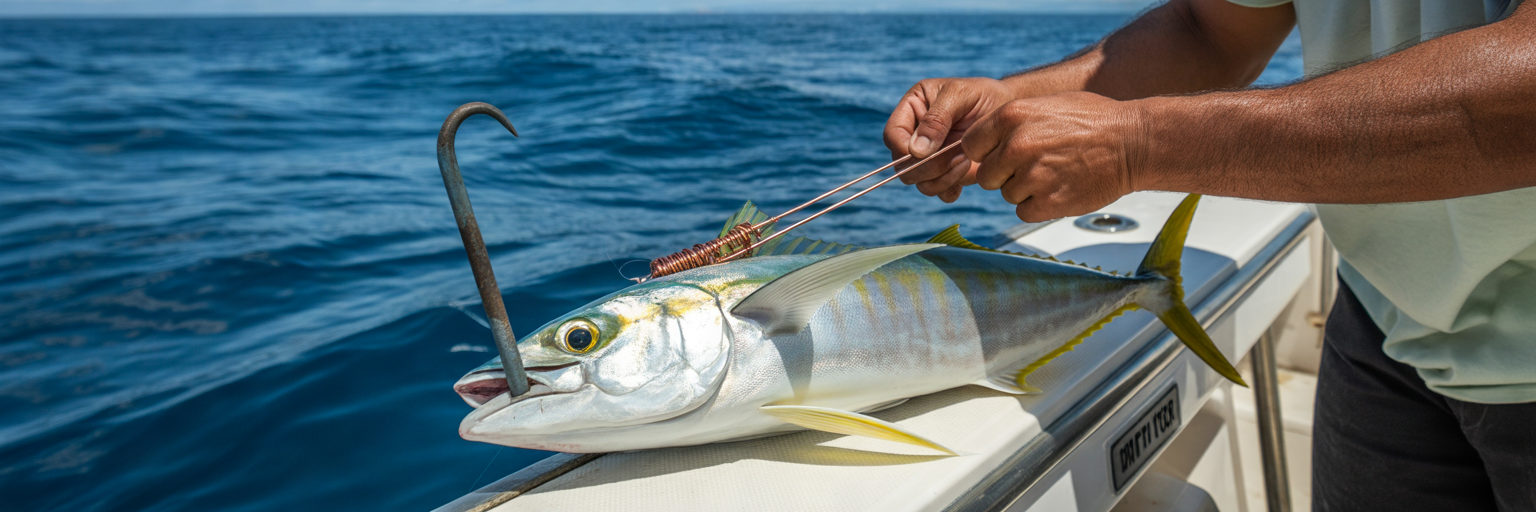
The chin weighted ballyhoo rig is the undisputed gold standard across Florida docks because it is fast to build, durable in rough water, and tracks arrow-straight right out of the rigger clip. Everything hinges on building a clean pin-and-weight assembly at the hook eye before you pick up the bait.
Measuring the Hook Exit and Seating the Chin Weight
Slide a double-barrel crimp sleeve onto your leader, pass the tag end through the eye of your long-shank J-hook, and before crimping it down, slip the loop of a stainless rigging pin and a nine-inch strand of copper wire right into the leader loop alongside the hook eye. Next, fit the top tabs of your segmented lead chin weight over the front of the hook eye so the lead hangs directly underneath the throat of the hook. Crush the crimp firmly with your pliers. You now have a self-contained rig where the pin stands upright at ninety degrees and the chin weight pivots right below the hook eye.
Locking the Pin and Wrapping the Jaws Shut
With your hardware crimped and your brined ballyhoo prepped on the board, follow this exact seven-step sequence to build a bulletproof presentation:
- Measure and mark the hook exit point: Lay the hook shank flat along the outside of the ballyhoo’s throat with the chin weight resting exactly inside the gill plates. Look at where the bend of the hook aligns with the anal vent, and use the tip of your hook point to scratch a tiny reference mark in the scales right at that spot.
- Thread the hook into the throat slot: Open the gill covers gently and push the hook point straight into the soft throat cavity between the gill arches. Walk the long shank backward into the gut cavity by bunching the belly skin slightly forward over the metal rather than forcing the hook straight through the meat.
- Punch the point cleanly out the vent mark: Once the hook bend reaches your reference scratch near the anal vent, rotate the point downward and poke it cleanly out through the bottom of the belly. Keep the exit hole tiny; tearing a wide gash in the ventral skin lets water rush inside the cavity and balloons the bait inside of five minutes.
- Seat the chin weight inside the gill covers: Pull the leader taut so the hook eye disappears into the throat and the lead chin weight settles snugly between the bottom edges of the gill plates. Pinch the gill flaps closed around the lead to verify that the weight sits dead-center like a keel.
- Drive the rigging pin through the skull: Bring the lower jaw up tight against the upper beak and push the stainless rigging pin vertically through the soft floor of the lower jaw, right behind the nose bone, until it pokes out the flat top of the head.
- Wrap the gill plates and jaws symmetrically: Take your copper wire tag and make two firm wraps behind the rigging pin, sweeping the wire under the gill plates to lock the chin weight in place. Next, cross the wire in front of the pin and make four to five tight, overlapping wraps forward toward the tip of the snout and back again, sealing both jaws completely shut so zero water can enter the mouth.
- Lock down the wire tag or bait spring: Bring the copper wire back to the rigging pin, wrap it twice around the base of the pin under tension, and twist the tag end off flush against the top of the skull. If you are using a screw-on bait spring instead of wire, slide the spring over the nose cone and wind it clockwise down onto the pin until the coils bite firmly into the beak.
The Palm-Roll Symmetry Check
Never lay a newly rigged bait onto the ice tray without running the palm-roll check. Hold the monofilament leader vertically about twelve inches above the nose of the ballyhoo and roll the leader rapidly back and forth between the flat palms of your hands. Watch the bait spin. A properly rigged ballyhoo will hang completely vertical with its nose pointed straight up the leader and its tail whipping loosely from side to side. If the body bows into a banana shape, your hook exited too far forward and is pulling tension on the belly skin, or the spine needs another firm pinch along the lateral line.
Pairing Skirts, Chuggers, and Sea Witches for 6 to 8 Knot Trolling
Once your pin rig passes the symmetry check, you have to decide what goes in front of the nose cone. When trolling ballyhoo for mahi at a standard 6 to 8 knot clip, sliding a skirt or resin head down the leader serves two distinct tactical purposes. Mechanically, the lure collar shields the tip of the ballyhoo’s snout and gill plates from direct water pressure, doubling the time you can pull that bait before it washes out. Visually and acoustically, the front-end hardware creates disturbance that pulls fish up from the thermocline.
Matching Chuggers, Slant Heads, and Hair Skirts to Sea State
Matching your head style to the surface conditions outside the inlet keeps your spread fishing in the strike zone instead of skipping out of the water. When you have a classic two-to-three-foot ocean chop with a little whitewater on the crests, slide a concave chugger head or medium slant head ahead of your ballyhoo. Every time that cupped face climbs the back of a wave and pops the surface, it gulps a pocket of air and leaves a three-foot trail of white smoke bubbles that looks exactly like a panicked flying fish.
On slick-calm summer mornings or days when a stiff cross-wind pushes your outrigger lines sideways across the swell, chuggers tend to blow out and tumble. That is the time to switch to a 1/4 oz to 1/2 oz nylon hair sea witch or a pointed bullet head. The streamlined lead nose and flared nylon fibers let the ballyhoo track six inches beneath the surface ripples without catching air, giving the bait a tight, natural swimming motion even at eight knots.
Florida Color Patterns and Naked vs. Skirted Baits
Color selection along the Florida peninsula follows water clarity and forage profiles. In the deep cobalt-blue water of the Atlantic Gulf Stream off Miami, Fort Lauderdale, and Stuart, blue-and-white and pink-and-white skirts imitate flying fish and squid better than anything else in the box. When you are working greener current edges, coastal temperature breaks, or Gulf Coast rips off Destin, Panama City, or Tampa Bay, high-contrast chartreuse-and-black, red-and-black, and dorado-pattern mylar skirts punch through stained water so fish can track them from a distance.
Even with a tackle box full of skirts, never run a four- or six-rod spread without at least one completely naked ballyhoo. A solitary fifty-pound bull dolphin shadowing a small piece of driftwood will often ignore noisy chuggers and heavy mylar tinsel. Dropping a naked medium ballyhoo on an 80 lb fluorocarbon leader way back on the center shotgun rod gives wary trophy fish an unobstructed look at a natural meal. Staggering your skirted chuggers on the flat lines, hair sea witches on the short riggers, and naked baits on the long riggers maximizes your hookup coverage during a pack attack, a layout we detail in our crew tactics guide.
Weedless Rig Modifications for Heavy Sargassum and Rip Lines
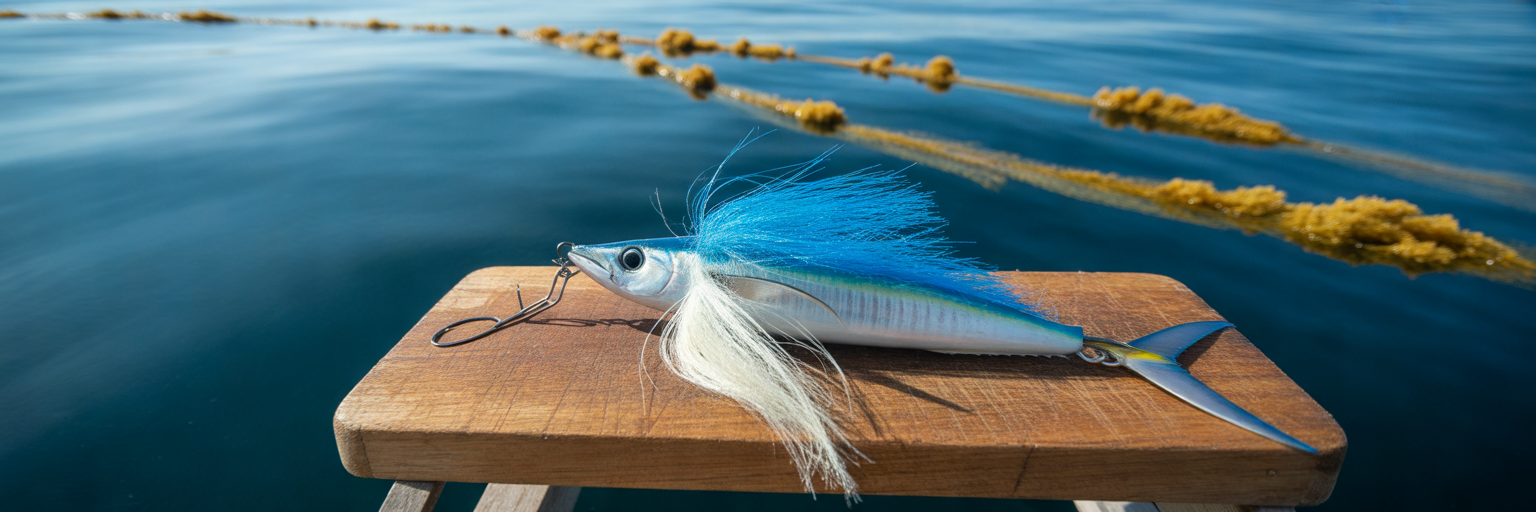
Nothing kills cockpit momentum faster than finally locating a mile-long golden sargassum rip off Boynton Beach or Marathon, dropping four pristine pin rigs into the water, and watching scattered flyers foul every single hook within ninety seconds. Dragging a two-pound clump of dead weeds over a school of mahi will spook the entire pack before you ever get a strike. Switching over to a weedless ballyhoo rig keeps your baits swimming clean right along the edge of the mat where the biggest fish ambush prey.
Rigging Inverted and Top-Hook Weedless Configurations
To keep grass strands from sliding down the leader and wrapping around an exposed downward J-hook, veteran offshore mates modify how the hook sits inside the bait. As highlighted in Salt Water Sportsman, two proven modifications keep ballyhoo running clean through heavy sargassum without sacrificing natural action. The first method involves skin-hooking or burying the standard downward J-hook point just inside the ventral opening of the anal vent so the sharp barb sits flush beneath a thin layer of belly skin rather than hanging wide open in the current.
The second option is building a top-hook or inverted pin rig. Instead of running the hook point out the bottom of the belly, you thread a long-shank hook or double-hook rig so the point curves upward through the back just behind the dorsal fin, or re-enters the belly cavity with the point barely dimpling the skin. Combine either hook placement with a snug rubber nose cone or a small hair sea witch pushed tight over the rigging pin, and floating weeds will slide right over the head and off the tail without snagging hardware. Understanding how wind and current stack these grass mats into productive lanes is just as vital as your terminal rig, which you can study in our dedicated boat angler’s guide to mahi weed lines.
Monel Wire Deflectors and Hookup Ratio Trade-Offs
If you want to keep a traditional rigging pin on the nose without catching small flyers of grass, swap your soft copper wire for slightly stiffer Monel wire. When you finish wrapping the jaws shut and twist the wire around the rigging pin, leave a half-inch tag end angled forward at forty-five degrees ahead of the pin, or bend the top of the pin slightly backward toward the eyes. That tiny ramped angle acts as a grass deflector, kicking stray sargassum strands up and over the nose cone before they can wrap the pin.
Let us be honest about the mechanical trade-off: burying your hook point inside the belly skin or inverting the rig will slightly drop your instant strike-to-hookup percentage compared to a wide-open downward J-hook. When a mahi smashes a weedless rig, you cannot simply slam the lever drag to strike and start winding. You have to drop the rod tip, feed the fish three to five seconds of free-spool so it turns its head and crushes the soft belly of the ballyhoo, and then slide the drag up smoothly to pull the hook point clear of the skin and into the jaw hinge. Even with that extra step, a weedless bait fishing 100 percent clean in the strike zone will always out-produce an exposed hook buried in a ball of weeds.
Boat-Side Testing, High-Speed Adjustments, and Spread Management
Rigging perfection at the dock only counts if the bait performs behind the transom in real ocean currents. The most expensive mistake anglers make offshore is pulling a rigged ballyhoo off the cooler tray, throwing the reel into free-spool, and sending the bait two hundred feet back into the rigger clip without ever looking at it in the water.
The Five-Second Prop-Wash Swim Test and On-the-Fly Fixes
Every single bait that goes over the gunwale must pass a five-second boat-side swim test right beside the cockpit at trolling speed. Drop the bait ten feet behind the transom in clean prop wash and hold the rod tip steady. A dialled-in ballyhoo will track upright just beneath the surface film with its back straight and its tail kicking in a tight, rapid blur. If it spins, planes on its cheek, or skips wildly out of the wake, haul it right back into the cockpit and use this troubleshooting matrix to fix the issue without cutting off your leader.
| Boat-Side Symptom | Root Mechanical Cause | On-Deck Fix (Without Re-Rigging) |
|---|---|---|
| Bait helicopters / spins rapidly | Hook exited too far forward or spine is still stiff | Re-bend the backbone aggressively and move the hook point back one-quarter inch at the vent |
| Bait planes on its side | Chin weight or pin is cocked off-center inside the gills | Pinch the gill covers around the lead weight to center the keel and tighten the nose wrap |
| Jaws gape open and belly balloons | Copper wire wrap slipped behind the beak | Add three tight wraps directly over the upper and lower jaw joint behind the pin |
| Bait skips wildly out of the wake | Chin weight is too light for sea state or boat speed | Slide a 1/2 oz rubber-core sinker or heavier sea witch over the leader ahead of the nose |
Stepping Up for 9 to 12 Knot Fast-Search Trolling
When weed lines are miles apart or you want to mix wahoo and blackfin tuna into the game plan while covering ground at 9 to 12 knots, a standard half-ounce rig will blow right out of the water. To keep natural dead bait swimming at high speed, step up to a 1.5 oz to 2 oz chin weight paired with a heavy bullet head or deep-cupped resin lure. Extend your salt-and-baking-soda brine soak to two full hours so the skin cures super tough, and use a rigging needle with waxed floss to stitch the anal vent completely shut behind the hook shank. Sealing the vent prevents high-pressure water from forcing its way up the hook slot and exploding the gut cavity at ten knots.
Cockpit Bait Care and Tray Rotation
- Use perforated rigging trays over block or crushed ice: Keep your rigged afternoon backups elevated on slotted plastic trays so cold air circulates underneath without letting the baits touch raw ice cubes.
- Drain fresh meltwater every thirty minutes: Never let rigged ballyhoo soak in sloshing freshwater runoff at the bottom of the cooler, which instantly reverses your brine and turns firm bellies to mush.
- Drape a damp salt-brined towel over the tray: Shielding exposed baits from direct Florida UV rays prevents the thin skin over the ribs from baking, shrinking, and splitting before the bait ever hits the water.
- Rotate washed-out baits on a thirty-minute clock: Even a untouched ballyhoo loses its oil slick and scale sheen after forty-five minutes in warm eighty-degree Gulf Stream water; reel in and swap out tired baits proactively so every line in your spread is ready when a trophy bull shows up.