

There is no sight more promising, or more frustrating, for a Florida angler than a vast turtle grass flat shimmering under the sun. You know the fish are there. The challenge is presenting your bait without it coming back looking like a salad. Mastering the right live-bait rigs for redfish, snook, and trout in these environments is not just a good idea, it is the difference between a full cooler and a day of frustration. These grassy flats are the engine of the inshore ecosystem, providing essential cover and ambush points for the predators we chase.
Fishing them is non-negotiable. While a well-placed soft plastic or topwater plug has its moments, nothing triggers a strike from a wary, pressured fish like the scent and panicked vibrations of live bait. A shrimp kicking frantically or a pinfish struggling just above the grass is a signal that big fish cannot ignore. The problem is that a poorly rigged bait will dive straight into the vegetation, fouling your hook and killing the presentation instantly. Your cast is wasted, the spot is disturbed, and the fish moves on.
This is not about luck. It is about technique. The solution lies in a handful of specific rigs designed to keep your bait in the strike zone, swimming naturally and clear of the snags below. Forget the one-size-fits-all approach. Success on the flats requires an understanding of how to adapt your presentation to the conditions you face on any given day.
This guide will give you the exact knowledge you need. We will cover the critical details of hook placement to maximize bait life and action. Then, we will break down the three core rigs every flats angler must master. Finally, we will explore the advanced adjustments to your tackle and casting that will turn you into a more effective and efficient angler on the grass. It is time to stop fighting the grass and start using it to your advantage.
Essential Live-Bait Rigs for Florida’s Grassy Flats
There is no sight more promising, or more frustrating, for a Florida angler than a vast turtle grass flat shimmering under the sun. You know the fish are there. The challenge is presenting your bait without it coming back looking like a salad. Mastering the right live-bait rigs for redfish, snook, and trout in these environments is not just a good idea, it is the difference between a full cooler and a day of frustration. These grassy flats are the engine of the inshore ecosystem, providing essential cover and ambush points for the predators we chase.
Fishing them is non-negotiable. While a well-placed soft plastic or topwater plug has its moments, nothing triggers a strike from a wary, pressured fish like the scent and panicked vibrations of live bait. A shrimp kicking frantically or a pinfish struggling just above the grass is a signal that big fish cannot ignore. The problem is that a poorly rigged bait will dive straight into the vegetation, fouling your hook and killing the presentation instantly. Your cast is wasted, the spot is disturbed, and the fish moves on.
This is not about luck. It is about technique. The solution lies in a handful of specific rigs designed to keep your bait in the strike zone, swimming naturally and clear of the snags below. Forget the one-size-fits-all approach. Success on the flats requires an understanding of how to adapt your presentation to the conditions you face on any given day.
This guide will give you the exact knowledge you need. We will cover the critical details of hook placement to maximize bait life and action. Then, we will break down the three core rigs every flats angler must master. Finally, we will explore the advanced adjustments to your tackle and casting that will turn you into a more effective and efficient angler on the grass. It is time to stop fighting the grass and start using it to your advantage.
Perfecting Hook Placement for Natural Presentation
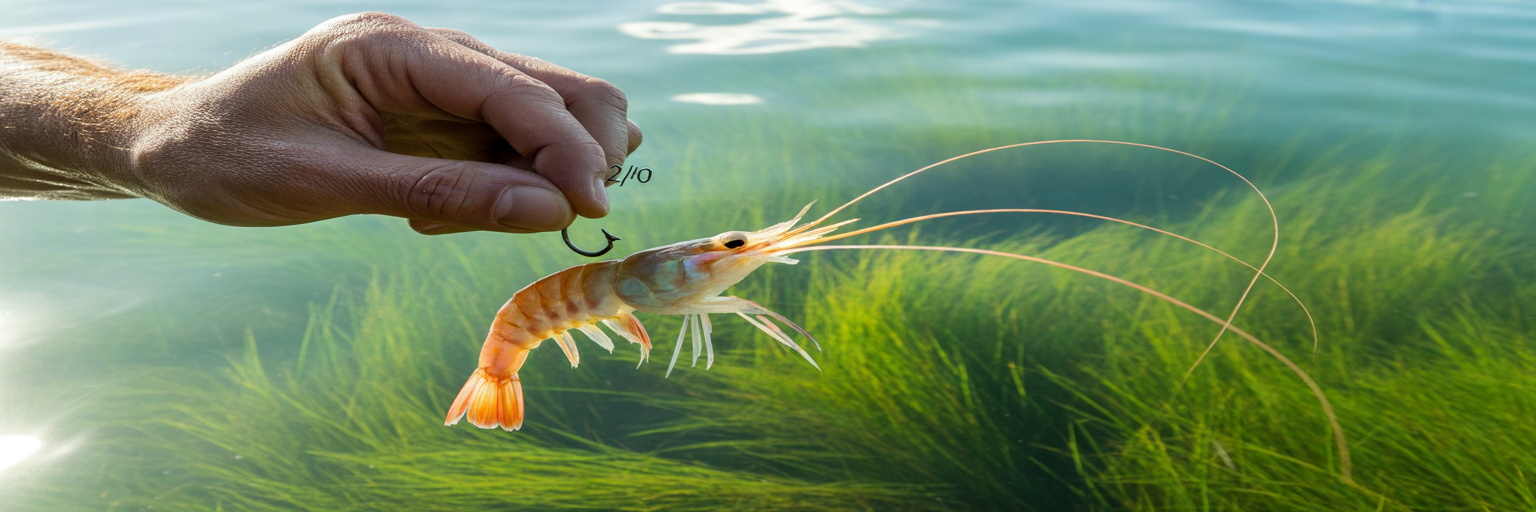
Before you even think about which rig to tie on, the connection between your hook and your bait must be perfect. A poorly hooked bait is a dead bait, or one that spins unnaturally and gets ignored. The goal is to make the bait look and act like it is not hooked at all. Your hook should be an invisible pivot point that allows for maximum movement and durability, not an anchor that weighs it down. This is the foundation of a successful live bait presentation, and getting it right is a non-negotiable skill.
How to Hook Live Shrimp for Maximum Kick
Shrimp are the universal currency of the flats, and knowing how to hook live shrimp correctly is fundamental. There are two primary methods, each with a specific purpose. The most common and effective for most situations is horn hooking. Hold the shrimp and look at its head. You will see a clear, hard carapace with a small, dark spot underneath. That dark spot is the brain. You must avoid it. Slide your hook point through the clear part of the horn, from one side to the other, well clear of that dark spot. This allows the shrimp to kick and swim freely without killing it. It is the best all-around method for casting and drifting over grass.
The second method is tail hooking. Pinch the tail fins together and run the hook point up through the last segment of the tail from the bottom. This method is excellent for making longer casts, as the shrimp becomes more aerodynamic. However, it can tire the shrimp out more quickly and cause it to spin if retrieved too fast. Use this when you need to reach a distant pothole or a school of fish you cannot get closer to without spooking them.
Rigging Pinfish and Other Baitfish for Freedom of Movement
For heartier baits like pinfish, pilchards, or greenbacks, the placement of the hook dictates how the fish will swim. The standard placement for casting and drifting is through the back, just in front of the dorsal fin. You are looking for the “sweet spot” in the hard muscle just below the fin. When you get it right, the hook acts as a pivot, allowing the baitfish to swim upright and naturally. If you hook it too far back, the bait will be nose-down and dive into the grass. Too far forward, and you risk hitting the spine, paralyzing it.
An alternative, and often superior, method when fishing in current is hooking the bait through the lips. Run the hook point up through the bottom lip and out through the top. This keeps the baitfish oriented correctly into the current, allowing it to breathe and swim naturally for a longer period. It is the go-to method when staking out on a grass flat edge and letting the tide do the work for you.
Techniques for Durable Finger Mullet Presentations
Finger mullet are tough, active, and a favorite meal of big snook and redfish. Their hardiness allows for secure hooking that can withstand aggressive casting and powerful strikes. The same two methods used for pinfish apply here, but with a slight difference in application. Nose hooking a finger mullet, from bottom lip to top, is ideal for casting long distances or even slow-trolling along a grass edge. The hook is secure in the mullet’s hard nose, ensuring it will not fly off during a powerful cast.
Hooking a mullet through the back, just in front of the dorsal fin, is the preferred method when you want the bait to swim freely under a cork or on a free-line. This placement gives the mullet the freedom to panic and send out the vibrations that draw predators from a distance. Because mullet are so active, this presentation creates a lot of commotion, making it an excellent choice for searching open areas of patchy grass.
Remember these core principles for any bait you use:
- Avoid vital organs: The brain and spine are off-limits. A clean hook placement means a lively bait.
- Allow for movement: The hook should enable, not restrict, the bait’s natural swimming motion.
- Match the hook to the bait: Use a hook that is large enough for a solid hookset but small enough to remain inconspicuous.
The Three Essential Rigs for Grass Flat Dominance
With your bait hooked for maximum action, it is time to choose the right delivery system. On the grass flats, you do not need a tackle box full of complicated rigs. You need to master three essential setups. Each one has a specific purpose, and knowing when to use each is what separates consistently successful anglers from those who just get lucky. These are the tools that will allow you to present your bait perfectly in any condition the flats throw at you.
The Free-Line Rig: The Ultimate Stealth Approach
This is the purest and simplest rig in fishing. It consists of your main line, a leader, and a hook. That is it. There is no weight, no cork, no hardware of any kind. The free-line rig offers the most natural presentation possible, allowing a live shrimp or small baitfish to swim and struggle with zero restriction. Its use case, however, is very specific. The free-line rig excels in glassy calm, skinny water, typically one to two feet deep, where fish are exceptionally spooky. In these conditions, the splash of a cork or the tick of a weight hitting the bottom can send a tailing redfish bolting for deep water. The free-line rig is your stealth weapon. Its drawback is clear: it is nearly useless in wind or current, as the bait will be pushed around on the surface and have no way to get down into the strike zone.
The Light Split-Shot Rig: Adding Control in Wind and Current
The split-shot rig is the solution to the free-line’s limitations. It is the next logical step when a bit of wind, chop, or current prevents your bait from getting down to where the fish are. The construction is simple: take your free-line setup and add a single, small split-shot weight to the leader, about 18 to 24 inches above the hook. The philosophy here is critical: use just enough weight to get the bait into the strike zone, not to anchor it to the bottom. You want the bait to drift naturally just above the grass, not get pinned down in it. This rig gives you the control needed to combat light to moderate conditions while still maintaining a stealthy and natural presentation. It is the perfect choice for drifting a flat on a breezy day or casting up-current into a pothole.
The Popping Cork Rig: The Workhorse of the Flats
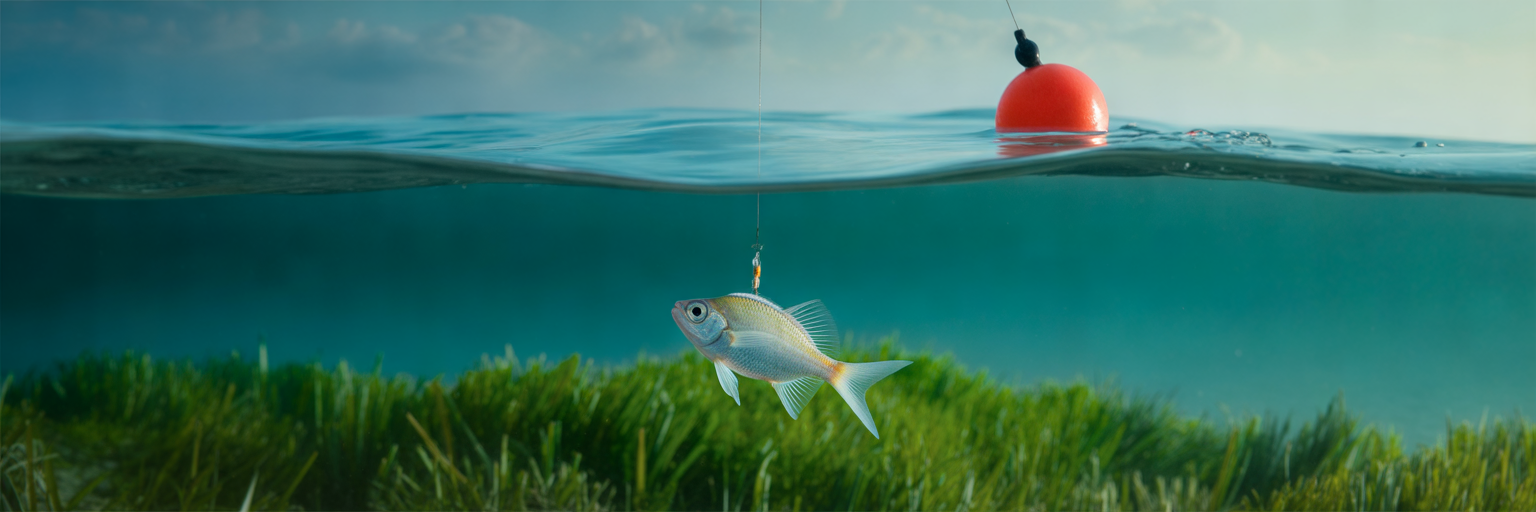
This is arguably the most effective and versatile rig for grass flat fishing. The popping cork serves two critical functions. First, it suspends your bait at a precise, predetermined depth, keeping it perfectly positioned just above the snag-filled grass. Second, and just as important, the cork itself is a fish attractant. A sharp tug on your rod makes the cork “chug” and “pop” on the surface, creating a sound that mimics feeding activity. This noise acts as a dinner bell, drawing curious redfish, trout, and snook out of the dense grass to investigate.
The classic retrieve is a “pop-and-pause.” Give the rod a firm twitch, then let the rig settle for several seconds. The strike almost always happens on the pause as the bait slowly drifts back down. When using a popping cork rig for shrimp, this action perfectly imitates a fleeing shrimp, making it irresistible. The single most important adjustment for this rig is the leader length. The formula is simple: your leader should be slightly shorter than the water depth above the grass. For example, if you are in three feet of water with one-foot-tall grass, the water column above the grass is two feet deep. A leader of about 1.5 feet is perfect. This keeps your shrimp kicking right in the fish’s line of sight, but safely out of the snags. This one detail is the key to success with a cork. The power of acoustic stimuli is not just angler lore. As a 2021 study in the Transactions of the American Fisheries Society highlighted, specific sounds can trigger predatory responses in fish, even in complex habitats like dense seagrass, validating what seasoned anglers have known for generations: the sound of a cork works.
Advanced Adjustments for Snag-Free Fishing
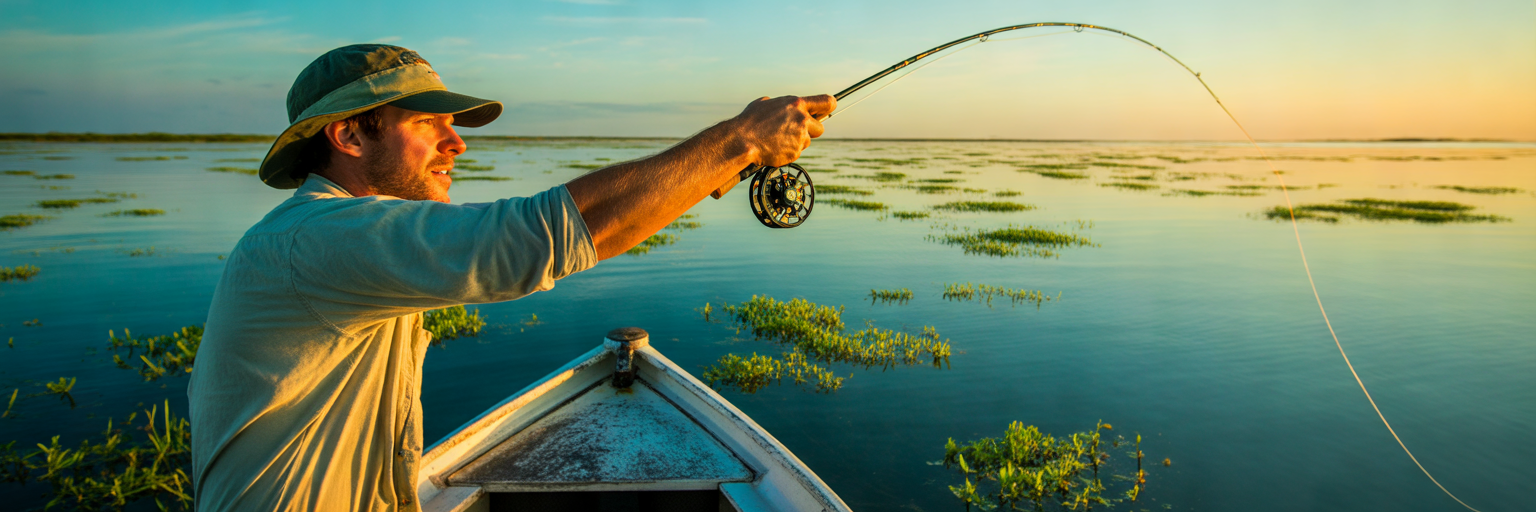
Mastering the three core rigs will put you ahead of most anglers, but fine-tuning the components is what leads to true expertise. The small details in your leader, hook, and casting technique can dramatically improve your efficiency and turn a good day into a great one. These are the adjustments that create truly snag-free fishing rigs, allowing you to fish with confidence in the thickest cover where the biggest fish often hide.
Leader Selection: Stealth and Abrasion Resistance
Your leader is the business end of your setup, and the material matters. For grass flat fishing, fluorocarbon is the only choice. Its main advantage is that it has a refractive index very close to that of water, making it nearly invisible to wary fish. Just as importantly, fluorocarbon is significantly tougher and more abrasion-resistant than monofilament. This is critical when your line is constantly rubbing against sharp grass blades. A 15 to 30-pound test fluorocarbon leader covers most inshore situations. Use the lighter end of that range (15-20 lb) for spooky fish in clear, calm water. Go heavier (25-30 lb) when fishing around thick grass, oyster bars, or when large snook are the target. While we are focused on leaders here, your entire setup matters, and having the right Florida inshore fishing gear is half the battle.
Hook Selection: Why Circle Hooks Reign Supreme
While traditional J-hooks still have a place, the in-line circle hook is superior for grass flat fishing. Their design is inherently more snag-resistant. As you retrieve your rig, the inward-facing point of a circle hook tends to bounce off grass blades rather than digging in. This simple design feature means you will spend far less time cleaning your hook and more time in the strike zone. We recommend sizes from 1/0 to 4/0, depending on the size of your bait. Beyond snag resistance, circle hooks provide a massive conservation benefit. They are designed to slide to the corner of a fish’s jaw and set themselves, resulting in a clean hookset and dramatically reducing the chances of gut-hooking a fish. This ensures a healthy release for any fish you do not plan to keep.
Casting with Finesse: The Gentle Lob
You can have the perfect rig and the liveliest bait, but it is all for nothing if you kill it on the cast. A hard, overhead “cannon” cast causes the bait to helicopter through the air and slam into the water. This impact can stun or kill a shrimp or small baitfish instantly. The proper technique is a gentle, sidearm “lob” cast. Keep your rod low and use a smooth, sweeping motion to send the rig toward your target. The goal is to have the bait land as softly as possible. This not only preserves the life of your bait but also creates a much stealthier entry that is less likely to spook shallow-water fish.
The Carolina Rig: A Tool for Potholes and Edges
While the split-shot rig is great for shallow water, the Carolina rig is a specialized tool for presenting bait in deeper potholes (four feet or more) or along distinct grass edges. It consists of a sliding egg sinker on your main line, followed by a small bead to protect the knot, a swivel, and then your fluorocarbon leader and hook. The sliding sinker allows you to pin the bait to the bottom in a specific spot, even in current, while the long leader lets the bait move around naturally. When a fish eats the bait, it can swim off with it, and the line will slide through the sinker without the fish feeling any weight. This makes it an incredibly effective rig for targeting fish holding in specific, deeper ambush points within the grass flat system.
Reading the Water to Find Redfish in the Grass
Having the right rigs is only half the equation. You need to know where to cast them. Learning how to fish turtle grass flats effectively is about training your eyes to see what others miss. It is about shifting your focus from gear to strategy and understanding how fish use this environment to their advantage. A grass flat is not a uniform field, it is a complex landscape of highways, ambush points, and feeding zones.
Your most important tool for this is a good pair of polarized sunglasses. They cut the glare on the water’s surface, allowing you to see into the water. Your primary targets are “potholes”. These are the lighter-colored sandy patches within the dark expanse of turtle grass. Redfish, snook, and trout use these potholes as travel corridors and ambush points, waiting for bait to be swept out of the grass. A cast to the edge of a pothole is one of the highest-percentage plays in all of inshore fishing.
Beyond spotting structure, you need to look for signs of life. Keep your eyes peeled for these visual cues:
- Tailing Fish: This is the classic sign of redfish feeding in shallow water. You will see the tips of their tails and backs breaking the surface as they root around on the bottom for crabs and shrimp.
- Nervous Water: This is a V-shaped wake or a subtle disturbance on the surface created by a cruising fish just below. It looks different from a wind ripple and indicates a fish on the move.
- Fleeing Bait: Watch for schools of mullet or other baitfish suddenly erupting from the water. Something is chasing them from below. Cast your rig right behind the commotion.
- Diving Birds: Pelicans and terns have better eyesight than we do. If you see them repeatedly diving in one area, it is a sure sign that a concentration of bait is present, and predators will not be far behind.
Spotting these signs is the core of effective sight fishing, a skill every flats angler should develop. It turns a guessing game into a calculated hunt. Of course, all of this activity is driven by the tide. Fish use the current to their advantage, often holding on the down-current side of a pothole or structure to ambush bait being washed toward them. Always check a tide chart before your trip. Understanding how fish use the tide is one of the most fundamental redfish fishing tips for consistent success.
Finally, all of this observation is useless without a stealthy approach. Shut down your outboard engine well before you reach your fishing spot. Use a push pole or a quiet trolling motor to move into position. Hull slap, loud talking, and dropped items on the deck create vibrations that travel far in shallow water. The fish on these flats are wary, and the quiet angler is the one who gets the bite.
Matching the Rig to Real-World Florida Conditions
Theory is one thing, but success on the water comes from making the right decisions in the moment. An expert angler is a problem-solver who can quickly analyze the conditions and select the perfect tool for the job. Here is how to apply everything we have covered to three common scenarios you will face on Florida’s grass flats. This is where you put it all together.
Scenario 1: The ‘Glass Calm’ Morning Ambush
Conditions: You arrive at the flat at sunrise. The water is 1.5 feet deep and perfectly calm. You can see the tips of redfish tails breaking the surface 50 feet away.
Chosen Rig: Free-lined live shrimp.
Rationale: In these conditions, stealth is everything. The splash of a popping cork or even a small split-shot could spook these ultra-wary fish. A free-lined shrimp, cast gently with a lob cast, will land softly and present the most natural offering possible. The lack of hardware means there is nothing to alert the fish that something is wrong.
Scenario 2: The ‘Breezy Afternoon’ Search
Conditions: It is now midday, and a 10-15 mph wind has put a moderate chop on the water. The depth is around 3 feet, and visibility is reduced. You are searching for fish across a wide area of patchy grass.
Chosen Rig: Popping cork with a 2-foot leader and a lively pinfish.
Rationale: The free-line is useless in this wind, and a split-shot might not be enough to attract attention. The popping cork is the perfect tool here. The sound of the cork will act as a dinner bell, calling fish in from a distance in the choppy, slightly turbid water. The 2-foot leader keeps the pinfish struggling just above the grass, making it an easy target for any predator drawn in by the commotion.
Scenario 3: The ‘Strong Incoming Tide’ Edge
Conditions: You are set up along a mangrove edge where the water drops to 4 feet. A strong incoming tide is creating a noticeable current along the grass line.
Chosen Rig: Light split-shot rig with a nose-hooked finger mullet.
Rationale: A free-line would get swept away, and a popping cork might move too quickly in the strong current. The light split-shot provides just enough weight to keep the bait in the strike zone near the bottom, right where fish will be holding to ambush prey. Nose-hooking the mullet ensures it stays on the hook and is oriented naturally into the current. For even deeper or more complex bottom structures, other setups come into play, and a good angler should understand a full range of Florida bottom fishing rigs.
This table provides a quick-reference guide for matching the right live-bait rig to the specific conditions you’ll face on Florida’s turtle grass flats. Use it to make fast, confident decisions on the water.
| Condition | Recommended Rig | Primary Reason |
|---|---|---|
| Shallow (1-2 ft), Calm, Spooky Fish | Free-Line Rig | Ultimate stealth; no hardware to spook fish. |
| Moderate Depth (2-4 ft), Wind/Chop | Popping Cork Rig | Attracts fish with sound and maintains perfect bait depth. |
| Moderate Depth (3-5 ft), Current | Light Split-Shot Rig | Keeps bait in the strike zone without anchoring it. |
| Deeper Potholes/Edges (4+ ft) | Carolina Rig | Pins bait to the bottom while allowing natural movement. |
Ultimately, there is no single “best” rig. The best anglers are adaptable. By mastering these live-bait rigs for redfish and understanding when to deploy each one, you stop being a victim of the conditions and start using them to your advantage. The best bait for redfish in Florida is a live one presented perfectly, and now you have the blueprint to do just that. Get out there, rig up with confidence, and start pulling more fish from the grass.