
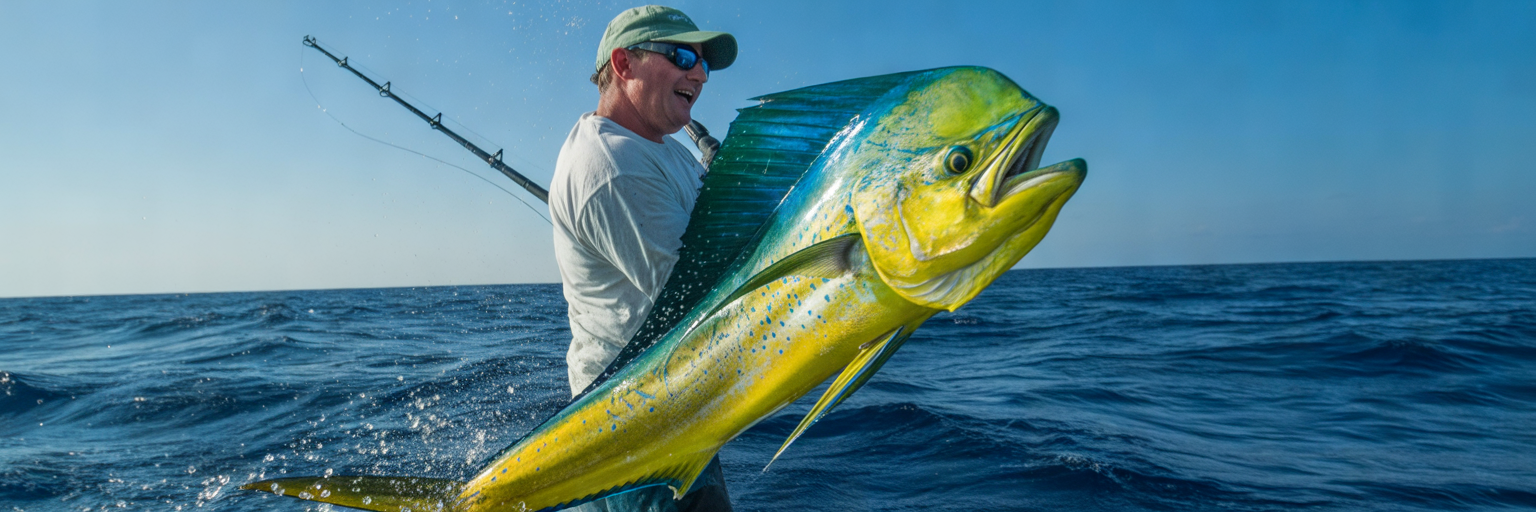
Mahi mahi can gain up to five pounds a month in warm offshore currents, forcing them to feed aggressively round the clock to sustain the highest metabolic rate of any pelagic species. For Florida crews, intercepting that constant hunger comes down to reading water edges and executing dialed mahi mahi fishing tactics.
Mahi Mahi Fishing Across Florida Seasons and Coasts
Every serious offshore crew in the state organizes their calendar around two distinct migration windows that define Florida mahi fishing. Most weekend boats focus exclusively on the primary May through September summer run. This warm-water window brings thick packs of hungry schoolies, classic gold sargassum mats, and heavy boat traffic at every ramp from Stuart to Key West.
The Two Distinct Migration Windows: Peak Summer vs. Autumn Push
Crews who rack their offshore rods right after Labor Day miss out on some of the heaviest fish of the year. The under-fished September and October autumn migration triggers a completely different bite as early cold fronts and multi-day 15-knot east blows push bait and respectable packs of dolphin within striking distance of the outer reef. As highlighted in Salt Water Sportsman’s coverage of South Florida’s second mahi season, this autumn push brings larger gaffers and slammers south along the reef edge with a fraction of the summer boat traffic. Whether you are targeting that late fall run or mapping out the early spring push using our Florida Keys mahi calendar for spring crews, timing the peak of the Florida Keys mahi season separates full fish boxes from expensive boat rides.
Atlantic Short Runs vs. Gulf Coast Deep-Water Marathons
Where you trailer or slip your hull dictates your fuel burn and tactical approach before you even ice down the fish box. Southeast Florida crews clearing the inlets of Palm Beach, Fort Lauderdale, or Miami hit blue water and the western edge of the Gulf Stream just a few miles off the beach. You can clear Lake Worth Inlet at dawn and have baits swimming in 600 feet of water fifteen minutes later.
Gulf Coast crews face a completely different marathon. Running out of Destin, Pensacola, or Tampa Bay requires serious range and fuel management to reach the Middle Grounds, the Steps, or deepwater rigs and spur-and-groove ledges. Before making that long Panhandle run, study our Destin offshore spot guide for private boat crews to pinpoint productive bottom drops and FADs. Regardless of which coast you fish, never untie the lines blind. Always check real-time local port reports to verify current position and active weed lines before burning $300 in fuel chasing yesterday’s bite.
Reading Current Edges, Water Temps, and Weather Before Leaving the Dock
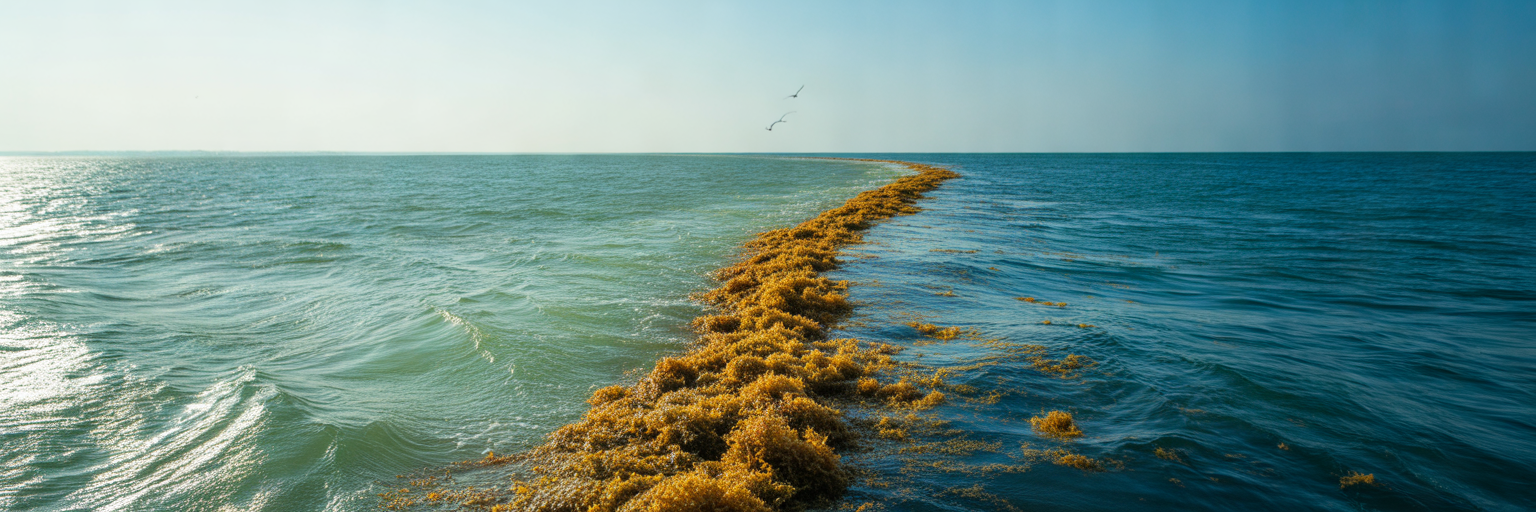
Knowing the seasonal migration calendar puts you in the right zip code, but finding the actual corridor where fish are feeding today starts the night before on your desktop. Experienced captains lock onto the 75 to 85 degree Fahrenheit thermal window before stepping onto the fiberglass. Mahi are prisoners of water temperature and dissolved oxygen, meaning they stack tightly along thermal boundaries where bait gets trapped.
Locking Onto Temperature Breaks and Gulf Stream Eddies
Pulling up satellite sea surface temperature (SST) charts, chlorophyll boundary maps, and real-time current data on HookCurrent lets you pinpoint hard temperature breaks, salinity shifts, and nutrient-rich upwellings before burning a drop of gas. Look for areas where green coastal water collides with cobalt blue offshore water to form a distinct density edge. On the Atlantic side, the Gulf Stream’s western wall and spinning cyclonic eddies dictate your daily compass heading as three-knot north currents shear against slower shelf water. Over in the Gulf, captains track Loop Current filaments pushing warm blue water over the continental shelf to decide where to point the bow.
How Wind Direction and Inlet Tides Dictate Your Run
Satellite charts only tell half the story until you factor in local wind and barometric pressure. A steady 10 to 15 knot east or southeast breeze acts like a bulldozer on the Atlantic coast, stacking up tight current rips, pushing blue water closer to the reef, and compacting floating sargassum into fishable lanes. Conversely, a stiff west wind blows weed lines apart, flattens out the color edge, and scatters surface bait across miles of open ocean. Run through this four-step pre-departure dock checklist to match your offshore intel with safe inlet timing:
- Overlay SST and Chlorophyll Charts: Mark the exact latitude and longitude where temperature breaks of at least 1.5 degrees align with clean blue-water edges and high current velocity.
- Verify Wind History Over 48 Hours: Check local buoy sustained wind speeds and directions to predict whether floating grass will be compacted into solid rips or blown into unfishable scattered fragments.
- Sync Inlet Tide with Offshore Current: Cross-reference our Florida fishing tide charts guide so you do not run an outgoing inlet tide straight into an oncoming 20-knot east wind and face brutal stacked standing waves in the cut.
- Set Throttles for Gray Light Arrival: Calculate your hull’s cruising speed against the sea state so you pull the throttles back at the first blue-water edge right as the sun breaks the horizon.
Finding Productive Water Beyond the Obvious Weed Line
Even the sharpest satellite recon cannot save you from the frustration every offshore crew knows too well: running 25 miles past the sea buoy only to find scattered, lifeless sargassum or completely clean blue water. Relying strictly on offshore weed line fishing leaves fish boxes empty when the grass is dead, devoid of micro-bait, or completely absent. When the surface looks barren, productive captains shift their focus from floating grass to deep-water bottom topography and aerial bio-indicators.
Working Deep Bottom Contours and Submarine Humps
When surface structure disappears, point the bow toward deep-water bottom contours between 500 and 750 feet. Prominent underwater mountains like the Islamorada Hump, the Marathon Humps, or the steep shelf drops off Jacksonville and St. Augustine act as permanent magnets for pelagics. When a three-knot offshore current slams into that vertical bottom topography, it forces cold, nutrient-rich upwellings and deep bait balls straight toward the surface. You might not see a single blade of grass on top, yet your sonar screen will light up with suspended bonito, blackfin tuna, and big gaffer mahi shadowing the bait columns.
Decoding Frigatebirds, Flyers, and Isolated Flotsam
While the bottom machine reads the depths, your eyes should stay glued to the horizon for live biological tells. As highlighted in Florida Sportsman’s insights on springtime dolphin tactics, reading open water requires separating dead water from active feeding zones. Learn to read the body language of a frigatebird from two miles out. A frigate cruising high on steady wingbeats is just commuting, whereas a bird swooping low, stalling, and erratic-diving is tracking a feeding bull pushing bait to the surface.
Watch the face of the swells for showering flying fish skittering across the calm water; if flyers are launching out of the wave tops, something green and hungry is chasing them from below. Furthermore, never pass up isolated flotsam in open water. A single wooden pallet, a floating bamboo stalk, or a solitary deep-water crab trap buoy holds far higher concentrations of big fish than a five-mile mat of compacted grass because every baitfish in that desert has only one piece of shade to hide under. Give any dry weed mat or floating log fifteen minutes of trolling pass time. If you do not mark bait or draw a strike, throttle up immediately toward the next subtle color change or nervous water rip.
Trolling Spreads and Speed Control to Cover Water
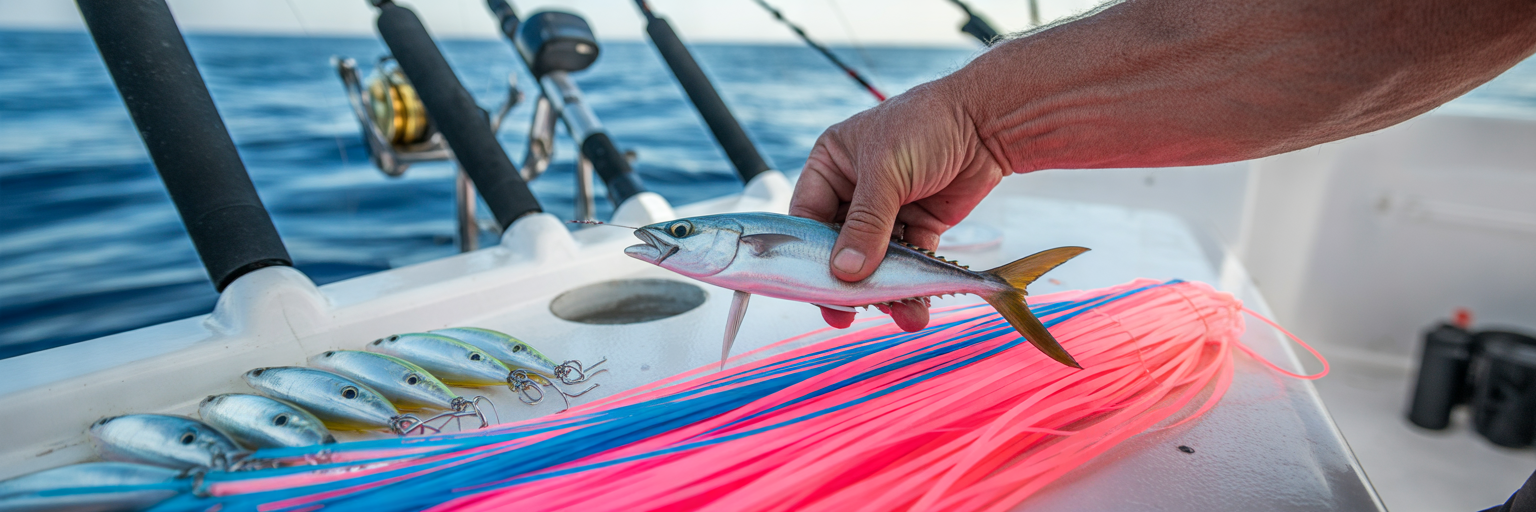
Once you locate a productive depth contour or a nervous current rip, efficient trolling for mahi lets you cover water rapidly and trigger the initial aggressive reaction strike. For a standard Florida center console or walkaround, a well-spaced four-to-six-rod spread maximizes hookups without creating a nightmare of crossed lines on sharp turns.
The Six-Rod Center Console Spread and Dual-Depth Strategy
Geometry and water clearance dictate where every bait rides behind the transom. Clip two flat lines low in the gunnel corners so they swim in the clean water pockets just behind the prop wash. Run two long rigger baits high from the outriggers so they skip in undisturbed water well outside the wake, and send a way-back shotgun bait 150 yards down the center alley. High-liner crews separate themselves from weekend boaters by adding a dedicated deep rod to run a dual-depth strategy. While five baits skip across the surface to draw in aggressive schoolies, pulling a #4 or #6 planer or an inline trolling sinker down 20 to 40 feet puts a bait right in the face of deeper, boat-shy bulls cruising underneath the pack.
Offshore Mahi Trolling Spread and Speed Matrix
| Spread Position | Bait or Lure Setup | Optimal Trolling Speed | Target Depth & Role |
|---|---|---|---|
| Short Flat Line (Port) | Medium brined ballyhoo under a 1 oz sea witch behind an inline weight or #4 planer | 5 to 7 knots | 20 to 35 feet; targets larger solitary bulls cruising below surface schoolies |
| Short Flat Line (Starboard) | Rigged swimming ballyhoo with a concave chugger head | 5 to 7 knots | Surface prop wash; creates smoke trail and bubble commotion near the transom |
| Long Outriggers (Port & Starboard) | Pin-rigged naked ballyhoo or light nylon skirted swimmer | 5.5 to 7.5 knots | Clean surface water outside the wake; natural skipping action for line-shy fish |
| Center Shotgun (Way Back) | Small resin bullet head, cedar plug, or mylar feather lure | 6 to 12 knots | Surface center wake 150+ yards back; picks up trailing fish and works during high-speed runs |
Rigging Brined Ballyhoo and Managing Search Speeds
Your hull speed must match the water you are covering and the lures tied to your leaders. When working tight structure or active birds, dial back to the standard 5 to 7 knot ballyhoo pace pairing natural baits with concave chugger heads or hair sea witches. When covering vast stretches of featureless water between humps or weed patches, push the throttles into high-speed search mode at 8 to 12 knots using resin jet heads, bullet lures, and feathers. You can dial in the exact color patterns and head shapes for both speed zones in our guide on mastering trolling lures for mahi.
Nothing ruins a trolling pass faster than a washed-out ballyhoo spinning like a propeller and twisting fifty yards of monofilament. Prep your baits the night before by brining fresh medium ballyhoo in a dry mix of kosher salt and baking soda over ice; this toughens the belly skin so baits swim straight for hours instead of washing out after twenty minutes. Use a pin-rig with a rubber band or light copper wire around the beak so your deckhand can swap out a shredded bait in ten seconds flat, and set your lever drags just heavy enough to prevent line creep at 10 knots without pulling hooks on the strike.
Pitching, Casting, and Chunking When the School Shows Up
When that long rigger snaps and a bright green-and-gold bull starts greyhounding across the wake, the first thirty seconds of cockpit execution determine whether you boat one fish or twenty. Keep the boat moving forward in slow gear for ten seconds to see if a double or triple hookup develops, then slide the throttles to neutral as the crew clears the opposite flat lines so a wild fish does not wrap four rods into an unfishable bird’s nest.
The Decoy Fish Rule and Controlled Chunking Rhythm
Once that first fish is cranked within twenty feet of the transom, enforce the golden rule of Florida dolphin fishing: always leave at least one hooked fish swimming in the water behind the boat. Mahi are fiercely competitive schooling predators, and a panicked hooked mate acts as a live decoy that holds the entire pack right at your trim tabs. Grab your spinning pitch rods and cast right behind that hooked fish. Never gaff or net the first mahi until a second angler is solidly hooked up and brings the replacement decoy to the transom.
To keep the school lit up and aggressive around the hull, establish a disciplined chunking rhythm using cut squid, dead pilchards, or fresh bonito belly strips. Dumping a five-gallon bucket of chum over the gunnel all at once is a classic rookie mistake; overfeeding satisfies the pack and lets them drift down out of sight with the sinking scraps. Instead, toss three or four thumb-sized chunks at a time just behind the motors to get the fish firing near the surface. Hide your circle hook completely inside a matching chunk and feed line out by hand so your bait drifts back at the exact same sink rate and current speed as the freebies.
Waking Up Lockjaw Bulls with Live Bait and Light Fluorocarbon
Every offshore angler has stared down the maddening sight of thirty glowing mahi circling three feet beneath the hull, inspecting every chunk of squid and turning their noses up at the boat. When a heavily pressured school gets lockjaw in slick calm summer water, heavy tackle and dead chunks stop working. Make three immediate adjustments to break their hesitation. First, drop down to a 20 or 25 pound fluorocarbon leader and downsize to a tiny #1 or 1/0 hook buried inside a fingernail-sized piece of squid. Second, dip a lively pilchard, threadfin herring, or cigar minnow out of the livewell and pitch it nose-hooked into the pack; the erratic vibration of a frantic live bait triggers an instant reflex strike from wary bulls. If the fish are hanging thirty feet down beneath the hull, snap a 1/2-ounce white bucktail jig tipped with a thin squid strip onto a light spinner, let it free-fall past the school, and rip it aggressively back toward the surface.
Rods, Reels, Line, and Terminal Tackle Built for the Job
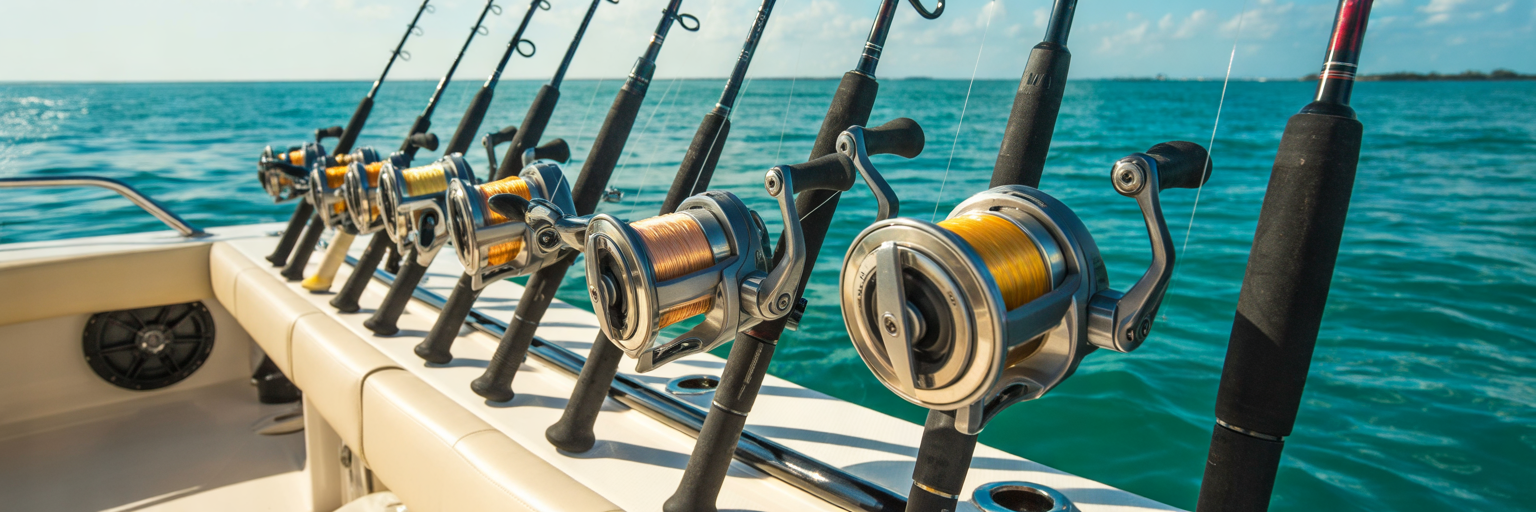
Transitioning smoothly from high-speed trolling to finesse pitching requires dedicated dolphin fishing tackle staged and ready before you leave the inlet. Trying to cast tiny live baits with a heavy trolling outfit or fighting a 35-pound bull in heavy current on under-gunned inshore gear costs you fish at the boat.
Trolling Outfits vs. High-Speed Pitch Spinners
Rack two distinct rod-and-reel combinations along the gunnels and T-top. For the trolling spread, run 20 to 30 pound class conventional lever-drag reels paired with 6-foot to 6-foot-6 standup rods. Spool these trolling reels with high-quality monofilament mainline; the natural stretch of mono acts as a critical shock absorber when a forty-pound slammer hits a jet head at 9 knots going the opposite direction. For the bail-out game, stage four 4000 to 6000 size high-speed spinning reels—workhorses like the Shimano Stella SW 6000XG—mounted on 7-foot medium-heavy fast-action graphite rods. That high-speed gear ratio lets you pick up nearly four feet of line per crank when a hooked mahi charges straight at the bow.
Braided Mainline, Fluorocarbon Leaders, and Hook Geometry
While monofilament rules the trolling spread, your pitch spinners belong spooled with 30 to 50 pound braided line. Using high-visibility yellow or metered braid on spinning setups lets the captain and crew track exact line angles when four anglers are hooked up simultaneously around the engines. You can review our exact knot systems and line capacities in our guide on dialing in braid for Florida mahi fishing. Tie a three-foot leader of 60-pound monofilament on trolling rigs to withstand bill abrasion, but step your spinning leaders down to 25 or 30 pound 100% fluorocarbon when the offshore water is gin-clear.
Match your hook geometry strictly to the presentation. Rig trolling ballyhoo with 7/0 or 8/0 long-shank J-hooks so the point rides well back in the body cavity to catch short-striking fish. For all chunking and live-bait pitching, tie on 4/0 to 6/0 inline non-offset circle hooks. When a mahi swallows a drifted chunk, simply point the rod tip at the fish and reel tight; the circle hook slides out of the stomach and locks cleanly in the corner of the jaw, preventing gut-hooked undersized peanuts and keeping your fingers safe during fast cockpit releases. Stage these six essential terminal tackle and cockpit tools at your rigging station before clearing the no-wake zone:
- 100-Pound Ball-Bearing Snap Swivels: Prevents spinning trolling baits or twisting bonito from destroying your monofilament mainline during long pulls.
- Pre-Tied Chugger and Sea Witch Rigs in Mesh Bags: Keeps spare trolling leaders organized so you can clip on a fresh bait the second a toothy wahoo or kingfish clips your rig.
- Long-Nose Dehooker Tool: Allows crew members to pop circle hooks out of undersized peanut mahi right over the gunnel without touching the fish or bringing slimy thrashing hooks onto the deck.
- Wrist Spools of 25 lb, 40 lb, and 60 lb Fluorocarbon: Staged in the leaning post caddy for instant re-tying when chaffed leaders come back from a heavy school.
- Sharp 4-Foot Gaff with a 3-Inch Hook Gap: Essential for sticking heavy gaffer bulls cleanly near the head before they throw the hook at boatside.
- Wide Rubberized Landing Net: Scoops legal 22-inch schoolies straight into the fish box without slinging loose hooks across the cockpit or tearing up fillets with a gaff.
Boat Handling, Crew Roles, and Florida Harvest Rules
Even the best tackle fails if the cockpit dissolves into chaos when a pack of fifty fish surrounds the hull. Smart boat handling and clear crew stations turn a frantic melee into a surgical harvest.
Throttle Control and Assigning Cockpit Stations
As the captain transitions the boat from trolling to drifting, throttle control keeps lines out of the props. Once the non-hooked trolling lines are reeled clear, kick the helm hard over and bump the engines in reverse to position the hull drifting beam-to or stern-to the wind. You want the boat drifting slightly faster than the current so your chum slick and hooked decoy fish stream cleanly away from the lower units and trim tabs.
Before the first pitch bait hits the water, assign four strict cockpit stations. One crew member manages the chunk bucket and monitors the decoy fish swimming behind the transom. Two anglers work the spinning pitch rods on the bow and stern corners, communicating every time they pass under or over a line. The fourth crew member owns the deck hardware: running the gaff or landing net, sliding every fish across the measuring board, and keeping the fish box lid latched between drops so nobody steps into an open hatch in a three-foot chop.
Florida Recreational Mahi Mahi (Dolphin) Harvest Regulations
| Management Zone | Minimum Size Limit | Daily Recreational Bag Limit | Vessel Limit & Key Notes |
|---|---|---|---|
| Atlantic State & Federal Waters | 20 inches fork length | 5 fish per harvester per day | 30 fish maximum per private vessel; captain and crew prohibited from keeping bag limits on for-hire charters |
| Gulf of Mexico State Waters | No minimum size limit | 10 fish per harvester per day | 60 fish maximum per vessel; anglers encouraged to release small peanut mahi using inline circle hooks |
| Gulf of Mexico Federal Waters | No minimum size limit | No federal bag limit (State limits apply when landing in Florida) | Must abide by Florida state possession limits when returning to any Florida port or boat ramp |
Atlantic vs. Gulf Regulations, Slurry Ice Care, and Safe Runs Home
Because Florida Fish and Wildlife Conservation Commission (FWC) and federal rules can shift seasonally, every captain should verify current rules and check our Florida saltwater fishing license guide to ensure everyone aboard is compliant before untying from the dock. In Atlantic waters, measure every borderline schoolie firmly from the tip of the lower jaw to the center fork of the tail; a 19.5-inch fish is an expensive ticket at the ramp. Unhook undersized peanuts right in the water using your dehooker rather than grabbing them with dry towels that strip their protective slime coat.
For the keepers going home to the grill, dry ice bags stacked on the bottom of a hot fiberglass box will not cut it in 90-degree Florida heat. Dump two five-gallon buckets of clean offshore seawater into your ice chest to mix a thick, slushy brine slurry. Submerging mahi immediately into that freezing slush chills the core meat in minutes, stops bleeding, and yields firm, snow-white fillets at the cleaning table. Finally, keep one eye on the horizon and your marine radar running during afternoon summer sessions. Towering anvil thunderheads build rapidly over the Florida mainland after 2:00 PM and push 40-knot gust fronts offshore, so stow the pitch rods and point the bow toward the inlet well before the horizon turns black.